Union demands include a 10% minimum wage increase, adjustments for other salaries and pensions, and a revision of next year's budget to better fund education and health. Security forces, numbering 70,000 officers, are deployed nationwide to ensure order during the protests. [1]
As the story develops
Update
Alert and Guide for Romanian Citizens in France: General Strikes and Social Demonstrations
There are no new factual updates in the passages; the content reflects preliminary mobilization details (the announcement of the strike and protests, anticipated participant numbers, and intervention by security forces), already fully covered in the first part of the finalized article. [2]
Update
France: Macron faces general strike and massive protests, avoiding a repetition of October disturbances
France prepares for a new day of national protests and a general strike, in a context where President Emmanuel Macron attempts to stabilize the situation and avoid a recurrence of the major disturbances from October. The event marks a continuation of the social crisis dominating the political agenda five months before the presidential elections. Authorities estimate participation by hundreds of thousands of demonstrators in cities across France, including outside the capital, where between 500,000 and 700,000 people are expected to join the marches. Public sector employees are on strike, amplifying the mobilization's impact on daily life. The mobilization is called by left-wing unions, including the General Confederation of Labour (CGT), and supported by student groups. This follows major demonstrations regarding the cost of living, the quality of public services, and education, which triggered the most serious civil unrest in France in recent years. 'We must go out in large numbers today,' Sophie Binet, president of the CGT union, told LCI television station, emphasizing the social movement's determination to force dialogue. French authorities seek to ease tensions after the riots and looting on October 17, which caught security forces off guard and left behind damaged shops and public buildings, fueling criticism of President Macron’s crisis management. To ensure public order, authorities will mobilize approximately 70,000 police officers nationwide. The Internal Intelligence Service estimates potential participation by hundreds of thousands of people. The education sector is heavily affected, with the Ministry of Education estimating that 17.5% of primary school teachers in state schools will go on strike. Unions have warned of significant disruptions to rail and public transport services. The economic impact of the strikes is already visible: France's nuclear production dropped by 2.4 gigawatts on Wednesday morning, due to energy conservation measures imposed by the strikes. The movement is also actively supported by students, who express dissatisfaction with poor school conditions and increasing uncertainty about their professional future. 'We are trying to mobilize as much as possible. Some people don’t because they are afraid. Many fear police violence,' explained Irma de Banville, a 19-year-old student from Paris, highlighting the polarization of public opinion. The French government has defended its police tactics but promised that any abuse will be investigated, attempting to maintain a balance between restoring order and respecting citizens' rights. Before the protests began, Macron convened an emergency meeting on defense and security, acknowledging that a movement initially started as an expression of students' anger over deteriorating school conditions had transformed into a broad challenge to his governance. An official close to Macron stated that the goal for the coming weeks is 'to bring the river back into its bed and launch the presidential elections under as calm conditions as possible,' noting a decrease in the number of blocked high schools compared to the start of the crisis. Although last Saturday’s protests were generally peaceful, with only a few minor clashes, the political atmosphere remains extremely tense. Presidential candidates capitalize on frustrations related to the cost of living, while opposition parties attempt to exploit dissatisfaction with government policy. The state utility company EDF announced that unions in the energy sector will also participate in Thursday’s general strike. A similar strike in September had already reduced electricity supply and the delivery capacities of France’s largest liquefied natural gas terminal, Dunkirk LNG. [3]
Update
Alert and guide for Romanian citizens in France: Strikes and protests
National protests and the general strike announced for Thursday in France will seriously affect traffic; transport companies recommend that citizens check in advance the status of rail and road networks in Paris. Several websites and apps provide updated information on traffic conditions, including SNCF Connect and Bonjour RATP. The CGT union requests an increase in the minimum wage from 1,400 euros net per month to 1,800 euros, salary adjustments for other categories of workers, increased pensions, and a reconsideration of next year's budget to better fund education and the health system. [4]
Similar strikes took place in August-September, leading to the closure of some stations, line blockages, and reduced electricity supply, even in a context of energy crisis. [4]
Unions in the energy sector urge EDF employees to reject the government’s work schedule and reduce their efforts during the mobilization period. The state utility company EDF announced that unions in the energy sector will also participate in Thursday’s general strike. A similar strike in September had already reduced electricity supply and the delivery capacities of France’s largest liquefied natural gas terminal, Dunkirk LNG. [4]
Update
Strikes and general protests in France: Macron mobilizes 70,000 police officers and avoids a repetition of October disturbances
France approaches a new day of national protests and a general strike, in a context where President Emmanuel Macron attempts to stabilize the situation and avoid a recurrence of the major disturbances from October. The event marks a continuation of the social crisis dominating the political agenda five months before the presidential elections. The mobilization is called by left-wing unions, including the General Confederation of Labour (CGT), and supported by student groups. This follows major demonstrations regarding the cost of living, the quality of public services, and education, which triggered the most serious civil unrest in France in recent years. [6]
French authorities seek to ease tensions after the riots and looting on October 17, which caught security forces off guard and left behind damaged shops and public buildings, fueling criticism of President Macron’s crisis management. 'We are extremely vigilant, as it is excluded that we relive the events of October 17,' said the government spokesperson, Maud Bregeon, during a press conference held after Wednesday’s cabinet meeting. To ensure public order, authorities will mobilize approximately 70,000 police officers nationwide. The Internal Intelligence Service estimates potential participation by hundreds of thousands of people, with between 500,000 and 700,000 people expected to join marches outside Paris. [6]
The education sector is heavily affected, with the Ministry of Education estimating that 17.5% of primary school teachers in state schools will go on strike. Unions have warned of significant disruptions to rail and public transport services. The economic impact of the strikes is already visible: France's nuclear production dropped by 2.4 gigawatts on Wednesday morning, due to energy conservation measures imposed by the strikes. The movement is also actively supported by students, who express dissatisfaction with poor school conditions and increasing uncertainty about their professional future. 'We are trying to continue mobilizing as much as possible. Some people don’t because they are afraid. Many fear police violence,' said Irma de Banville, a 19-year-old student from Paris. [6]
The French government has defended its police tactics but promised that any abuse will be investigated, attempting to maintain a delicate balance between restoring public order and protecting fundamental citizens' rights. Before the protests began, Macron convened an emergency meeting on defense and security, acknowledging that a movement initially launched as an expression of students' anger over deteriorating school conditions had transformed into a much broader challenge to his current governance. An official close to Macron declared that the priority for the coming weeks is 'to bring the river back into its bed and launch the presidential elections under as calm conditions as possible,' noting simultaneously that the number of blocked high schools has decreased since the beginning of the crisis. Although last Saturday’s marches were predominantly peaceful, with only a few minor incidents, the political climate remains extremely sensitive. Political opponents capitalize on citizens’ grievances related to the cost of living, attempting to exploit dissatisfaction with government policies. The state utility company EDF confirmed the participation of unions in the energy sector in the general strike scheduled for Thursday. A similar mobilization carried out in September had already led to a reduction in electricity supply and a decrease in the delivery capacities of France’s largest liquefied natural gas terminal, located in Dunkirk. [6]
The CGT union requests an increase in the minimum wage from 1,400 euros net per month to 1,800 euros, salary adjustments for other categories of workers, increased pensions, and a reconsideration of next year's budget to better fund education and the health system. The state utility company EDF announced that unions in the energy sector will also participate in Thursday’s general strike. A similar strike in September had already reduced electricity supply and the delivery capacities of France’s largest liquefied natural gas terminal, Dunkirk LNG. [6]
Update
France: General strike and massive protests. Macron mobilizes 70,000 police officers and avoids a repetition of October disturbances
In France, a general strike and national protests against the cost of living, public services, and education are taking place on Thursday, called by left-wing unions such as the CGT, and supported by students and pupils. The mobilization, considered a major test for Emmanuel Macron’s government five months before the presidential elections, aims at reducing the cost of living, improving public services, and enhancing school conditions. The government estimates participation by hundreds of thousands of people, including between 500,000 and 700,000 demonstrators outside Paris, and has mobilized approximately 70,000 police officers to prevent a repetition of the violence on October 17, an event that severely affected the political image of the President. Union demands include raising the minimum wage from 1,400 euros net per month to 1,800 euros, adjustments for other employee categories, increased pensions, and a reconsideration of the budget for funding education and health. The impact of the mobilization is immediately visible, with 17.5% of primary school teachers on strike and a drop in nuclear production by 2.4 gigawatts. Additionally, the state-owned company EDF announced the participation of unions in the energy sector, threatening electricity supply and deliveries from the Dunkirk LNG terminal. [5]
Update
France prepares for new large-scale protests: 70,000 police officers mobilized, ruling out a repetition of October disturbances
France prepares for new large-scale protests, with mobilization organized by left-wing unions, including the General Confederation of Labour (CGT), and supported by student groups. This social situation arises as a continuation of the crisis triggered by dissatisfaction with the cost of living, the quality of public services, and education, which led to the most serious civil unrest recorded in France in recent years. French authorities are trying to reduce tensions following the events of October 17, when riots and looting caught security forces by surprise, causing significant material damage to shops and public buildings. These events intensified criticism directed at President Macron’s crisis management strategy. [7]
Government spokesperson Maud Bregeon specified, in a press conference held Tuesday evening immediately after the government meeting, that France 'is extremely vigilant,' emphasizing that it is 'excluded that we relive the events of October 17.' The measure reflects the prioritization of social stability before major political events. To guarantee public order, authorities will deploy approximately 70,000 police officers nationwide, according to reports transmitted by BFM TV. Estimates by the Internal Intelligence Service indicate participation of between 500,000 and 700,000 people in marches organized outside Paris. [7]
The educational sector will be strongly affected: the Ministry of Education estimates that 17.5% of teachers in state primary schools will go on strike. Unions have also warned of major disruptions to the railway network and public transport system. Among those anticipated to participate in Thursday’s protests are pupils, motivated by precarious conditions in educational institutions and increasing uncertainty regarding their professional prospects. [7]
Irma de Banville, a 19-year-old student from Paris, expressed the movement's determination: 'We are trying to continue mobilizing as much as possible.' She however highlighted the polarization resulting from the fear of some individuals regarding potential police violence, which prevents citizens from joining the marches. [7]
The French government has defended the intervention methods used by the police, but committed that any abuse will be subject to a separate investigation, thus attempting to maintain a delicate balance between restoring public order and protecting citizens’ fundamental rights. [7]
One day before the outbreak of protests, Macron convened an emergency meeting dedicated to defense and security issues, publicly acknowledging that the initiative initially launched as a reaction to deteriorated school conditions had metamorphosed into a much broader challenge to his current governance. [7]
An official close to the Élysée declared that the priority for the coming weeks is 'to bring the river back into its bed and launch the presidential elections under as calm conditions as possible,' noting simultaneously that the number of blocked high schools has decreased since the onset of the crisis. Although the marches organized a week ago unfolded predominantly peacefully, with only a few minor incidents, the political climate remains extremely sensitive. Political opponents capitalize on citizens’ grievances related to the cost of living, attempting to exploit dissatisfaction with government policies. The state utility company EDF confirmed the participation of unions in the energy sector in the general strike scheduled for Thursday. A similar mobilization conducted in September had already led to a reduction in electricity supply and a decrease in the delivery capacities of France’s largest liquefied natural gas terminal, located in Dunkirk. [7]
Update
Simultaneous protests in France and Greece: 70,000 law enforcement forces mobilized in Paris
Thursday’s protests, November 5, 2026, primarily target France, where authorities estimate participation by up to 700,000 demonstrators outside Paris and mobilize approximately 70,000 police officers and gendarmes. Simultaneously, in Greece, demonstrations are scheduled concerning the financing of public education and conditions in schools and universities. [8]
France faces a new day of nationwide demonstrations on Thursday, after several weeks in which pupils and students actively participated in protests. [8]
The mobilization is supported by trade unions in various sectors, including education, agriculture, and transport. According to French authorities' estimates, between 500,000 and 700,000 people could participate in demonstrations organized outside Paris. To manage the protests and prevent incidents, authorities have prepared the mobilization of approximately 70,000 police officers and gendarmes nationwide. [8]
Security measures were taken in the context of protests held in recent weeks, some of which were accompanied by violent incidents. [8]
Protest movements continued even after authorities' appeals to stop blocking educational institutions. On Monday, pupils installed barricades again at the entrances of over 100 high schools, while tens of thousands of students participated in marches organized in Paris, Lyon, Marseille, and Rennes. [8]
Protests in France are accompanied by interruptions in activity in several sectors. The French Ministry of Education estimates that 17.5% of teachers in public primary schools will participate in Thursday’s strike. [8]
At the same time, organizations have warned that employee mobilization could cause difficulties in train circulation and the operation of public transport. Workers from the energy sector are also expected at the demonstrations. [8]
The state company EDF announced that unions in the field will participate in the protest actions scheduled for November 5. [8]
A similar strike, held in mid-September, determined a reduction in electricity production and affected the delivery capacity of the Dunkirk LNG liquefied natural gas terminal, the largest in France. The participation of energy workers in Thursday’s protests could have consequences on the activity of essential services. [8]
Protests are scheduled for Thursday in Greece, where pupils, student organizations, and teaching staff request an increase in financing for the public education system. [8]
In Athens, participants are expected to gather at 11:00 in front of the main building of the University of Athens, located on Panepistimiou Street. [8]
The action aims to support free access to public education and improve conditions in which educational institutions carry out their activity. According to the publication eKathimerini, both pupils and students, as well as teachers dissatisfied with the situation in the education system, are expected at the protests. [8]
The Federation of Secondary Education Teachers in Greece (OLME) announced an activity interruption in the interval 10:00-14:00, to allow teaching staff to participate in the demonstrations. The trade union organization complains about issues related to insufficient education funding, lack of personnel, and inadequate conditions in school buildings. [8]
Teachers draw attention to the large number of pupils in classes, as well as to increasingly high expenses borne by families for children's education. [8]
In the communiqué sent before the protests, the federation criticized current policies in the field of education and requested the allocation of additional funds for schools and universities. Teacher representatives also requested an increase in investments in health and research, at the expense of increasing military expenditures. [8]
The protests in Greece take place on the same day as the strikes and protests organized in France, where unions warn of possible disruptions to transport, education, and the energy sector. [8]
Update
Alert and Guide for Romanian Citizens in France: General Strikes and Social Demonstrations
The mobilization, called by left-wing unions, including the CGT, and supported by student groups, comes after demonstrations regarding the cost of living, public services, and education triggered the most serious civil unrest France has experienced in recent years. 'We must go out in large numbers today,' said Sophie Binet, president of the CGT, to LCI television station. Authorities attempted to calm tensions after the riots and looting on October 17 caught security forces off guard, leaving behind damaged shops and public buildings throughout the country and fueling criticism of how President Macron handled the crisis. French authorities will mobilize approximately 70,000 police officers nationwide. The Internal Intelligence Service estimates that between 500,000 and 700,000 people will join demonstrations outside Paris. The Ministry of Education stated that 17.5% of teachers in state primary schools are expected to go on strike, while unions warned of possible disruptions to rail and public transport services. The strike has already contributed to a reduction in France’s nuclear production by 2.4 gigawatts on Thursday morning. Among those expected to join Thursday’s marches are pupils, who claim dissatisfaction with school conditions and growing uncertainty regarding their future. 'We are trying to mobilize as much as possible. Some people don’t because they are afraid. Many fear police violence,' said Irma de Banville, a 19-year-old pupil from Paris. The French government defended police tactics, affirming at the same time that any abuse will be investigated. 'Bring the river back into its bed' Macron convened a meeting on defense and security topics on Wednesday, before the protests, highlighting how a movement that started from pupils' anger over deteriorating school conditions and concerns about youth opportunities transformed into a broader challenge for his government. 'The goal for the coming weeks is to bring the river back into its bed and launch the presidential elections under as calm conditions as possible,' an official close to Macron stated, pointing out the lower number of blocked high schools this week compared to the start of the crisis. National protests last Saturday were generally peaceful, with a few clashes on the margins. However, the political atmosphere remains tense, with candidates maneuvering ahead of the elections, and opposition parties attempting to capitalize on public frustration related to the cost of living and government policy. Even unions in the French energy sector are to join the strike on Thursday, the state utility company EDF declared. A previous strike in the energy sector, in mid-September, reduced electricity supply in the country and diminished delivery capacity at France’s largest liquefied natural gas terminal, Dunkirk LNG. [9]
Update
France: Violence and incidents during protest days, a high school burned near Toulouse
On Thursday, November 5, 2026, France faces a new wave of national protests and strikes organized by unions, amidst persistent social tension. By 13:00, approximately 270,000 people had already participated in demonstrations outside Paris. The day was marked by violent incidents, including the burning of a high school near Toulouse and confrontations with security forces in several cities. [10]
Authorities initially estimated participation between 500,000 and 700,000 people outside Paris, with another 40,000-80,000 anticipated in the capital. The new mobilization is a continuation of weeks of protests against government policies, following violent events, destruction, and looting in the preceding month. [10]
One of the most serious incidents resulted in the burning of an administrative space at the Marie-Louise-Dissard-Francoise High School in Tournefeuille, near Toulouse. The incident was preceded by the intrusion of individuals with covered faces into the school premises, who threw pyrotechnic devices. [10]
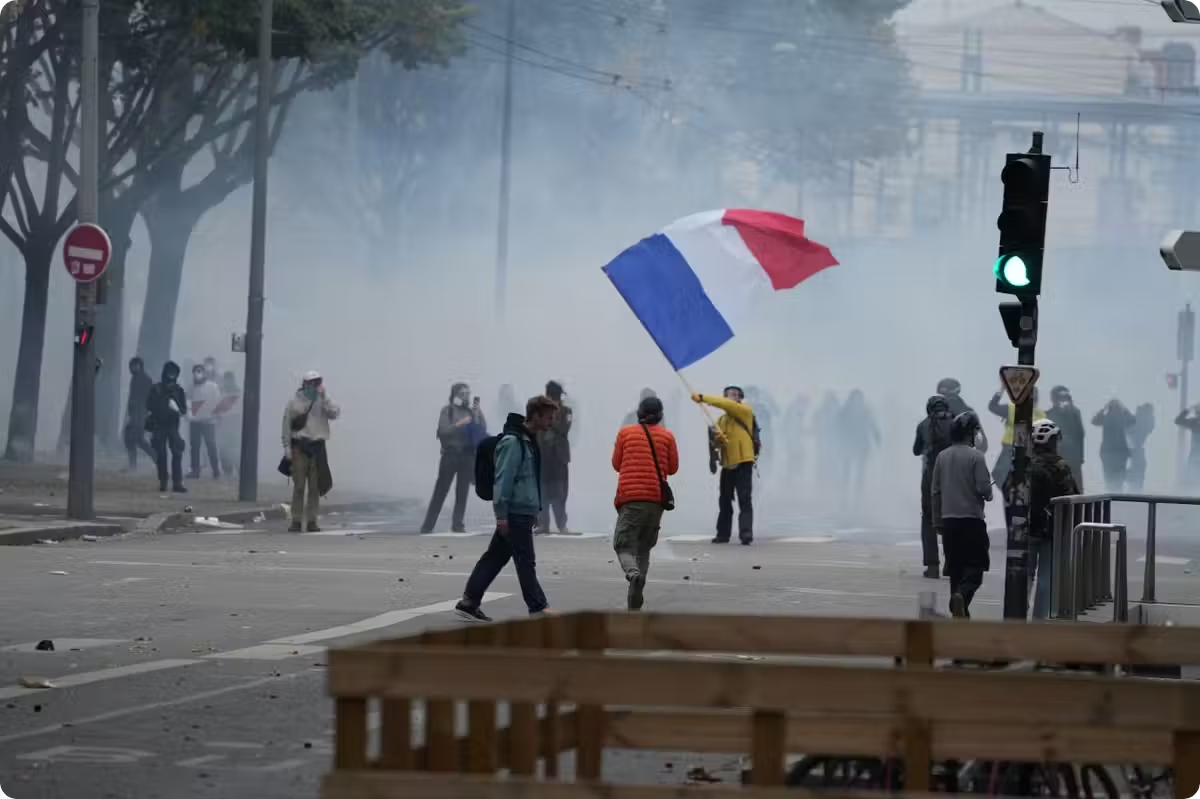
In Lyon, the Garibaldi area was the scene of confrontations between security forces and approximately 500 people dressed in black with covered faces, associated with black bloc groups. They attacked shop windows of a recruitment agency and threw objects at the police, who intervened using tear gas. [10]
The demonstrations in Nantes ended near the University Hospital, where clashes with the police broke out. Security forces used tear gas and stun grenades against masked individuals. Other people began removing paving stones, preparing them as projectiles, before the protesters fled onto the hospital grounds. [10]
Protests also affected the education system. In Paris, in front of Lamartine High School, a teacher was assaulted while trying to intervene after the situation deteriorated at 10:00, when pupils from other institutions arrived. The high school had been blocked since 06:30. [10]
At the Cesar-Baggio High School in Lille, the educational unit was evacuated after the damage to a gas meter. The police signaled the risk of an explosion, caused by the technical accident occurring during the protests. [10]
In the Lyon region, the Pierre-Brossolette High School in Villeurbanne was evacuated and classes continued online after pyrotechnic devices were launched within the premises. [10]
The Ministry of Education reported at 10:00 that approximately 16% of teachers participate in the strike, and 33% of school units are affected by protests. Of the approximately 3,700 high schools in France, 81 were completely blocked. [10]
Unions demand salary increases, job protection, and additional funds for public services. They accuse the Government of not offering sufficient solutions to protect purchasing power, as salaries are not keeping pace with price hikes. [10]
Update
Alert and Guide for Romanian Citizens in France: General Strikes and Social Demonstrations
French security forces intervened forcefully and used tear gas against protesters in Lyon, in a context of social tensions that continue to pressure President Emmanuel Macron, reports Reuters, cited by Agerpres. The demonstrations, organized by unions and supported by student groups, target the cost of living, public services, and education, and CGT union leader Sophie Binet announced protests scheduled in approximately 260 locations. A banner displayed in Lyon emphasized unity among different social categories: 'High schoolers, pensioners, students, workers, all together. Unity wins.' [12]
Violence also manifested in other cities: a high school near Toulouse was burned, and in Paris protesters blocked a street using garbage containers. The demonstrations started in the morning in Lyon, Marseille, and Nantes. After the riots and looting on October 17, which surprised security forces and caused material damage, the government defended its tactics, promising investigations in case of possible abuses. Five months before the presidential elections, the atmosphere is tense, with prospects of a second round between Marine Le Pen and Jean-Luc Mélenchon. Participation is estimated between 500,000 and 700,000 people outside Paris, for which 70,000 national police officers were mobilized. Between 15% and 17.5% of state teachers are on strike, and the Eiffel Tower was closed due to the mobilization. The strike caused a drop in nuclear production, without major impacts on transport. [12]
Update
Violent reunions in Lyon: Anti-riot police confront protesters
Anti-riot police moved in force against a group of demonstrators in Lyon, central France, during national protest marches, according to CNN. [11]
Update
France: Chaos and violent incidents at protests and strikes, high school burned near Toulouse
Security forces intervened with tear gas and force on Thursday, November 5, 2026, in several cities in France, on a new day of national demonstrations and a general strike, amid persistent social tensions. [13]
In Toulouse, a violent fire partially devastated the 'Françoise de Tournefeuille' High School situated nearby, reports BFM TV. Several people entered the school grounds early in the morning, and pyrotechnic projectiles were launched at the building, causing a strong fire that devastated the administration and reception of the institution. No injuries were recorded in the Toulouse incident, and firefighters dispatched immediately to the scene. The exact value of the material damages has not been communicated. [13]
Kamel Chibli, Vice-President of the Occitanie Regional Council, denounced on the X platform 'unacceptable acts' and called for their 'condemnation with the utmost firmness,' requesting 'exceptional measures and sanctions commensurate with the seriousness of the facts.' [13]
In Paris, clashes erupted in the morning between protesters and police. A street in the capital was blocked with garbage bins. [13]
Street confrontations occurred in Lyon between protesters and security forces. Certain participants, dressed entirely in black with covered faces, chanted slogans against the police, reports Reuters. [13]
The French Ministry of the Interior confirmed violent incidents near high schools in several cities, including Rennes, Toulouse, Bordeaux, Strasbourg, and Paris. [13]
'The protest is a right, but endangering others and destroying property cannot be tolerated,' the ministry stated on the X platform, according to France 24. The ministry mentioned the use of pyrotechnic articles, starting fires, disrupting traffic, and throwing objects at security forces as forms of aggression. [13]
While demonstrations in Lyon and other cities, including Marseille and Nantes, started early in the morning, the main manifestation in Paris was scheduled later, at local time 14:00 (13:00 GMT), starting from Place de la Republique. [13]
Interior Minister Laurent Nuñez announced on Wednesday that over 220 demonstrations and gatherings are scheduled in France. Authorities mobilized 70,000 police officers, the same force deployed during the national protests of the last two weekends. [13]
National-level protests and the strike of public sector employees, organized by unions and supported by student groups, occur after demonstrations related to the cost of living, public services, and education triggered the most serious social disturbances in recent years in France. [13]
Tensions arise five months before the presidential elections, where there is a probability of a runoff between Marine Le Pen, of the far-right, and Jean-Luc Mélenchon, of the far-left, while Emmanuel Macron can no longer run for a third term. [13]
Update
France: Riot police clash with protesters in Lyon during national strikes
In France, police intervened with tear gas and force against protesters in Lyon, marking a new wave of tensions in the context of the national strike and demonstrations. CGT union leader Sophie Binet announced the organization of demonstrations in approximately 260 locations, with the mobilization of students and various social categories. [14]
Update
General strike in France: 1.6 million protesters and the government's response
Almost 1.6 million people demonstrated on Thursday in France against the rising cost of living, including 350,000 in Paris, according to an announcement by the General Confederation of Labour (CGT), cited by TF1info. The Ministry of the Interior announced, in an initial count made at 17:00, that at least 600,000 people demonstrated in France, including in Paris. The Ministry of Transport, Philippe Tabarot, stated that at 14:00, transport supply was generally ensured at a high level: 9 out of 10 TGV trains circulated, approximately two-thirds of regional and territory-balancing trains, while metros, trams, and buses operated normally in Île-de-France. Air traffic remained almost normal at Paris-Charles-de-Gaulle and Paris-Orly airports, with limited disruptions at some regional airports, such as La Réunion and Strasbourg. [15]
In Lyon, the Rhône prefecture reported 40 injured, of whom 34 belong to security forces, and five degraded shops. The police carried out 24 arrests, mainly for mortar firing, throwing projectiles, and insults. In Nantes, the Loire-Atlantique prefecture registered 30 arrests at 16:00. Presidential candidate Raphaël Glucksmann participated in the demonstration but was forced to leave the procession, declaring that he does not pay attention to militants 'hostile' to his presence. [15]
Prime Minister Sebastien Lecornu announced the organization of a 'social conference' with unions and employers on Monday at Matignon, to respond to 'questions related to purchasing power and salaries,' requesting the Minister of Labor to finalize consultations by Sunday. [15]
Update
Chaos and violent incidents at protests and the general strike in France
Interior Minister Laurent Nuñez confirmed that approximately 600,000 people participated in demonstrations in over 70 cities in France, in the context of the general strike and social tensions.StirileProtv Violent incidents persisted, with security forces intervening against groups of protesters who had blocked arteries in Paris without authorization and confronting hooligans in Lyon. A provoked fire partially devastated a high school in Tournefeuille, near Toulouse, and a fire was set at the gate of a high school in Lille.StirileProtv Kamel Chibli, vice-president of the Occitanie region, characterized this act as 'a catastrophe' and an attack against the Republic, promising cooperation with the prefecture to identify the perpetrators.StirileProtv The CGT union estimates participation at 1.6 million people, and unions report the blocking or closing of over 1,000 educational institutions, while the government speaks of over 80 blocked.Bursa Regional rail traffic, especially in the Paris region, was seriously disrupted, although TGV trains circulated for the majority. [16]
- Categories:
- Politics
- Entities:
-
- Paris
- Emmanuel Macron
- CNN
- France
- Sébastien Lecornu
- Marine Le Pen
- Toulouse
- Tournefeuille
- Kamel Chibli
- Lyon
- Rhône
- Bordeaux
- Agerpres
- Franța
- Rennes
- CGT
- Reuters
- MAE
- EDF
- Maud Bregeon
- Dunkirk
- BFM TV
- Dunkirk LNG
- LCI
- Sophie Binet
- Irma De Banville
- CGT
- Dunkirk LNG
- Guvernul Franței
- Ministerul Educației
- 17 Octombrie
- Grecia
- Atena
- Marseille
- eKathimerini
- Ministerul Francez Al Educației
- OLME
- Nantes
- Lille
- Villeurbanne
- Guvern
- Sindicate
- Marie-Louise-Dissard-Francoise
- Lamartine
- Cesar-Baggio
- Pierre-Brossolette
- Marsilia
- Turnul Eiffel
- Jean-Luc Melenchon
- Place De La République
- Strasbourg
- Ministerul De Interne Francez
- Consiliului Regional Din Occitanie
- Françoise De Tournefeuille
- Turnul Eiffel
- Raphaël Glucksmann
- Paris-Orly
- Paris-Charles-De-Gaulle
- Philippe Tabarot
- Loire-Atlantique
- TF1info
- Matignon
- Laurent Nuñez
- Ministerul De Interne
Sources
- stirileprotv.ro Sute de mii de oameni, așteptați la proteste în Franța. 70.000 de polițiști vor fi mobilizați. Alertă de călătorie pentru români
- Financial Intelligence Noi proteste de masă, anunțate în Franța; Sindicatele anunţă şi o grevă a funcţionarilor publici
- News.ro Franţa se confruntă joi cu noi proteste, în timp ce Macron încearcă să prevină repetarea tulburărilor din octombrie
- MediaFax Franța, din nou în stradă. Emmanul Macron încearcă să evite repetarea violențelor din octombrie
- Bursa Reuters: Franţa se pregăteşte pentru un nou val de proteste şi greve naţionale
- Digi24 Franța se pregătește pentru noi proteste: 70.000 de polițiști vor fi mobilizați. „Exclus să retrăim evenimentele din 17 octombrie”
- PRO TV Chișinău Franța se pregătește de noi proteste de amploare: 70.000 de polițiști vor fi mobilizați în toată țara
- Evenimentul Zilei Proteste de amploare în Franța și Grecia. 70.000 de polițiști și jandarmi, mobilizați
- observatornews.ro Proteste masive în Franța: 700.000 de oameni aşteptaţi să iasă în stradă în oraşe
- Cotidianul VIDEO Franța fierbe din nou. Un liceu a fost incendiat. Sute de mii de protestatari, în stradă
- CNN Riot police charge at group of protesters in Lyon, France
- Bursa Reuters: Ciocniri între forţele de ordine şi protestatari la Lyon, în timpul manifestaţiilor naţionale din Franţa
- SpotMedia Haosul răbufnește iar în Franța: Un liceu din Toulouse a luat foc, lupte de stradă la Paris și Lyon (Video)
- Forbes România Franța: Ciocniri între forțele de ordine și protestatari în Lyon
- Bursa Aproape 1,6 milioane de manifestanţi în Franţa împotriva scumpirii vieţii, potrivit CGT
- stirileprotv.ro Haos în peste 70 de orașe din Franța. Sute de mii de oameni protestează față de scumpiri, iar violențele escaladează