The first years of life represent a crucial period for accelerated brain development, during which children process information quickly when actively interacting with their surrounding environment. Experts agree that learning through play offers the most durable benefits for early development, combining fun activities with specific educational objectives to guide children’s growth. Free play and independent exploration stimulate the creation of essential neural connections, allowing children to learn through direct discovery. [1]
Play-centered environments facilitate the development of social and emotional skills, offering children space to interact with peers and understand their own and others' emotions. Through play, children learn to identify emotions and resolve minor conflicts with teammates, under the guidance of teachers who ensure a safe and respectful environment. Emotional control developed in these contexts helps children manage minor frustrations and adapt more easily to new situations, preparing them for future academic challenges. [1]
Play encourages creative problem-solving, developing skills such as spatial awareness, logical thinking, the ability to make independent choices, and tolerance for error. Children learn basic principles of logic and reasoning through simple constructions or puzzles, understanding that making mistakes is part of the learning process. [1]
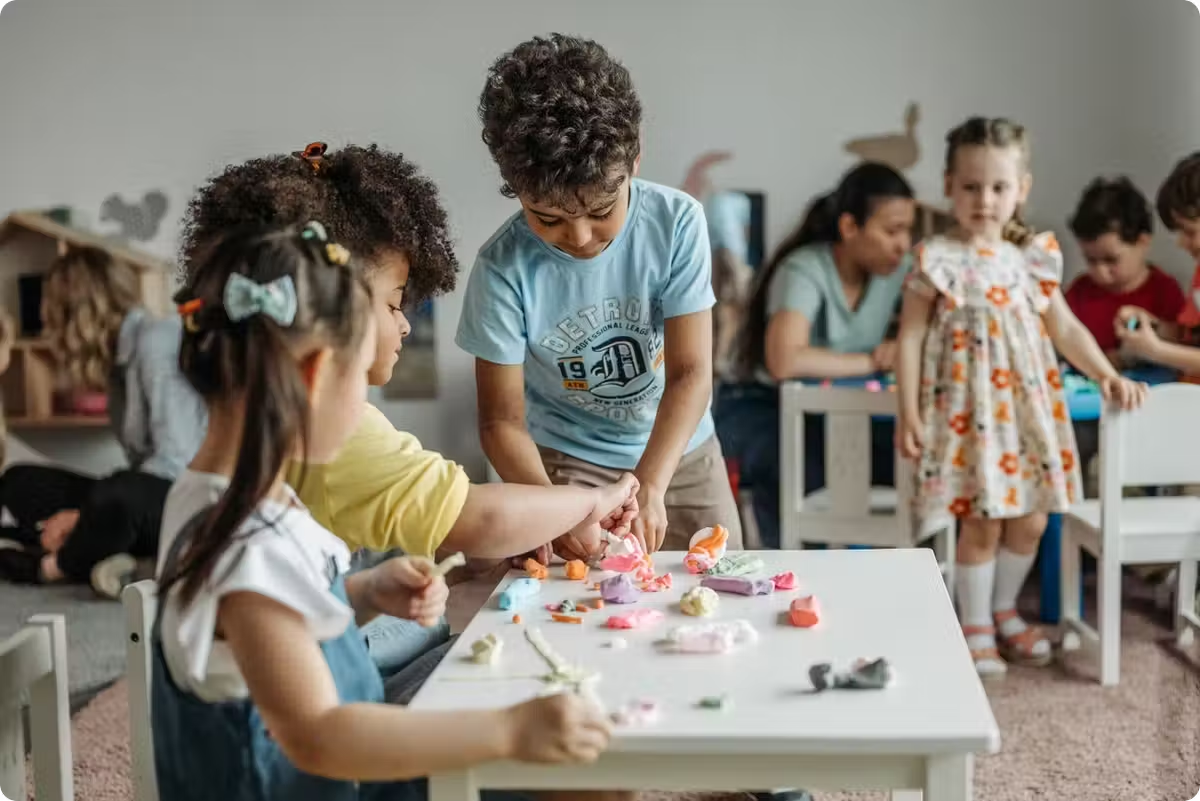
Intense physical movement, characteristic of active play, supports brain development and spatial awareness, strengthening large muscles and improving balance, running speed, and overall coordination. Indoor activities focus on developing fine motor skills by manipulating objects with the hands and fingers, fundamental skills for later activities such as writing. [1]
Language development is the foundation of success in reading and other subjects; educational centers use songs, stories, and role-playing games to expand vocabulary and encourage clear communication. Recognizing sounds, expanding vocabulary, clearly expressing feelings, and becoming familiar with books are essential linguistic competencies developed through regular interactions. [1]
Children’s natural curiosity is channeled through scientific and sensory-type activities, building internal motivation and the ability to observe nature to understand how the world works. [1]
Enrolling in a high-quality play-based learning program provides children with a solid foundation for long-term academic success and personal development, ensuring a smooth transition to primary school. [1]
Structured interactions and adult-guided play allow teachers to observe children’s development and tailor learning experiences based on each student’s needs and interests. Guided play gives children the opportunity to build essential academic skills, such as early literacy and mathematical concepts, in an environment of safety and support. [1]
Respecting the child’s individual pace within play protects their confidence and motivation, reducing stress and anxiety associated with formal schooling. [1]
A play-based pedagogical approach helps children integrate harmoniously into the education system, providing them with the tools necessary to successfully navigate academic and social challenges. [1]
Pedagogical intervention focused on play does not exclude academic rigors but rather facilitates access to them, demonstrating that fun and learning can be synergistic in early development. [1]
Organized play spaces that combine elements of freedom with attentive supervision prevent isolation and allow children to develop their social resilience. [1]
Investment in early education through the lens of play is recognized as a determining factor for the mental health and broader performance of the child in the following decades. [1]
- Categories:
- Education
- Entities: