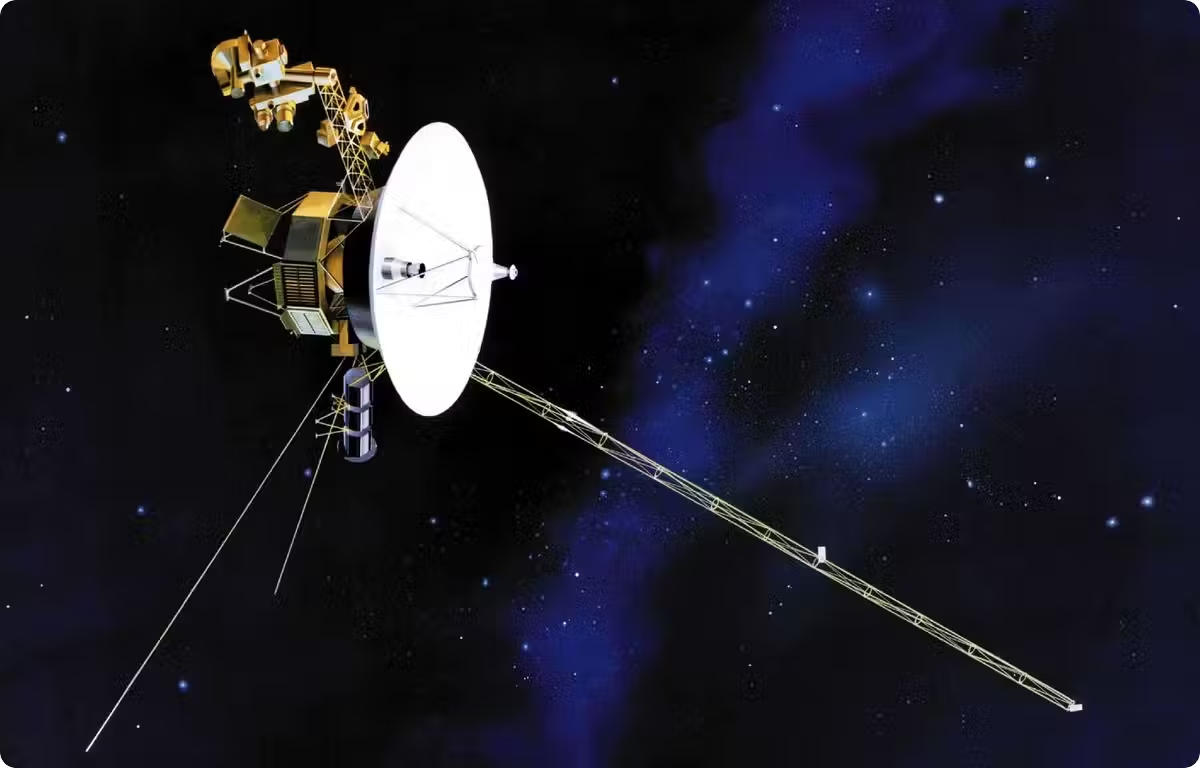
On 18 November 2026 the Voyager 1 probe, launched in 1977 by NASA, reached about 25.9 billion kilometres from Earth, i.e. the distance travelled by light in 24 hours. According to sources cited by 20 Minutes, based on Le Devoir and Courrier International, this is the first time a man-made object reaches a distance of one light-day.
Launched on 5 September 1977, the probe took advantage of a rare alignment of the giant planets, which occurs about once every 175 years, to use gravitational assistance and accelerate towards the outer Solar System. It reached Jupiter two years later and flew over Saturn at the end of 1980, then was diverted towards Titan, abandoning Uranus and Neptune, later explored by twin Voyager 2.
Since 2012, Voyager 1 has been crossing interstellar space, after passing the heliopause, the limit where the influence of the solar wind ceases and interstellar space begins. The radio signal now takes about 24 hours to reach the probe and as much to return, making a dialogue last almost two days.
Energy from radioisotope thermoelectric generators is continuously decreasing. According to reports taken over, the power sources could be exhausted in the next ten to fifteen years. Afterwards, the probe will remain drifting in interstellar space without contact, carrying the Golden Record with sounds and images from Earth.
Astrophysicist Robert Lamontagne, cited by the Canadian press, emphasizes that the probe will persist for billions of years even after the disappearance of the human species and the death of the Sun, remaining a silent witness of humanity in the galaxy.