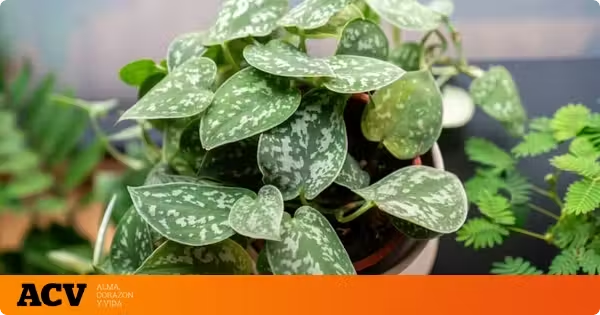
Hanging plants have emerged as one of the most popular options for decorating interiors, particularly when seeking to add a natural touch without occupying excessive space. Among the most striking species is the Scindapsus pictus, commonly known as satin pothos, a tropical plant that captivates with its green leaves featuring silver reflections. Beyond its aesthetic appeal, it requires indirect light, moderate watering, and minimal maintenance, allowing it to adapt to various spaces within the home. [1]
Native to the tropical regions of Southeast Asia, including Thailand, Malaysia, and Indonesia, this species is characterized by its velvet-like, heart-shaped leaves. Its main distinguishing feature is the silver spots appearing on the green surface, whose intensity changes depending on the illumination. These reflections are not caused by artificial pigments but by structures and air spaces present in the leaf tissues, which modify how light is reflected. [1]
One of the primary advantages of the Scindapsus pictus is its hanging growth habit, which allows it to be placed on shelves, ledges, or in suspended pots. Its stems progressively elongate and fall, forming a cascade of silver leaves. However, it can also be cultivated as a climbing plant if a stake is provided to support its roots. When it finds adequate support, it can develop larger leaves, reproducing part of its behavior in its natural habitat. [1]
To maintain its colors and favor healthy growth, it is highly recommended to place it near a window where it receives abundant indirect light. Intense midday sun can cause burns and dry spots on the leaves, while lack of illumination can cause the stems to grow excessively and new leaves to be smaller. The ideal temperature ranges between 18 and 27 degrees Celsius, and it is advisable to keep the plant away from heating systems and air conditioning. [1]
Watering is another fundamental aspect for preserving this plant in good condition, as excess water can cause root rot. Before watering again, it is recommended to check that the surface layer of the substrate has lost moisture. Using a soil mix with perlite or pine bark to improve drainage is also useful. If the leaves begin to roll up, it may indicate a lack of water, while yellowing accompanied by a wet substrate may warn of root problems. [1]
Scindapsus pictus has different varieties, among which 'Argyraeus' stands out for its small leaves with silver dots, and 'Exotica' for its larger leaves with more extensive spots. Additionally, it can be easily reproduced via stem cuttings with at least one node, placed in water until roots develop. Although it is a low-maintenance plant, it should be kept out of reach of small children and pets, as its leaves contain calcium oxalate crystals that can cause irritation if chewed. [1]
- Categories:
- Tourism