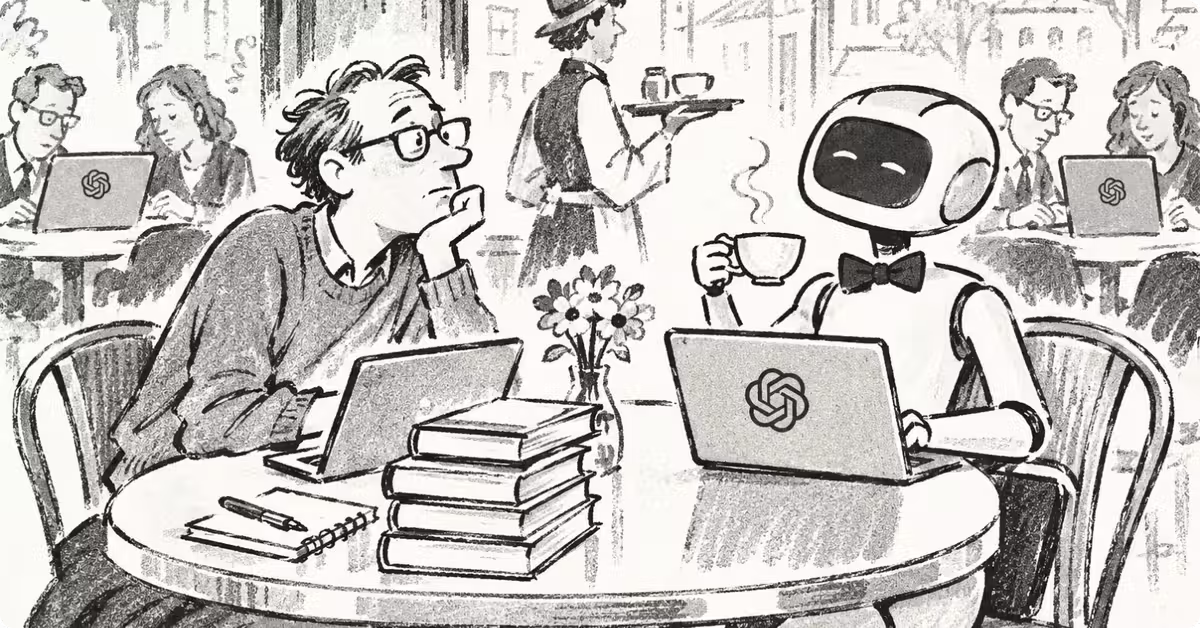
In a span of years, behaviors that once provoked outrage—such as asking a machine to write birthday messages, composing condolence notes, or drafting love letters—have evolved from absurd or callous to commonplace. As of 2026, generative AI outputs have become all-pervasive across personal and professional spheres. This shift marks the emergence of 'AI-tiquette': a rapidly evolving, largely unwritten set of norms governing what actions are delegated to AI, what still requires human effort, and how society judges these boundaries as they shift. [1]
Social norms typically arise without fanfare, morphing as behaviors evolve. Just as answering a phone at the dinner table transitioned from signaling importance to plain discourtesy, and texting replaced calling from being impersonal to the default, AI is accelerating a similar integration. However, unlike previous technological shifts that primarily altered communication style, AI modulates the amount of human effort underlying the communication itself. Experiments involving email, texting, dating, and social media reveal that this AI-tiquette is highly unstable. While many people initially failed to suspect AI involvement unless prompted by suspicious phrasing, AI use is now increasingly taken for granted. Crucially, when the use of AI is explicitly disclosed, judgments tend to become negative, reflecting a phenomenon known as the 'AI penalty,' where AI-mediated messages are perceived as less trustworthy and authentic. [1]
AI-tiquette presents a paradox: concealing AI assistance can feel deceptive, yet revealing it can diminish the message's value. Most people simultaneously believe that AI involvement ought to be disclosed, yet they often fail to do so. This tension extends beyond interpersonal dynamics to the behavior directed at the machines themselves. Users frequently treat AI assistants with abrupt commands, such as 'Wrong, redo. Shorter,' rather than polite requests. Research indicates that impolite prompts can yield more language but less useful information relative to energy consumed. Furthermore, studies on repeated human-AI interactions show that politeness toward AI deteriorates over time, and at a faster rate than in human-to-human exchanges. While giving an AI a more human-like presence may prolong courtesy, the concern is whether the habit of commanding, interrupting, and dismissing an 'infinitely patient' subordinate will erode the behavioral boundaries that separate human interaction from machine management. [1]
The deeper etiquette problem arises when humans are on both ends of an AI-filtered exchange. Consider a scenario where one colleague drafts an email, a second colleague uses AI to summarize and respond, and the first user employs AI to summarize the response. The exchange appears impeccable in tone, grammar, and professionalism, yet no two humans have encountered each other's true thought processes. The potential discourtesy lies in the withdrawal of attention from the relationship, even if the appearance of the exchange is preserved. As AI agents communicate on behalf of senders and receivers, this disconnect is becoming twice removed from human engagement. [1]
Effort has traditionally served as evidence of care. A handwritten letter held value partly because someone sat down and wrote it. Generative AI removes much of this friction, which can be valuable for bridging languages, clarifying thoughts, and overcoming barriers. However, friction is also part of how value is created. AI-assisted writing experiments demonstrate that people can produce messages perceived as warm and trust-building while spending considerably less time writing them. Additionally, research on emotionally engaging conversations suggests that AI-generated responses can foster feelings of interpersonal closeness if recipients believe another person wrote them. We are approaching a threshold where the signal of care can be produced independently of the actual experience or expenditure of care. [1]
If everyone can generate elaborate proposals, comments, images, and responses on demand, abundance may gradually drain these outputs of their informational and emotional value. The emerging breach of AI-tiquette may thus be akin to wasting someone else’s time—an insult that backfires as recipients learn to ignore contributors in an attention-scarce environment. To navigate this landscape, four guiding questions are proposed: Why skip doing it yourself if it exercises a capacity or communicates care? Why produce this at all when creation is effortless, and does it deserve to exist and demand attention? And fundamentally: What is your 'why'? In an era where almost everything can be pursued with minimal effort, what are you passionate enough to create? [1]
- Categories:
- Technology