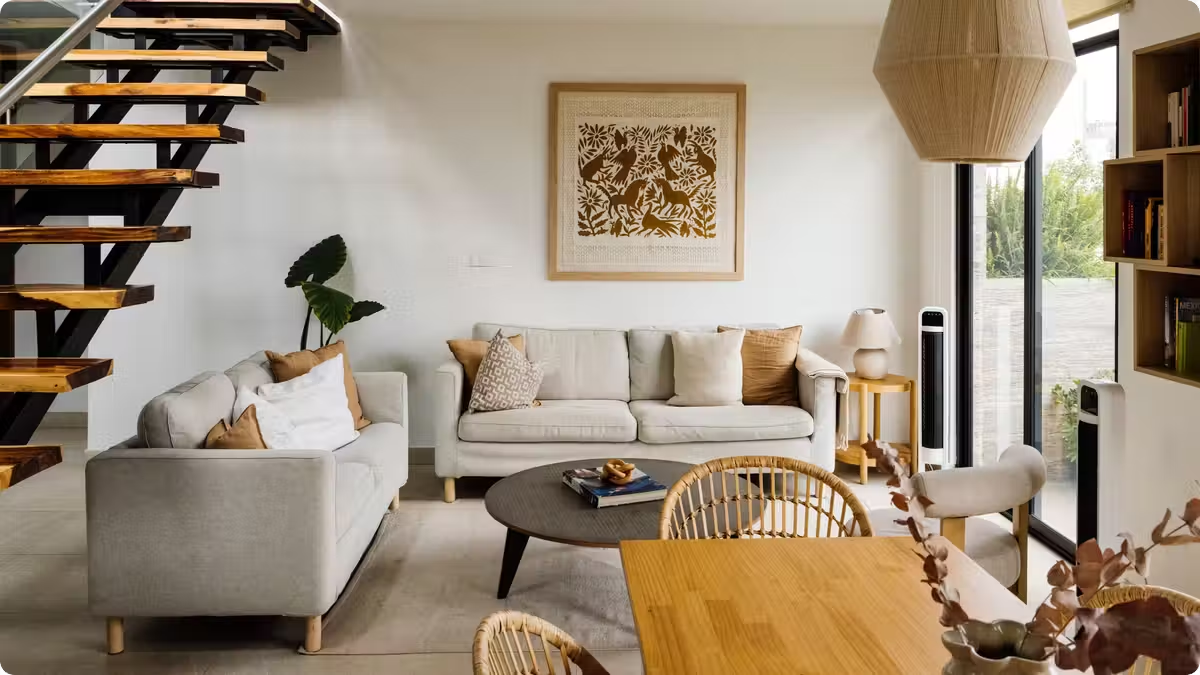
Freundin reports five low-effort tricks for making small living rooms feel larger without remodeling, focusing on compact furniture choices and visual openness. It opens by describing how sofas, TVs, storage, rugs, side tables and circulation space can make a small living room feel cluttered rather than cozy, and argues that extra square metres are not required to make a living room appear more spacious. [1]
The piece frames the challenge as one of perceived openness rather than actual area, stressing that thoughtful selection of furnishings and keeping open surfaces clear can extract surprising functionality from limited square metres. [1]
Trick one substitutes a classic coffee table with a narrow bench, preserving surface space for books, coffee or a tray while intruding less into the room and adding occasional seating for guests. [1]
Trick two calls for furniture on visible slender legs. Keeping a strip of floor visible under sofas, sideboards or armchairs lets the eye travel underneath instead of stopping at a continuous base, which visually lightens the space. [1]
Trick three recommends a larger rug that extends well under the sofa and armchairs. Rather than a tiny rug chosen from fear of crowding, a rug that unifies the seating area creates a single connected floor plane instead of fragmented islands. [1]
Trick four directs attention to walls as underused storage. Slim wall shelves, tall bookcases and storage reaching toward the ceiling free up floor area while vertical emphasis from high furniture and long curtains draws the gaze upward to make ceilings read higher and rooms more generous. [1]
Trick five treats light as a spatial tool. A large mirror opposite or near a window reflects daylight for added depth, while keeping window areas free maintains a visual connection to the outside and softens perceived boundaries. At night, multiple small light sources rather than a single ceiling fixture create varied brightness zones and reduce a closed-in feel. [1]
Across the five suggestions Freundin presents a consistent theme of perceived openness through careful placement, vertical use and reflective light rather than structural change. [1]
- Categories:
- Technology