An essay titled 'I Kept Choosing People Who Couldn’t Love Me. It Wasn’t Bad Luck. It Was a Decision I Didn’t Know I Was Making,' published on The Good Men Project, explores the psychological patterns behind recurring romantic failures. The author challenges the common belief that repeated heartbreak is a matter of bad luck, arguing instead that individuals often unconsciously select unavailable partners, mistaking this dynamic for fate. Individuals often describe emotionally stable partners as 'nice' but 'safe' or 'dull,' leading them to pursue those who induce anxiety. The essay posits that this preference is a survival mechanism rooted in early development, where love was conditional or fragmented. Recognizing that calm feels like emptiness due to this conditioning is a crucial step toward redefining what love should feel like. [1]
The narrative describes a cycle where different partners appear in various forms, yet the underlying relational dynamic remains identical. The author realizes that their choices were driven by a need to repeat early childhood experiences, specifically seeking out individuals who were emotionally distant or required constant effort to win affection. This behavior is interpreted not as misfortune, but as a subconscious loyalty to a traumatic template established in early life. The path to healthier relationships involves acknowledging that the discomfort of security is not a defect, but a sign of healing. As the author concludes, when one can clearly see the pattern of choosing unavailable partners, the power to choose differently returns. It is not about blaming oneself, but about understanding that a part of the psyche is still operating on outdated scripts, and recovery is the process of writing a new one. [1]
Central to the argument is the concept that humans confuse familiarity with compatibility. The heart is drawn not necessarily to what is healthy or beneficial, but to what is recognizable. When early attachments involve instability or partial availability, the adult brain learns to equate longing and confusion with intense chemistry. Consequently, stable, secure relationships feel unfamiliar and are often perceived as boring or suspicious, while chaotic connections feel electric and destined. The article serves as both a personal confession and a broader reflection on attachment styles. It highlights how easy it is to project external circumstances onto internal wounds, believing that we are unlucky in love when we are actually loyal to pain. The visibility of these patterns is presented as the first and most difficult step toward breaking free from destructive cycles. [1]
The essay explains that the anxiety felt in dysfunctional relationships is frequently misidentified as passion. Individuals may describe healthy, available partners as lacking spark, whereas the unresolved pain from past wounds creates a sense of intensity that masquerades as deep connection. The author notes that the 'flatness' experienced around emotionally available people is actually the absence of anxiety, a state the nervous system has never learned to recognize as love. The distinction between being 'chosen' by trauma and making conscious choices is the essay's core thesis. By reframing romantic struggles as decisions made by an unconscious part of the self, the narrative empowers readers to reclaim agency. The goal is not to eliminate feelings of attraction instantly, but to create enough space to question whether those feelings serve one's well-being. [1]
Breaking the cycle requires more than simply attempting to choose 'better' partners; it demands deep awareness. The author suggests that change begins when one can recognize the shape of their repetitive pattern—the same unresolved feelings manifesting across different faces. By inserting a moment of reflection between impulse and action, individuals can start to distinguish between genuine love and the recreation of old wounds, allowing for intentional choice rather than automatic reaction. Published originally on Medium and reposted on The Good Men Project, the piece resonates with themes of emotional availability and mental health in modern dating. It encourages readers to look beyond surface-level compatibility and examine the deeper psychological currents driving their preferences, suggesting that true connection is found not in the thrill of the chase, but in the quiet reassurance of mutual presence. [1]
The essay's attribution to its previous publication on Medium adds context to its widespread circulation within online relationship communities. The image accompanying the piece, credited to Eugenia Pan’kiv on Unsplash, visually reinforces the intimate and introspective tone of the narrative. [1]
Readers interested in further content from The Good Men Project on dating and relationship dynamics can explore their broader collection of essays, which often tackle similar themes of self-awareness and emotional growth in interpersonal relationships. [1]
The newsletter prompt included in the source text indicates that The Good Men Project offers regular updates on topics related to dating and relationships, promising to deliver insights directly to subscribers' inboxes. [1]
The publication platform's strategy of cross-posting content across multiple Medium publications suggests a broad interest in accessible, psychologically informed discussions about love and human behavior. [1]
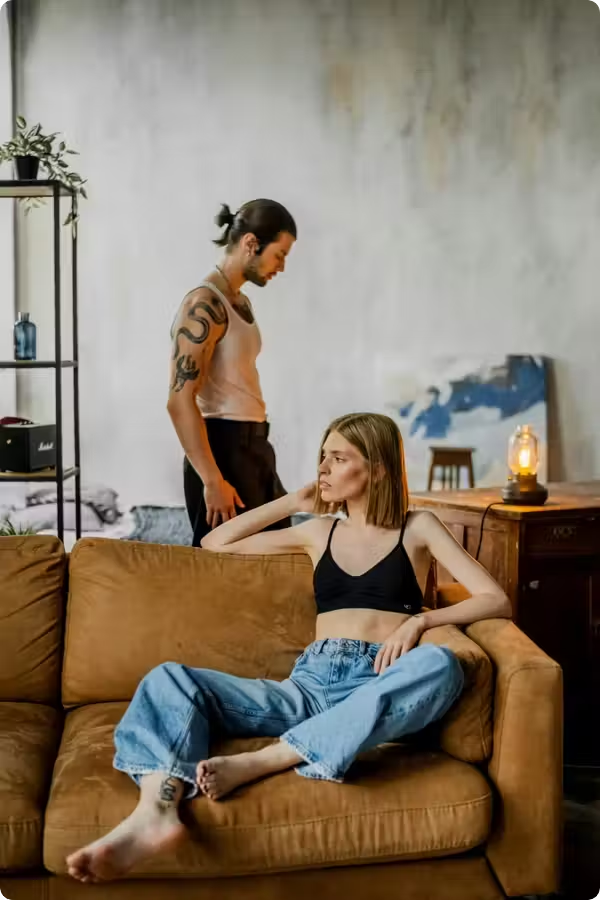
The visual component of the article, featuring a photograph of a woman sitting on a couch next to a man, complements the textual narrative by depicting a scene of quiet intimacy, contrasting with the often chaotic or high-stakes nature of the dating dynamics described. [1]
As noted in the source metadata, the piece has been syndicated, which helps amplify its message to audiences already engaged with discussions on mental health and relationship advice. [1]
The call to action for subscribing to the weekly newsletter underscores the ongoing relevance of these topics, indicating that many individuals seek guidance on navigating complex emotional landscapes in their personal lives. [1]
The reference to the author's previous work on Medium provides a trail for readers who wish to explore their earlier writings, potentially offering additional perspectives on the themes of attachment and self-discovery. [1]
The inclusion of source credits for photography ensures proper attribution, maintaining journalistic standards while enhancing the visual storytelling aspect of the article. [1]
The structural separation between the main narrative and the publication details highlights the distinction between the content's thematic focus and its logistical distribution channels. [1]
No further actionable details were extracted from this segment as it served primarily as a separator or formatting element within the source document. [1]
The photo credit to Eugenia Pan’kiv on Unsplash is retained here as a factual detail regarding the visual assets accompanying the essay. [1]
- Categories:
- Society