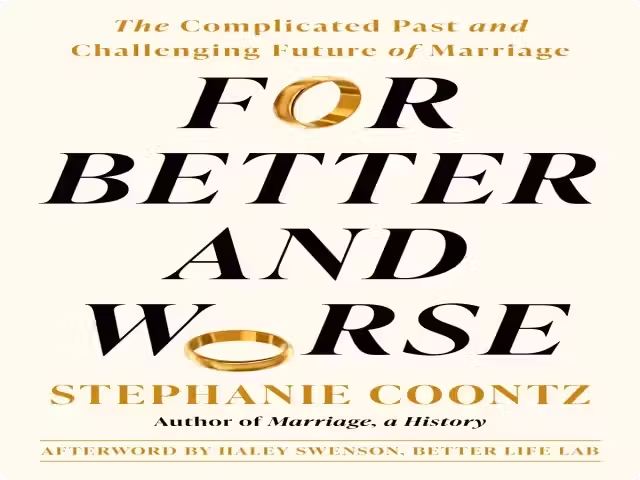
Marriage rates are at their lowest in decades, with approximately 47% of US households headed by a married couple, compared to 79% in 1949. It is no longer mandatory for economic security, safety, or sexual satisfaction. However, most Americans will eventually marry; 87% of women marry before age 54. In her book “For Better and Worse: The Complicated Past and Challenging Future of Marriage”, historian Stephanie Coontz delineates truths and fictions about the institution and how myths affect perceptions of what a marriage should be. [1]
Coontz, director of research and public education for the Council on Contemporary Families, states that today's marriages have new rules. She demonstrates how nostalgia for the past is linked more to economic anxiety than to anything else, and our outdated opinions do not serve us well. One message transmitted about marriage today is that it must be the most important relationship in life; another is that it serves as a means of mutual support and of bringing together separate social networks. [1]
Living together does not replace marriage. Most who cohabit do not consider it an alternative to marriage but rather an extension or a refuge after failure. Historical research shows that many believe men and women have fixed emotional natures, but this is false; men have had emotional roles throughout history, and women were not always considered more altruistic. Nostalgias for the '50s reflect rather current economic losses and a polarized economy ('K-shaped') than an authentic desire to return to old structures. [1]
For a successful marriage today, the most important predictor is organizing a satisfying personal life, with friends and social commitments. Recent investigations show that when couples nurture equal relationships and go out into the world, love grows over time. Practical barriers include economic pressures and unemployment, which undermine the negotiation skills needed. Coontz also criticizes 'gatekeeping' (the behavior of controlling how a partner carries out tasks), suggesting a more empathetic and historical approach to inert behaviors. [1]
- Categories:
- Society
- Entities: