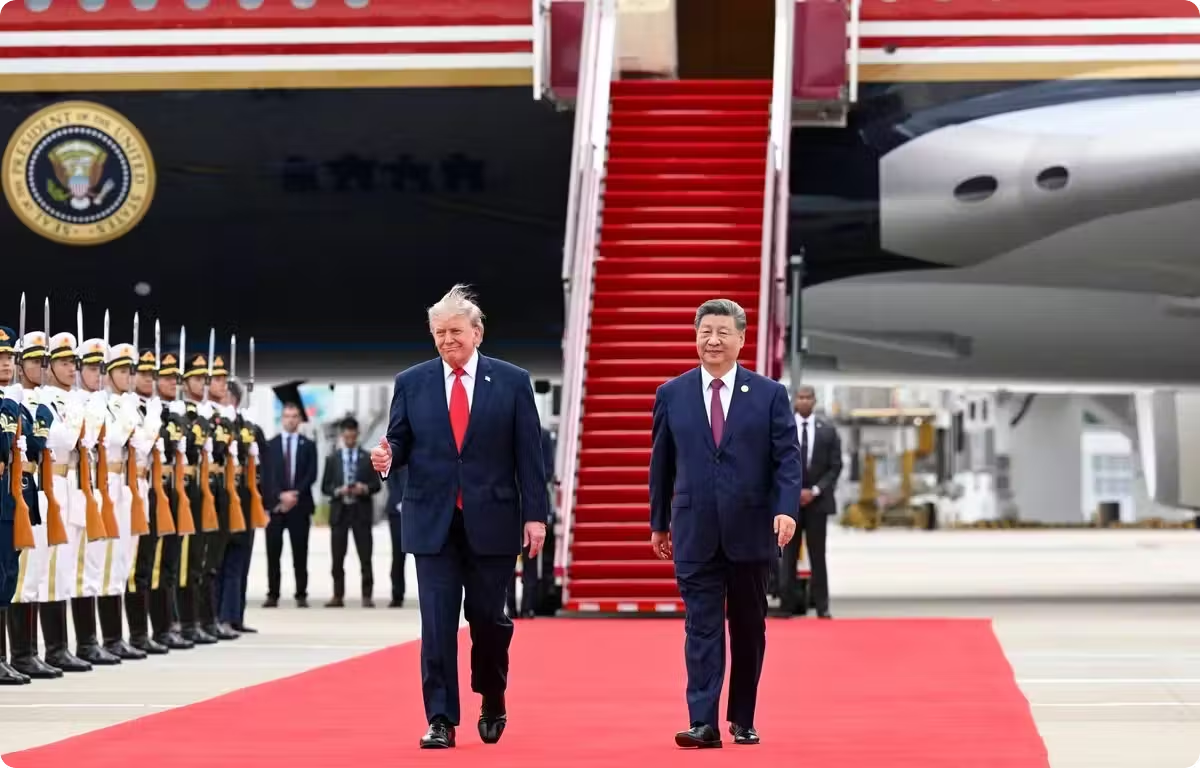
Xi Jinping travelled personally to Shenzhen airport on Wednesday to greet Donald Trump, an unprecedented reception in decades, with a red-carpet embrace in front of performers before both leaders left for their vehicles. The photo is expected to be historic but results remain uncertain: Xi Jinping, Donald Trump and Vladimir Putin meet on Thursday for an unprecedented summit in southern China amid multiple crises. Donald Trump arrived on Wednesday in Shenzhen where Xi Jinping personally welcomed him at the airport before the trilateral meeting with Vladimir Putin scheduled for Thursday on the sidelines of the APEC summit. Xi's welcome at the foot of the aircraft stairs with an embrace, honour guard and military aircraft is unusual for the Chinese leader. According to Xinhua, cited by The Guardian, Xi told Trump he wants a constructive, strategic and stable relationship based on respect, fairness and reciprocity. Previously Xi called Putin a 'old friend'. After more than two hours of talks, the Chinese leader described the relationship with Russia as unshakable in the face of storms and stable as a mountain and called for intensified cooperation through political and military dialogue mechanisms. Putin said he sees considerable potential benefits in discussions with Trump and Xi. Putin presented Asia-Pacific as the centre of a transformation of the world economy and said Russian-Chinese relations are flourishing, contributing to a multipolar world order. The Russian leader described Europe as in 'humiliating decline' and said sanctions have lost their power of constraint. For Moscow, participation has value even without an agreement. BBC observes some Russian media already present the visit as a 'diplomatic victory'. Trump said discussions will cover many things, including denuclearisation. Arms control is one of the few explicitly stated objectives by the US president. The US president arrived from the Philippines where he announced a new trade deal presented as favourable to US farmers and energy sector. In Sino-US relations, the immediate objective appears to be stabilising the trade truce, not resolving rivalry. Xi used his speech to criticise 'unilateralism and protectionism', without naming the United States, and presented China as a defender of globalisation. Shenzhen reinforces this demonstration: the city hosts companies such as Huawei, DJI and BYD and offers Beijing a framework to showcase its technological capabilities. For Kyiv and European capitals, the main risk is that their security is negotiated without their participation. The Yalta comparison expresses a fear. The role of Ukraine on the agenda is not clear either: CNN recalls Trump's earlier statements about discussing the war, while BBC and The Guardian cite information that US officials do not expect him to raise the subject. Beyond photographs, results should be evaluated on concrete commitments: extension of trade truce, launch of a nuclear negotiation process or communication rules concerning AI incidents. The format suggests caution. According to BBC, the meeting should last about an hour in a villa in Shenzhen. Overall it is for now a diplomatic opportunity with different objectives: Xi seeks stability without renouncing the Russian partnership, Putin obtains visibility and recognition, while Trump seeks results he can present as negotiation successes. Vladimir Putin anticipates 'significant potential benefits' following his meeting with Donald Trump and Xi Jinping. [1] [2] [3]
Xi referred to his September visit to Washington where Trump had picked him up at the airport and cited China's tradition of courtesy valuing reciprocity of good intentions, according to the official agency Xinhua. Kremlin spokesperson Dmitry Peskov said the meeting will not last more than one hour. The meeting brings together three nuclear powers amid trade and technology tensions and wars in Ukraine and Iran. CNN notes Xi has never personally welcomed a US president at the airport during his term. This formula translates an availability to manage differences, not their disappearance. Beijing appears to try to stabilise relations with Washington while simultaneously reaffirming that its rapprochement with Moscow is not questioned. These statements express the Kremlin's position, which seeks to demonstrate that Russia has economic and diplomatic alternatives to the West. Canadian Prime Minister Mark Carney directly contested this assessment: sanctions are 'very real', produce effects and will continue to be strengthened as long as the war continues. Analysts cited by The Guardian say Putin's presence alongside US and Chinese leaders consolidates his international status and may shift discussion from Russia's responsibility in the war to broader negotiations among great powers. Expectations should be tempered: China has been reluctant towards trilateral nuclear negotiations, citing the difference between its arsenal and those of the US and Russia. The Guardian notes no details were provided and Manila had not announced such a deal at the time of the report. According to BBC, suspension of high tariffs threatened by both sides expires in January. He promised to reduce tariffs and widen market access to China and called for maintaining stable supply chains. In this context, cordial welcome and strategic competition coexist in negotiations on chips, market access and industrial dependencies. Volodymyr Zelensky warned against a new 'Yalta', with redistribution of influence among great powers. Under these conditions there is no solid basis to anticipate progress on peace. The Guardian reports discussions could include use of AI in nuclear command systems. Experts interpret this less formal setting as a way to limit political cost in absence of tangible results. The difference between symbolic scope and real effects will depend on the content of commitments, not the solemnity of the welcome. [1] [2] [3]
Vladimir Putin received a different reception; he was met on Wednesday morning by Cai Qi, Xi's right-hand man and member of the Politburo Standing Committee, after arriving for the APEC summit. Issues include wars in Ukraine and the Middle East, US customs offensive, rivalry and fears around AI revolution. Diplomatic signals are clearer than prospects for agreements: Beijing talks about stability, Moscow about benefits of dialogue, and Washington about the possibility of nuclear talks. The gesture is explained by reciprocity: Trump had welcomed Xi in the same way in the United States in September. Trump thanked him for the personal welcome, according to the same agency cited by BBC. Washington has introduced new restrictions on Chinese companies' access to advanced US chips via third countries, maintaining pressure in a sector considered essential for national security. The message targets both the relation with Trump and the wider audience of Asia-Pacific leaders and businesses. Ukrainian Foreign Minister Andrii Sybiha said the meeting will only encourage Putin to continue the war. A limited risk reduction mechanism would be distinct from a broad strategic agreement but could have practical value. [1] [2] [3]
The three presidents are scheduled to meet on Thursday in Shenzhen for their first trilateral summit. The meeting is set for 14:30 local time, 01:30 Eastern, on the sidelines of the Asia-Pacific Economic Cooperation meeting in Shenzhen. The exact agenda remains insufficiently specified. According to BBC, the ceremony aims to create a favourable climate for negotiations without implying substantive concessions. [1] [2] [3]
Xi said he wants to discuss cooperation in the Asia-Pacific and the international situation to advance a constructive and strategically stable relationship between China and the United States, according to Xinhua. A high-stakes bilateral meeting between Donald Trump and Xi Jinping will also take place that day, while Trump leaves open the possibility of a surprise appearance by North Korean leader Kim Jong-un. [1] [2]
Ryan Hass, director of the John L. Thornton China Center at Brookings Institution, assesses that Beijing seeks mainly to prolong the fragile calm in Sino-American relations as long as possible. China, host of APEC's 21 members, said the trilateral will discuss world peace and strategic stability in relations among great powers. [1] [2]
The White House wants to discuss nuclear proliferation and the war in the Middle East. [2]
The Kremlin said the agenda is not finalized but leaders may hardly ignore the war in Ukraine, which for nearly five years has isolated Russia from the West and brought Moscow and Beijing closer. [2]
Peskov said 'We have no extraordinary expectations, our expectations are pragmatic', although Putin said he expects a 'highly useful' meeting. [2]
On Wednesday the three leaders staged their good understanding: Xi met Vladimir Putin for more than two hours, then personally welcomed Donald Trump at the airport, an honour reserved for a foreign leader for decades. [2]
The three men exchanged handshakes and courtesies in the evening when they met for the first time for a reception and family photo with other APEC leaders. [2]
The trilateral has sparked parallels with the 1945 Yalta conference with US, British and Soviet leaders, which laid the basis for Soviet domination in Eastern Europe. [2]
For China it is an opportunity to position itself as an indispensable actor in major world affairs. [2]
Donald Trump seeks to offset by diplomatic gains the defeat of his camp in US mid-term elections. [2]
Vladimir Putin can show an image of Russia welcomed among great powers despite Western economic sanctions he described Wednesday as ineffective and belonging to the past. [2]
For the first time since Russia's offensive in Ukraine in February 2022, Putin appeared in the family photo of a major diplomatic event in the presence of Western leaders beyond the US, including Canada, Australia and Japan. [2]
His handshake Wednesday evening with Donald Trump marked their first meeting since the August 2025 Alaska summit, which yielded no major progress. [2]
Europeans are absent, worried about the recent rapprochement between Trump and Putin. [2]
They obtained inclusion in talks between Russians and Ukrainians under US mediation, and two White House envoys are expected Thursday at a meeting of Kyiv allies in Berlin, according to Axios. [2]
The trilateral coincides with intensification of hostilities in Ukraine and new violence in the Gulf. [2]
It will be preceded by a bilateral meeting between Xi Jinping and Donald Trump, while points of disagreement abound between the two largest economies. [2]
A commercial truce concluded a year ago between Washington and Beijing expires in January. [2]
Artificial intelligence and a communication line the two capitals want to establish to avoid incidents could also be on the agenda. [2]
The meeting was preceded by the Nvidia scandal, which led to the resignation of Jensen Huang, involved in espionage and smuggling of US chips to China. [2]
As the story develops
Update
Xi Jinping gives Donald Trump an unprecedented airport welcome ahead of first trilateral summit with Vladimir Putin in Shenzhen
Political scientists interpret the disparity between the welcomes as a function of protocol and long-standing ties. Guillaume Devin, a professor of political science at Sciences Po Paris speaking to 20 Minutes, explains that protocol communicates value and importance attached to a state relationship. He says the expected reciprocal Chinese welcome for Trump aims to avoid wounding U.S. sensitivities and warm relations ahead of difficult issues. Devin notes Putin has visited China about fifty times since 2012, creating established complicity and familiarity that reduces need for formal honours. He describes protocol as ambivalent: excessive display signals willingness to dialogue, while absence signals familiarity. The analysis includes the illustration that close friends need not bring wine, implying the lack of formal welcome for Putin reveals proximity with Russia. [4]
- Categories:
- Politics
- Entities:
Sources
- 20 Minutes Sommet Trump-Xi-Poutine : Xi Jinping réserve à Donald Trump un accueil sans précédent depuis des décennies
- lapresse.ca Chine Xi, Trump et Poutine réunis pour un sommet inédit
- informat.ro Xi Trump Poutine Chine stabilisation des relations craintes
- 20 Minutes Xi Jinping plus chaleureux avec Trump qu’avec Poutine ? « Quand on invite un proche, pas besoin d’un protocole voyant »