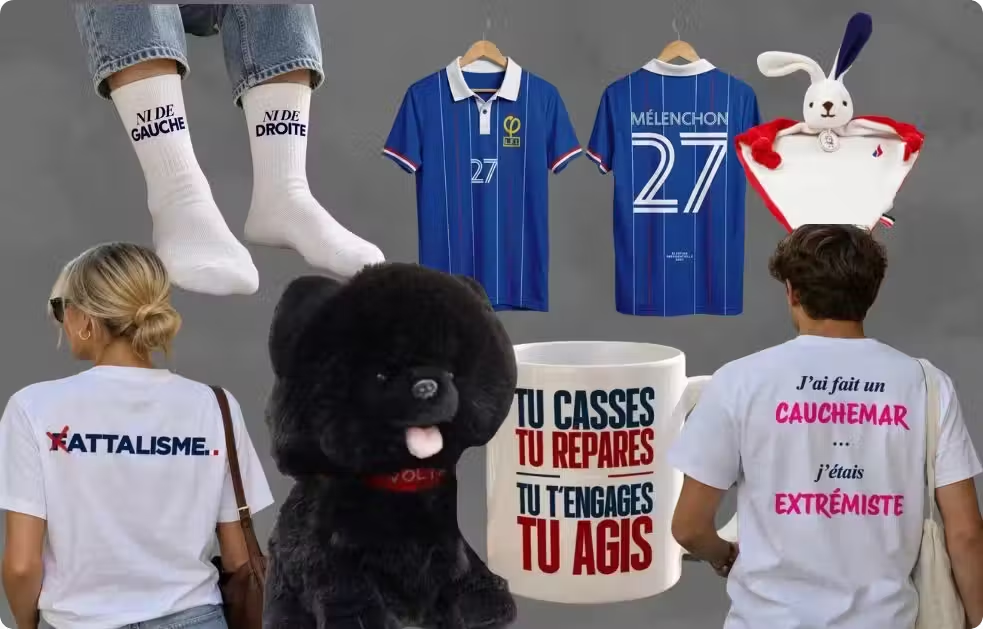
Political movements in France are increasingly adopting merchandising strategies similar to those used by pop stars to build community and visibility. Supporters of former Prime Minister Gabriel Attal, through the 'Jeunes en marche' movement, have launched an online store featuring items such as a plush toy of Attal's dog, Volta, priced at 19.99 euros. Louison Bastien, the movement's vice president in charge of communication, stated that the shop was created in response to militant demand, aiming to provide tools for campaigning—such as leafleting and door-to-door activities—while moving beyond classic campaign t-shirts by utilizing puns and cultural references to personalize the campaign around Attal's young and dynamic image. [1]
The trend extends across the French political spectrum. The National Rally (RN) operates its own store, selling a blue-white-red rabbit plush and mugs featuring Jordan Bardella's phrase, 'Where does he find all this energy?'. Similarly, La France Insoumise previously gained attention with football jerseys branded 'Melenchon 27' during the World Cup. While the 'Jeunes en marche' store reported over 100,000 visitors, 492 orders, and 312 Volta plushies sold—generating revenue exceeding 20,000 euros—Louison Bastien noted that the financial stakes are secondary to the communication goals. [1]
Experts distinguish between different types of political merchandise. Benoît Heilbrunn, a philosopher and co-director of the Brands, Consumption Imaginaries and Politics Observatory at the Jean-Jaurès Foundation, compares these efforts to iconic symbols like Barack Obama's 'Hope' poster or Donald Trump's MAGA hats, which sell adherence to a specific political message. In contrast, he criticizes 'self-referential' products that focus on the candidate's persona rather than societal issues, arguing that while such items can maintain notoriety and reinforce a small group of aficionados, they risk being perceived as grotesque and are insufficient for building a collective political brand or ensuring voter adherence. [1]
The music industry provides a blueprint for this strategy. Jean-Charles Mariani, digital strategy director at Universal Music, explained to Les Échos that purchasing merchandise is a visible part of the relationship between an artist and their fans, serving as a sign of belonging to a community. However, whereas music merchandise can balance a tour's budget—as noted by The Guardian—political merchandise in France currently serves more as a tool for visibility and attention in a crowded field of presidential contenders. [1]
- Categories:
- Politics
- Entities: