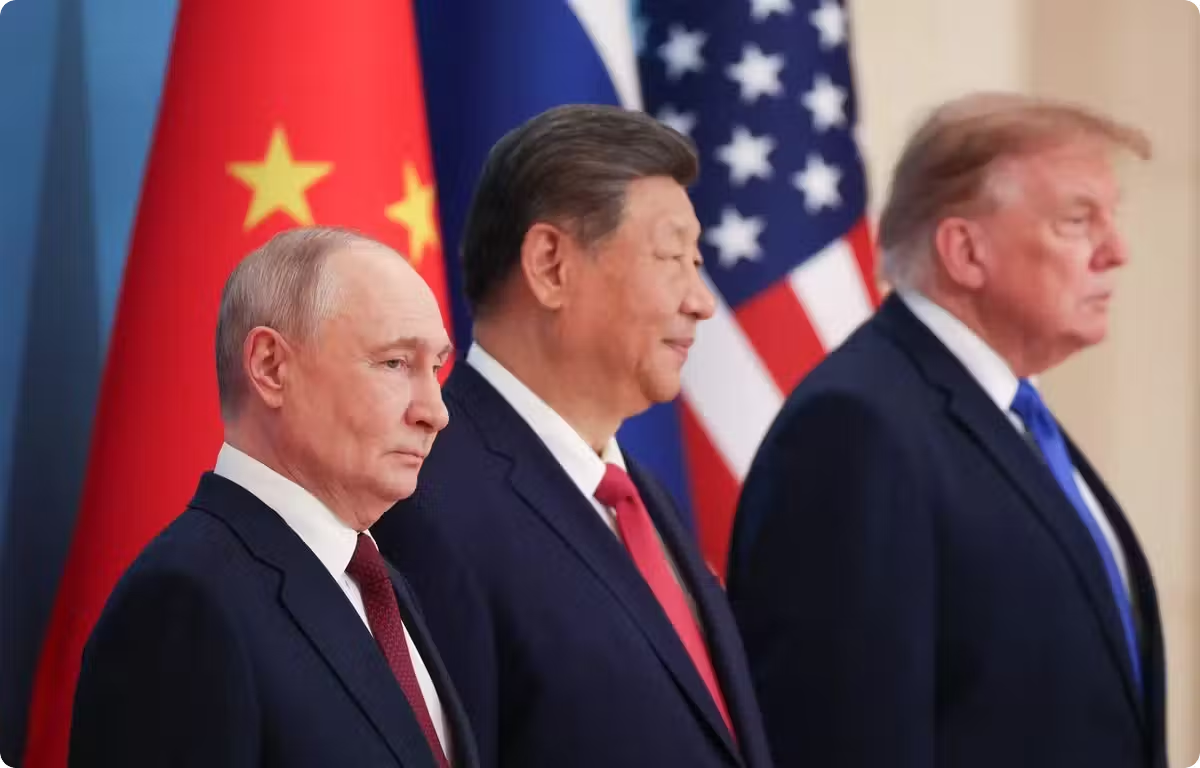
The image was striking, perhaps more evocative than the official statements that followed: Donald Trump, Xi Jinping, and Vladimir Putin gathered around a table of vertiginous dimensions. This millimeter-perfect choreography of power took place on the sidelines of the Asia-Pacific Economic Cooperation (APEC) summit in Shenzhen, China. On Thursday, following their meeting—during which Europeans were explicitly excluded—the three leaders adopted a “declaration in favor of peace,” displaying common but vague objectives for stability and nuclear risk reduction. The scene offered a window into the intricate, often unseen mechanics of high-stakes diplomacy, where the furniture itself becomes a primary instrument of negotiation. [2] [1]
Beyond the content of the discussions, the setting spoke volumes. “In a diplomatic negotiation, nothing is neutral: the choice of location, the shape of the table, and the seating plan relate to protocol, logistics, and symbolism,” summarizes Aurélien Colson, a professor of political science at ESSEC and director of the Institute for Research and Education on Negotiation (IRÉNÉ). This assessment is confirmed by Elodie Mielczareck, a semiotician and expert in non-verbal language. Before the leaders even speak, the space begins to communicate, establishing relationships and power dynamics long before any words are exchanged. [2]
The seating arrangement was particularly calculated. “Everything was calibrated with cameras facing Xi, who was in a position of majesty,” explains Claude Blanchemaison, a former ambassador. Xi had Putin to his right—the oldest head of state—and Trump to his left, who has been in power for less time, following established protocol. For Jean de Gliniasty, another former ambassador, this setup also allowed the Chinese president to avoid appearing overly familiar with Vladimir Putin. The arrangement was not merely logistical but a precise signal of status and diplomatic distance. [2]
The sheer size of the table served practical purposes as well. Each delegation needed space to place files, take notes, and accommodate their teams. Around the main plate, each delegation aligned its representatives in the front row, with a larger group of advisers seated behind them. However, this distance also affected the psychology of the actors. “You don’t speak in the same way at one meter as at five meters,” notes Aurélien Colson. The greater the distance between interlocutors, the more complicated the exchange can become, potentially leading to stagnation. “From one end to the other of the room, you can hardly see each other, whereas it is better to see the facial expressions of the speaker,” observes Blanchemaison. [2]
History offers stark examples of the symbolic use of such tables. The most notable instance remains the six-meter-long table installed in the Kremlin by Vladimir Putin in February 2022 to receive Emmanuel Macron. The stated reason was that the French president had refused a Russian PCR test, but the underlying message was one of distanced treatment—a gesture of defiance that included no handshake after the meeting. “The size is not linked to practical needs but is purely symbolic,” analyzes Mielczareck. It validates the one who dominates while leaving the guest far away, making them feel isolated against the other’s grandeur. The contrast was sharp the following day, when Macron met Zelensky in Kyiv around a small, very convivial round table. [2]
The geometry of the table also dictates the nature of the interaction. A round or oval table plays the card of equality; it has no “side” and no naturally dominant position, suggesting proximity. This form, privileged at Yalta in 1945 and currently at the G7, favors a direct tone, with few documents and a more informal atmosphere. In contrast, the rectangular table, traditional for negotiations, assumes a face-to-face dynamic. It underscores a logic of confrontation: “us” on one side, “you” on the other. VIPs sit in the center, accompanied by advisers in descending order of importance, reinforcing hierarchical structures. [2]
This decorum functions like theater, dressing the action and communicating it to spectators—journalists and citizens alike. As Mielczareck notes, “The set clothes the action, and communicates it.” An image does not restore the complexity of an exchange; it proposes a narrative. However, this stage play is not always where deals are sealed. Colson distinguishes between “the stage” and “the wings”: the large table gives a representation of the negotiation in full light, but it is not necessarily where the decisive negotiation takes place. Once the cameras turn off, compromises are built out of frame. Meetings often occur in antechambers, or during coffee breaks, creating links and enabling mini-negotiations that happen in the shadows, behind the spotlights. [2]
The outcome of this theatrical display was a joint declaration emphasizing “strategic stability,” nuclear risk reduction, and prevention of nuclear proliferation. The leaders also called for UN reform, attacked the International Criminal Court (ICC), and affirmed their desire to increase oil supplies. Trump declared, “We are truly writing history,” while Xi spoke of a meeting of “foundational significance” and Putin of a new “page in the history of diplomacy.” For China, it was an opportunity to pose as an indispensable actor in global affairs; for Trump, to obscure the defeat of his camp in the US midterms with diplomatic gains; for Putin, to show Russia being received as an equal by the world’s two great powers despite Western sanctions. [1] [2]
- Categories:
- Politics
- Entities: