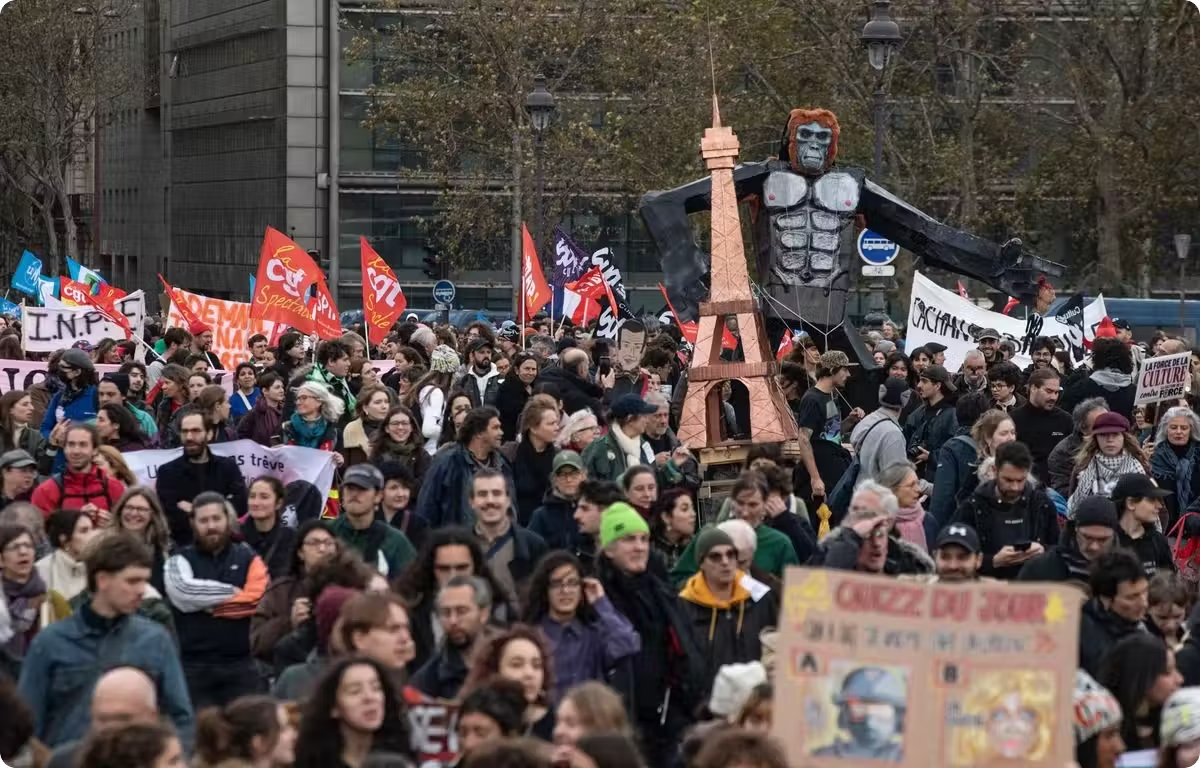
France is witnessing another day of massive mobilization this Saturday, marking the sixth consecutive week of popular protests. This series of demonstrations, designated as 'Act VI' by the Yellow vests, brings together a diverse coalition including major unions (CGT, CFDT, FO, FSU, Solidaires), left-wing parties, student and high school organizations, as well as the Yellow vests movement. The demands remain unchanged since the start of the movement: improved wages, defense of public services, better study conditions, and access to decent housing. In Paris, several thousand participants left Place de la République around 2 p.m., heading towards Place de la Nation to the sound of 'Emmenez-moi' by Charles Aznavour, sung in unison by the crowd. The atmosphere was festive but fueled by deep discontent, with banners stating 'Gen Z against selection and militarization' or 'No to the license to kill,' directly referencing the controversial law on the 'presumption of legal use of weapons by law enforcement,' adopted by the French Parliament the previous day. [1]
This mobilization also falls within the framework of a coordinated European call by unions and housing rights associations, requesting joint actions from Friday to Sunday. 'It's spreading like oil now at the European level,' explained Sophie Binet, general secretary of the CGT, adding that this international solidarity 'feeds us and gives us strength.' Manon Moret, general secretary of UNEF, deplored the precariousness experienced by young people in many countries: 'We have to choose between housing, healthcare, and eating our fill.' She called for an immediate increase in housing benefits (APL) and grants, as well as more places in higher education. Sabrine Kharbach, spokesperson for the Union Étudiante, stressed the urgency: 'We can't wait six months for the presidential election; the emergency must be addressed now.' Several hundred people, many of them young, also gathered in Marseille under the blue sky at Les Réformés. The procession sang the Marseillaise, The Internationale, and antifascist songs. Véronique Rolando, 73, denounced the 'license to kill' and the situation regarding the Social Security budget, expressing fear for the future. [1]
This Saturday marks a particularly symbolic moment: it coincides with the eighth anniversary of the origins of the Yellow vests movement, initially triggered in 2018 against a rise in fuel prices. Azelma Signaux, spokesperson for the National Coordination of the Yellow vests, recalled during a press briefing that these movements were symptomatic of 'precarity, social injustices, and the lack of democracy.' According to her, the situation has 'deteriorated': 'Our only democratic tools have been completely destroyed and stolen from us,' citing bans on demonstrations, police repression, and the discarding of petitions signed by hundreds of thousands of people. Figures such as Yann, a teacher in a high school mobilized since mid-October, or Brigitte, a 73-year-old Lutte Ouvrière activist, expressed their support for the youth's fight against budget cuts in education and against the 'policy of destroying public services that widens inequalities.' She also denounced the 'violent repression' of the movement. [1]
Despite the persistence of the mobilization, the scale of the gatherings appears to be declining compared to previous peaks. On October 17, France experienced a historic mobilization bringing together approximately 550,000 participants according to the Ministry of the Interior, accompanied by violence and vandalism in several cities. Since then, official figures indicate a decrease. According to the Ministry of the Interior, the mobilization this Saturday began in an atmosphere 'globally calm' and 'in clear decline compared to previous days.' At 2 p.m., 44 actions had been recorded across the national territory outside Paris, for approximately 2,200 participants, compared to 9,800 participants at the same time on November 14. Authorities describe the situation as calm, although the context remains tense. CFDT, CGT, and UNSA accuse employers of hindering wage negotiations and have called on private sector workers to join a new day of public sector mobilization scheduled for December 1. [1]
The Yellow vests also called on Saturday, November 28, to join the feminist demonstrations organized by the collective 'Nous Toutes' on the occasion of the International Day for the Elimination of Violence against Women. This convergence of calls illustrates the multiplicity of causes championed by the movement. As weeks pass, social tension remains high. Union and student organizations maintain pressure, refusing to let the movement die out before receiving concrete responses from the government, even during the pre-election period. The French mobilization therefore continues to be part of a broader trend affecting a significant portion of the youth and workers, with echoes in other European countries. [1]
- Categories:
- Politics