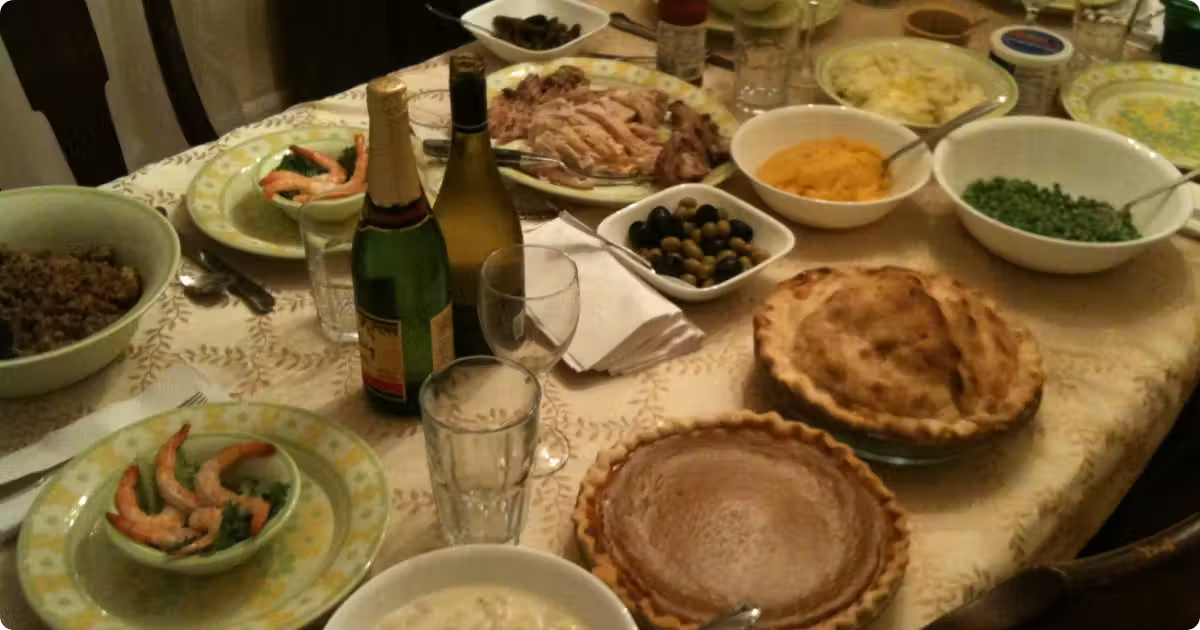
For many Latino families in the United States, Thanksgiving is a day defined by contrast rather than tradition. It falls on a Thursday that may offer a long weekend for some, but remains a regular workday for others working in essential services. While national advertisements depict the holiday as a universally shared experience centered on turkey and gratitude, the reality for many immigrant and second-generation households involves navigating two calendars simultaneously. One calendar marks the arrival of Day of the Dead and the beginning of the Christmas novenas, traditions rooted in Latin American heritage. The other demands participation in an American ritual that feels both welcome and inherently foreign. This dual belonging creates a complex psychological landscape where the holiday is both a gift and a source of fatigue, characterized by the feeling of being received by a celebration that does not fully belong to you. [2] [1]
The tension often arises not from the food itself, but from the comments surrounding it. In many Latino households, food is synonymous with affection, and offering a second plate is a gesture of care. However, this cultural norm frequently collides with modern concerns about body image and health. Relatives may comment on weight gain or dieting with the same casualness used to discuss the weather, believing their concern is understood as love. These remarks, such as saying someone looks fuller or urging them to eat more because they are too thin, originate from close family members rather than strangers. Consequently, they carry a deeper emotional impact, blending intimacy, authority, and public scrutiny. The contradiction is inherent to the message itself: a relative may criticize a person's body while simultaneously insisting they eat more, creating a confusing environment where rejection of the food is seen as a slight, yet acceptance is scrutinized. [2] [1]
Research on weight stigma provides a framework for understanding why these interactions are particularly painful. A 2009 review by Rebecca Puhl and Chelsea Heuer, published in the journal *Obesity*, documented weight stigma across various sectors, including healthcare, education, and close relationships like family. When this stigma manifests in the domestic sphere, it is often wrapped in concern or humor, making it difficult to address. The pain is amplified by the public nature of family meals, where multiple witnesses are present, and the history of the relationship complicates any attempt to set boundaries. For individuals who have struggled with body image issues for years, each comment can reopen old wounds, reinforcing feelings of shame or inadequacy. It is not an exaggeration to feel affected by these remarks, nor is one being ungrateful for wishing to deflect the conversation. [2]
Protecting children from these types of comments requires immediate but gentle intervention. Studies indicate that weight-related teasing from family members is associated with increased body dissatisfaction and risky eating behaviors in adolescents. For instance, a 2010 study in the *Journal of Adolescent Health* found that over half of the teenage girls surveyed reported experiencing weight-based ridicule from relatives, with no associated positive outcomes. When a comment is directed at a child or adolescent, parents are advised to intervene calmly, perhaps by redirecting the conversation to the child's strengths or activities. It is crucial to follow up privately with the child, reinforcing that their body is not subject to table debate and that they are loved unconditionally. This reaction helps the child distinguish between normal behavior and harmful criticism, establishing a secure boundary against familial pressure. [2]
The approach to Thanksgiving also involves hybridizing cultural practices. Many Latino families combine traditional Latin American dishes, such as rice with pigeon peas, tamales, or pernil, with American staples. This culinary fusion serves a psychological purpose: it affirms identity and signals presence within the new culture. For children, seeing both cultures represented on the same plate is a practical lesson in identity formation, demonstrating that two worlds can coexist. However, this adaptation should not become an exhausting competition to maintain a 'perfect' table that satisfies both cultural expectations. The focus should remain on the enjoyment of the meal and the company, rather than the performance of a specific cultural narrative. Additionally, for those who cannot celebrate due to work obligations, the holiday can be shifted to another day, maintaining the spirit of family connection without the constraint of the calendar. [1]
When tensions arise, whether from political disagreements, uncomfortable questions, or resistance to celebrating a non-Latino holiday, effective communication strategies are essential. Having a predetermined phrase to change the subject can prevent conflicts from escalating. If a family member insists on continuing inappropriate comments after a clear, calm boundary has been set, repeating the same statement without raising one's voice is often more effective than arguing. Engaging an ally at the table can also help steer the conversation. Ultimately, the goal is to protect the peace of the gathering while honoring personal boundaries. If the anxiety regarding body image or food becomes a constant source of distress throughout the year, seeking professional help is recommended. Resources such as the National Institute of Mental Health provide information on eating disorders, emphasizing that these conditions are treatable. In crisis situations, reaching out to emergency services or helplines like 988 in the US is critical. The holiday, therefore, becomes not just a feast, but a practice in managing cultural identity, familial love, and mental well-being. [2] [1]
- Categories:
- Media
- Entities: