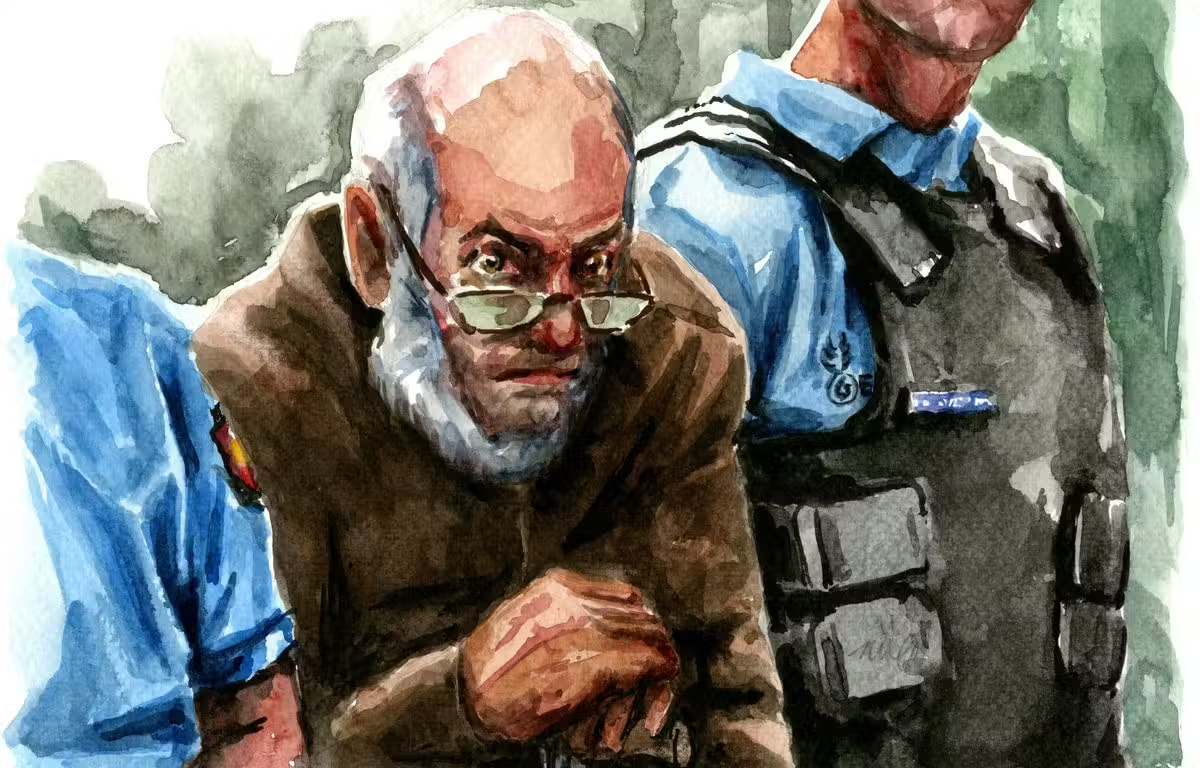
The criminal court (cour d’assises) in Blois is hearing the case against Ahmed Touloub, 74, who is accused of complicity in acts of torture and barbarity in the case of his daughter Inass. Her body was found beside the A10 motorway in 1987. Investigators identified the family through DNA from one of Inass’s brothers, who was arrested over a fight. According to testimony by psychologist Sam Hamidi, Touloub acknowledged that he had been cowardly in failing to report violence that he attributed to his former wife, Halima El Bakhti. He denies direct involvement. The couple’s adult children gave testimony describing violence they attributed to El Bakhti. [1]
The court found Touloub fit to stand trial after a scan and blood test, following an earlier assessment that raised the possibility of early dementia. Touloub repeatedly told the court he did not remember. The experts discussed whether he had been under his former wife’s influence and expressed differing views. El Bakhti said he had forced her to leave Morocco. The cause of his reported lapses remained open. [1]
As the story develops
Update
Experts debate Halima El Bakhti's mental state in Blois murder trial
The criminal court in Blois, France, is continuing its trial regarding the 1987 death of four-year-old Inass Touloub, focusing this week on the mental state of the victim's mother, Halima El Bakhti. Since the controversial public display of Inass’s autopsy photographs, psychiatrists have testified on whether the mother, described as loving by her other six children, possessed full legal discernment during the acts of torture and barbarity that resulted in her daughter's death. The body was discovered on the shoulder of the A10 motorway in August 1987. [2]
Dr. Daniel Zagury, a psychiatrist cited by the defense, expressed the profound difficulty legal experts face in processing such extreme violence. He noted that upon seeing the extent of the injuries—including internal bruising, burns, untreated fractures, and disabling bites—the instinct is to label the perpetrator a monster or a pathological individual without seeking understanding. However, determining the level of consciousness and discernment at the time of the acts remains crucial, particularly given that El Bakhti has admitted only to administering slaps, not the severe abuse documented by medical examiners. [2]
Psychiatric experts presented diverging views on El Bakhti’s mental condition. While none diagnosed her as a psychopath or sadiac in the clinical sense, they identified significant psychological disturbances. Dr. Zaguary characterized her as bordering on paranoia, with a tendency to attribute the origin of her actions to external blame. Her own children have previously reported signs of her mental distress, including head-banging and hair-pulling, yet experts clarified that having a pathological personality does not equate to being mentally ill in a way that removes responsibility entirely. [2]
The prosecution and defense experts emphasized a deep depressive state as a key explanatory factor. El Bakhti is understood to have suffered from chronic depression, exacerbated by successive pregnancies, a failed marriage, and the professional frustration of abandoning her career as a teacher in Morocco to work in her husband’s grocery store in Puteaux, France. Expert Roland Coutanceau, who initially excluded diminished discernment in 2018 and 2019 reports, reversed his position during the current hearings, now arguing for altered discernment based on this chronic depression. [2]
Inass Touloub appears to have borne the brunt of the violence, a dynamic linked to her infancy. When Inass was one month old, she was sent to live with her grandmother in Casablanca, Morocco, while her parents established their business in France. Upon her return more than a year later, the child was disconnected and distressed. Dr. Zaguary explained that El Bakhti perceived this distress—manifested through crying, vomiting, or rejection of affection—as a personal attack and deliberate offense. [2]
The resulting cycle of violence was catastrophic. Inass suffered burns on her buttocks that made sitting impossible, and an untreated forearm fracture led to permanent limb shrinkage. Witnesses stated that on the day of her death, the mother was enraged because the child had stained her clothes. Experts analyzed this 'cataclysmic destructiveness' partly through the lens of El Bakhti’s own childhood, where she reportedly endured floggings and burns by her parents, though she firmly denies being a victim of such abuse. Regardless of the cause, psychiatrists agreed that her psychological vulnerability could mitigate the severity of her sentence, which carries a potential penalty of life imprisonment. [2]
- Categories:
- Justice
- Entities: