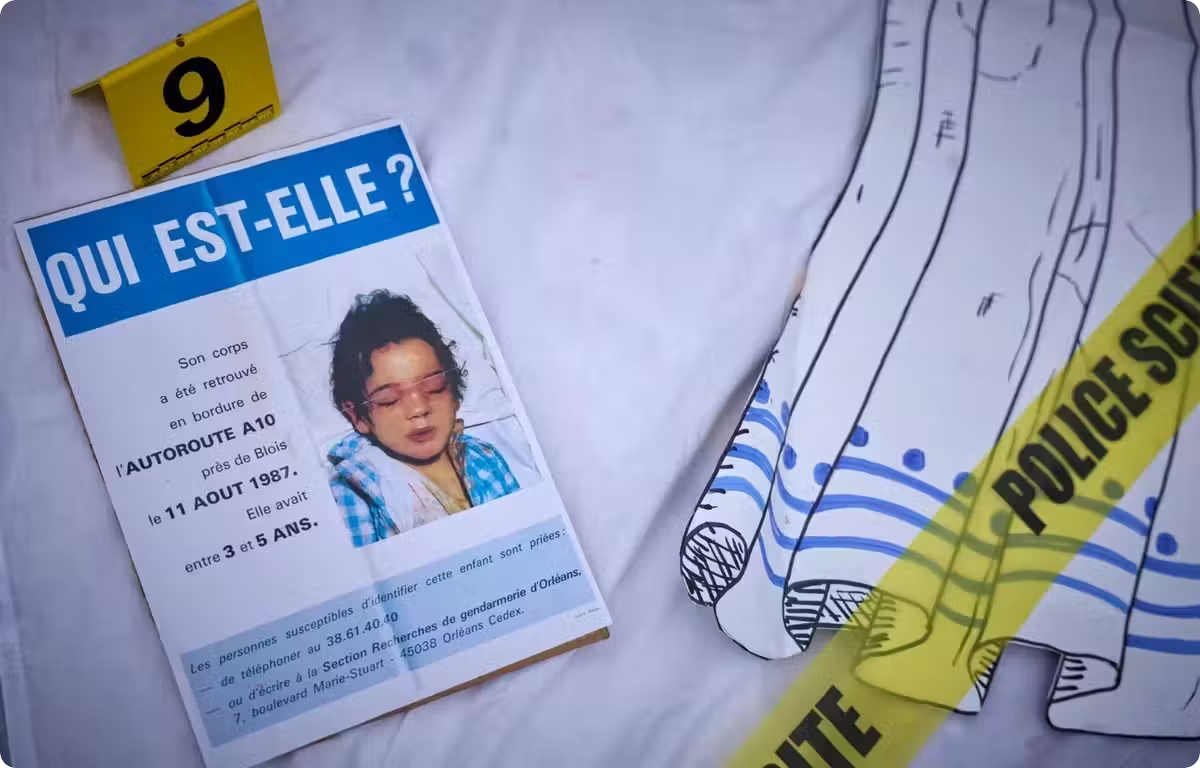
During the ongoing trial of Halima El Bakhti and Ahmed Touloub at the Cour d'Assises in Blois, France, the defendant’s ex-husband, Ahmed Touloub, took the stand, admitting he knew his four-year-old daughter Inass was being abused long before her tragic death but failed to intervene. Touloub, 74, sat beside El Bakhti, 72, on the dock throughout the proceedings without exchanging a word. While El Bakhti is on trial for torture and barbarity resulting in death, Touloub faces charges of complicity, with both facing life imprisonment. [1]
Touloub testified that he became suspicious of the abuse late in 1984 or early 1985, shortly after Inass arrived in France from Morocco. He recounted finding the child with bruises and bite wounds, initially believing El Bakhti’s claim that Inass had fallen on an iron. He admitted to treating some of her injuries with eosin, a red antiseptic, but claimed he did not grasp the full extent of the suffering until the autopsy. He told the court: “I saw the bruises, the wounds caused by bites... I treated them sometimes with the red stuff.” However, the presiding judge challenged his ignorance, noting that autopsy images showed a body covered in wounds of varying ages, including deep bites penetrating to the blood and untreated fractures. [1]
Under pressure from the presiding judge, Touloub admitted to hearing screams and witnessing El Bakhti striking Inass, yet he remained passive. “I hear screams and when I open the door, she beats Inass,” he stated. When asked what he did, he replied: “I can’t do anything. Even if I shout, she shouts louder than me.” He repeatedly described himself as “cowardly” and a “scoundrel” who was too afraid of his wife to protect his children, claiming, “I myself was tortured.” He cited fear of domestic retaliation as the reason he never contacted police, social services, or medical professionals during the six years of investigation. [1]
Regarding the night of July 10–11, 1987, when Inass died, Touloub testified that he arrived home around 23:30 to find Inass under a blanket on the sofa. El Bakhti had told him, “Inass is dead.” Unlike El Bakhti, who insists Inass was alive when they began their journey to Morocco, Touloub admits he did not check for a pulse or call an ambulance. Instead of going to the police station to report the death, he turned back, complying when El Bakhti suggested taking Inass to Morocco. During the drive, Inass’s body was placed on the right side of the rear seat, next to a 13-day-old baby in a crib and two other children. Hours later, El Bakhti allegedly instructed him to stop on the shoulder of the A10 motorway to abandon the body. Touloub maintains it was too dark to see her retrieve her handbag without the child. [1]
The judge expressed frustration at Touloub’s failure to act even decades later. Touloub stated he had lived his whole life waiting for authorities to arrest him, citing emotional devastation after separating from El Bakhti in 2011 when his children were adults. The president retorted: “The fact is that you lived for 40 years after this event.” The couple, married for nearly 35 years with seven children, shared a mutual dislike of their arranged marriage, yet their testimonies on all other matters contradicted each other entirely. [1]
- Categories:
- Justice