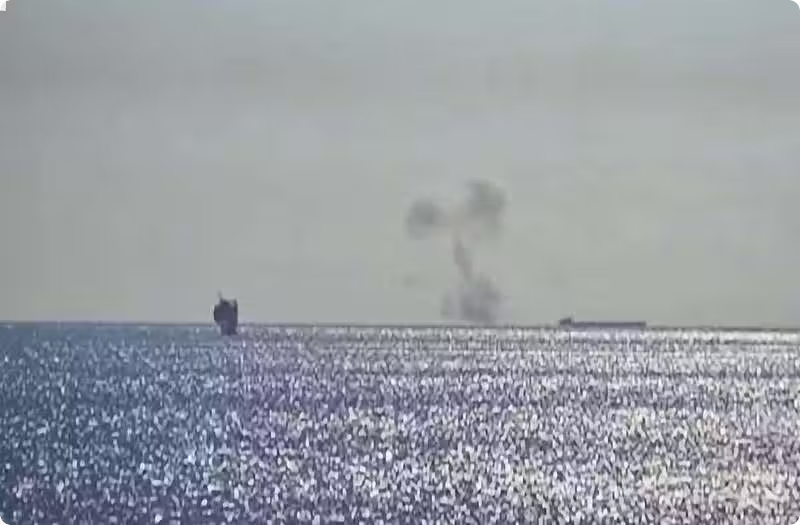
The Black Sea has emerged as the world's most lethal shipping route this year, surpassing even the conflict-affected area of the Strait of Hormuz. Nearly 600 ships have been struck in the Black Sea so far, with incidents resulting in the death of at least 40 sailors. These figures double the number of deaths in the Persian Gulf and exceed by six times the number of attacks recorded in the Strait of Hormuz, indicating a significant escalation of risks in the Pontic space.
According to a report by the Financial Times and maritime security company Ambrey, together with the International Maritime Organization, the casualty toll in the Black Sea is the highest globally. In contrast, in the Strait of Hormuz area, where Iran has continued to block maritime passage and target unauthorized ships, only 24 deaths have been confirmed since the start of the current conflict.
The escalation of violence in the Black Sea is attributed to a Ukrainian drone campaign against Russian ships, initially designed to disrupt diesel supplies from Crimea but which has spread rapidly. Latest data shows that approximately 387 ships were targeted between July and September, more than five times as many as in the previous quarter. Additionally, tactics have changed: both Russia and Ukraine are now targeting command decks and accommodation spaces, not just cargo or mechanical areas, increasing mortality rates.
For the maritime industry, financial and human risks are enormous. War risk insurance premiums can reach 15% of the cargo's value, a rate close to double that applied in the Persian Gulf. This is causing shipowners to use older vessels, some up to 50 years old, to minimize potential losses. The social situation of sailors is critical, with salaries being among the lowest, and threats of penalties in case of early contract termination being frequent.
As the story develops
Update
The Black Sea is becoming the world's most dangerous shipping route, surpassing the Strait of Hormuz
The Black Sea has emerged as the world's most dangerous maritime shipping route in 2026, surpassing even the conflict-affected area of the Strait of Hormuz in terms of mortality. According to consolidated data from maritime security company Ambrey and the International Maritime Organization (IMO), nearly 600 ships have been struck in the Pontic space so far, with incidents resulting in the death of at least 40 sailors. This casualty toll is double that of the Persian Gulf and six times larger than the attacks recorded in the Strait of Hormuz, indicating a significant escalation of risks. [2]
The escalation of violence is attributed to the expansion of the Ukrainian drone campaign against Russian ships, initially designed to disrupt diesel supplies from Crimea but which has spread rapidly to international commercial traffic. Approximately 387 ships were targeted between July and September, a figure over five times higher than in the previous quarter. Aggressive tactics have changed: both parties to the conflict are now targeting command decks and accommodation spaces, not just cargo or mechanical areas, which drastically increases the mortality rate, confirmed by the sinking of the Greek container ship Contship Jet, hit by three drones on October 28. [2]
Financial and human risks for the maritime industry are enormous, with war risk insurance premiums reaching 15% of the cargo's value, a rate close to double that applied in the Persian Gulf. This situation causes shipowners to use older vessels, some up to 50 years old, to minimize potential losses. The social situation of sailors is becoming critical: salaries are among the lowest in the sector, and threats of penalties in case of early contract termination are frequent, in an environment characterized by increased uncertainty and lack of guaranteed protection. [2]
Update
France extends the mission of the Atlantique 2 aircraft in the Black Sea to monitor maritime risks
The presence of the French maritime patrol aircraft Atlantique 2 has been extended for the coming weeks to ensure the safety of commercial navigation in the Black Sea. France moved the Atlantique 2 aircraft to the Romanian Mihail Kogălniceanu Air Base on October 18, at the request of Romania and Bulgaria, to strengthen regional monitoring capacity. The Atlantique 2 patrol aircraft specializes in detecting submarines, warships, and minor threats, including maritime drones and mines, but is not capable of neutralizing them directly. Initially scheduled to conclude its mission on November 6, the aircraft's presence in Romania was extended due to the escalation of tensions. The additional aerial presence comes amid an accelerated pace of attacks on commercial ships that have raised major concerns about the security of the Pontic route. Recent incidents also targeted the coastal areas of Romania and Bulgaria, with at least nine cargo ships struck in October and a human toll of approximately 34 sailors killed or missing. During the attack that led to the sinking of a ship in Bulgarian exclusive economic waters on October 28, the Atlantique 2 aircraft successfully identified the three drones involved. The aircraft commander emphasized the role of surveillance and detection of the French crew, clarifying that the mission does not include active interception of threats. [3]
Update
France extends the Atlantique 2 mission in the Black Sea amidst safety escalations
The mission of the French maritime patrol aircraft Atlantique 2 in the Black Sea will be extended by several weeks to ensure the safety of commercial navigation in an area marked by the escalation of the conflict. [4]
The Atlantique 2 mission presence will be maintained for several weeks from now on. We are here to ensure the safety of commercial traffic navigation in the Black Sea, [4]
The aircraft was temporarily relocated to the Romanian Mihail Kogălniceanu Air Base on October 18 after Romania and Bulgaria requested reinforcements to counter recent incidents. [4]
The Atlantique 2 patrol aircraft specializes in detecting submarines, warships, and minor threats, including maritime drones and mines, but is not capable of neutralizing them directly. [4]
Initially scheduled to conclude its mission on November 6, the aircraft's presence in Romania was extended due to the escalation of tensions. [4]
The extension of the aircraft's stay occurs amid attacks on commercial ships that have amplified concerns regarding safety in the Black Sea. [4]
At least nine cargo ships were struck near the coast of Romania and Bulgaria in October, with approximately 34 sailors reported dead or missing. [4]
The aircraft managed to detect the three maritime drones that struck and ultimately sank the ship in Bulgarian exclusive economic waters on October 28. [4]
We are a surveillance aircraft, [4]
Update
France Extends Surveillance Mission in the Black Sea Amid Rising Threats
France extends its maritime surveillance mission with an Atlantique 2 aircraft stationed at Romania’s Mihail Kogălniceanu air base for several weeks. The decision follows a series of recent attacks on commercial vessels in the Black Sea, escalating security concerns for NATO members Romania and Bulgaria. [5]
The maritime escalation driven by the war between Russia and Ukraine poses a major challenge to NATO’s security perimeter in the Black Sea, directly exposing member states such as Romania and Bulgaria. The region remains critical for the transport of grain, crude oil, and petroleum products. [5]
France deployed the Atlantique 2 to Mihail Kogălniceanu on October 18 after Romania and Bulgaria requested reinforcements from the alliance amid rising tensions. [5]
“The presence of the Atlantique 2 will be maintained for a few weeks. We are here to ensure the safety of commercial traffic navigation in the Black Sea,” stated the aircraft’s commander, whose identity has not been disclosed by French naval forces for security reasons. Initially, the aircraft was scheduled to rotate out by November 6. [5]
Security risks have reached alarming levels: at least nine cargo ships were hit near the Romanian and Bulgarian coasts in October alone, leaving approximately 34 sailors reported dead or missing in the incident. [5]
During a critical moment, the French aircraft successfully detected three naval drones that subsequently struck and sank the Greek container ship “Contship Jet” within Bulgaria’s exclusive economic zone on October 28. [5]
Authorities highlighted that Bulgarian authorities and the vessel itself were notified one hour before the naval drones struck, allowing the crew to escape uninjured. [5]
Emphasizing the limitations of their equipment, the commander clarified, “We are a surveillance plane. We can detect, but we do not have the capability to neutralize and intercept such drones.” [5]
To counter these asymmetric threats, NATO announced this week a commitment to invest more than $40 billion over the next five years into drone defense capabilities. The alliance underscored that its pledge to defend all member states, including those bordering the Black Sea, remains unwavering. [5]
Update
Role of the French Atlantique 2 aircraft in detecting drones and extending the mission
The French maritime surveillance aircraft Breguet Atlantique 2 played a critical role in the intervention on October 28, detecting three surface drones targeting a civilian ship in Bulgaria's economic zone. The assistance operation led by the French general staff saved 18 lives, demonstrating the usefulness of early detection against asymmetric attacks. Beyond detecting the threat and warning the crew of the targeted ship, the aircraft's crew transmitted the exact position to the competent authorities. Thus, they contributed to coordinating rescue operations alongside Bulgarian naval forces, warning other ships in the area of the imminent danger. [7]
The incident on October 28, which took place in the Bulgarian economic zone, occurred while the ship was heading towards Constanta. The event coincided temporally with the meeting of defense ministers from Romania, Bulgaria, and Turkey held in Sofia, focused on Black Sea security. In the context of these threats, Romania recently signed, under the SAFE program, a contract for the acquisition of 12 Airbus H225M military helicopters, valued at over 850 million euros, including logistical support and training. The initial mission of the French Navy's Atlantique 2 maritime patrol aircraft in Romania was scheduled to end on November 6, 2026. Although Romanian military leaders have acknowledged the difficulty of detecting low-altitude maritime drones, they continue to request ally support. [7]
At Mihail Kogălniceanu Air Base, France presented the aircraft responsible for monitoring the Black Sea and detecting drones threatening commercial ships. Although the mission was scheduled to end the next day, French authorities decided to extend it in response to the frequency of recent incidents. The monitoring center of the Atlantique 2 aircraft allows French military personnel to monitor the economic zones of Romania and Bulgaria using radar, cameras, and sensors. High-performance systems can detect a submarine's periscope or small naval drones. Information is analyzed by operators and transmitted to allied forces. The aircraft's commander highlighted the efficiency of the equipment, including an optical camera and a new acoustic system, capable of locating small targets such as drones. Last month, the crew located a ship hit by drones 24 kilometers from the Romanian coast, saving nine sailors. Five days later, radar detected three drones heading towards ships in Bulgarian waters, providing hours of advance warning, allowing crews to prepare. [6]
The French aircraft will remain in Romania beyond the initial deadline of November 6, the extension being dictated by the growing threats in the Black Sea. While half of young Romanians express doubts about NATO's defense capability, cultivated by Russian propaganda, the continued presence of allied forces, such as this one, serves as evidence of the alliance's commitment. [6]
- Categories:
- International Relations
- Entities:
-
- AFP
- Financial Times
- Iran
- Sofia
- Teheran
- Lucas
- Franța
- Washington
- Statele Unite
- Rusia
- Bulgaria
- NATO
- Ucraina
- News.Ro
- Sulina
- Shahed
- Portul Constanța
- Petromidia
- Marea Neagră
- Oil Terminal
- Gărzile Revoluţiei
- Deha Aydin
- Esenyel & Partners
- Turcia
- Contship Jet
- Ambrey
- Atlantique 2
- Marinei Naționale Franceze
- Comandantul Aeronavei
- Franța
- Baza Militară Mihail Kogălniceanu
- Airbus
- SAFE
- Breguet Atlantique 2
- Airbus H225M
Sources
- Profit.ro 3 nave au luat foc în Strâmtoarea Ormuz
- Financial Intelligence CE … SE ÎNTÂMPLĂ PE „LACUL RUSESC” DE PE FLANCUL ESTIC AL NATO? Marea Neagră între navele care se scufundă și explicațiile care plutesc (opinie Cătălin BALOG)
- MediaFax Franța prelungește șederea avionului de patrulare maritimă în Marea Neagră. Cât va sta ATLANTIQUE 2 la Mihail Kogălniceanu
- G4Media Franța prelungește cu câteva săptămâni șederea avionului de patrulare maritimă în Marea Neagră / Este conceput pentru a detecta submarine, nave de război, drone maritime și mine
- Digi24 Franța prelungește misiunea unui avion militar în România, după atacurile asupra navelor din Marea Neagră
- observatornews.ro Cum arată Atlantique 2, nava de supraveghere care patrulează deasupra Mării Negre şi care poate detecta drone
- monitorulapararii.ro Aeronava franceză de supraveghere maritimă Atlantique 2 a detectat [...] | Monitorul Apărării și Securității