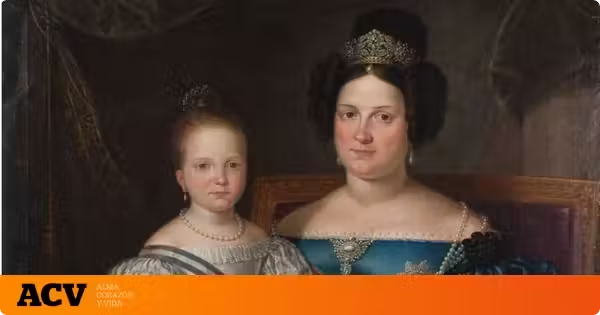
María Cristina of Bourbon-Two Sicilies remains one of the most enigmatic and controversial figures of the 19th-century Spanish monarchy. As the fourth wife of King Fernando VII, mother of Isabella II, and Queen Regent for seven critical years, her life was a constant battle between the rigid expectations of the Crown and a private existence defined by clandestine romance and financial ambition. Operating within a court deeply divided between defenders of the Ancien Régime and advocates of liberal freedoms, the Neapolitan princess used political cunning to ensure her lineage's survival while hiding a secret marriage that would eventually damage her public reputation.
Born in Palermo on April 27, 1806, María Cristina grew up in the Bourbon court of the Two Sicilies. She was the daughter of King Francis I and the Spanish Infanta María Isabel of Bourbon, making her the biological niece of Fernando VII. Her youth in Palermo and Naples was shaped by traditional court education designed to prepare princesses for strategic matrimonial alliances. This destiny was fulfilled when Fernando VII, having widowed three times without surviving offspring, chose his 23-year-old niece to secure a direct heir to the Spanish throne.
The marriage was celebrated by proxy in Naples and ratified in Madrid on December 11, 1829. Fernando VII was 22 years older than María Cristina and physically debilitated by obesity and gout. Despite the gap in age and health, María Cristina quickly gained her husband's trust, projecting a more approachable and kind image that contrasted with the stiffness of the Ferdinandine court. Her presence ignited a political struggle between the intransigent absolutists—led by her brother-in-law, Infante Carlos María Isidro—and the moderates who saw her as an ally capable of curbing the influence of the ultra-royalists.
A pivotal moment occurred with the announcement of the Queen's pregnancy. To allow women to reign in the absence of male heirs, Fernando VII promulgated the Pragmatic Sanction. On October 10, 1830, their first child, the future Isabella II, was born, followed by Infanta Luisa Fernanda on January 30, 1832. This female succession effectively removed Don Carlos from the line of inheritance. Following the King's death on September 29, 1833, María Cristina assumed the regency for her young daughter.
Only three months after Fernando VII's funeral, on December 28, 1833, the new Regent entered into a secret marriage with Agustín Fernando Muñoz y Sánchez, a handsome sergeant of humble origins from Tarancón who served in her escort, the Guardia de Corps. The ceremony was held in absolute secrecy because contemporary laws and conventions would have stripped her of the regency and the guardianship of the young Queen had she married outside the royalty. Over the following decade, the couple had eight children: María Amparo, María de los Milagros, Agustín María, Fernando María, María Cristina, Juan María Bautista, Antonio de Padua, and José María.
Maintaining such a secret became impossible as the pregnancies became visible, leading to widespread gossip in Madrid. Her political enemies mockingly dubbed her 'the woman married in secret and pregnant in public,' highlighting the perceived hypocrisy of a palace where everyone knew of the parallel family but no one could officially acknowledge it.
Between 1833 and 1840, María Cristina steered Spain through the volatile transition from absolute monarchy to a liberal state. This shift was driven by dynastic survival rather than ideological conviction. The First Carlist War, sparked by the supporters of Infante Carlos who refused to recognize Isabella II's rights, forced the Regent to seek urgent military and political alliances. She initially partnered with moderate liberals, promoting the Royal Statute of 1834 as a middle ground between absolutism and parliamentarianism.
As the civil war intensified and social unrest grew, María Cristina was forced to accept more radical measures. She supported figures like Juan Álvarez Mendizábal, enabling the desamortización (confiscation and sale of church lands), which fundamentally altered property structures in Spain. Following the 1836 Sergeants of La Granja uprising, she temporarily restored the Constitution of 1812 and eventually sanctioned the more progressive Constitution of 1837.
Beyond politics, María Cristina is often cited as a precursor to institutional corruption in modern Spain. Leveraging her power, she allegedly built an extensive network of private economic interests. After Fernando VII's death, he left a personal fortune of approximately 500 million reales (300 million in linked assets and 200 million in cash and jewelry). As tutor and regent, María Cristina reportedly diverted a significant portion of this inheritance to fund her secret family.
She was accused of diverting public funds to private accounts, trafficking in influence, and participating in lucrative slave trade businesses in overseas colonies, particularly Cuba. Her involvement extended to strategic national sectors, including mercury mining in Almadén, salt contracts, and early railway concessions. This opaque management of state resources, known popularly as the Queen Mother's 'secret pocket,' severely eroded her moral authority and fueled opposition from progressive sectors.
By October 1840, the combination of her double life and corruption scandals made her position untenable. Following the end of the Carlist War and pressure over a restrictive municipal law, she resigned the regency in Valencia and fled to France. Power passed to General Baldomero Espartero. Following her departure, inventories conducted by Espartero's circle and the girls' new tutor, Agustín Argüelles, revealed a massive looting of royal sites. María Cristina had emptied much of the royal jewelry box, taking hundreds of high-value pieces—including diadems and pearl necklaces—belonging to both the Crown and Isabella II. She also took gold and silver tableware, porcelain, paintings, and furniture, some of which were later sold in Paris.
From Paris, María Cristina used her wealth to conspire against Espartero's government, financing military pronouncements and aligning with moderate generals. These efforts succeeded in 1843 with Espartero's fall. She returned to Spain in 1844 after Isabella II's majority was declared early. Under the government of General Narváez, she finally legalized her marriage to Muñoz, who was ennobled as the Duke of Riánsares.
However, her continued political interference and financial ambitions led to further conflict. Her residence on Calle de las Rejas became a shadow center of power for ministerial appointments and economic concessions. This interference, combined with general social exhaustion over corruption and railway scandals, contributed to the 1854 revolution known as the Vicalvarada. Angry mobs attacked and burned her Madrid residence, demanding accountability for the depletion of the national budget. Consequently, the Parliament stripped her of her life pension and decreed her definitive expulsion from Spain in August 1854.
Despite her efforts to secure the throne for her daughter, the emotional bond between María Cristina and her royal descendants remained cold. Isabella II and later Alfonso XII maintained a distant relationship with her, influenced by the memory of a maternal absence and disapproval of her morganatic marriage. María Cristina spent her final years at Villa Mon Désir in Sainte-Adresse, Normandy. She witnessed the fall of Isabella II in 1868 and the Bourbon Restoration in 1874 from afar.
María Cristina died of heart failure on August 22, 1878, at the age of 72. Despite the controversies and two expulsions from her country, her status as Queen Consort and mother of the monarch earned her royal funeral honors. Her remains were returned to Spain and interred in the Pantheon of Kings at the Monastery of San Lorenzo de El Escorial alongside Fernando VII.
- Categories:
- History
- Entities: