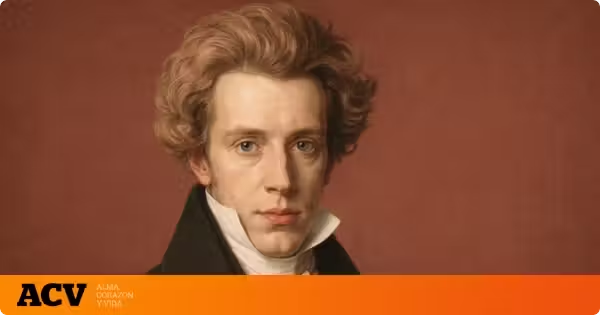
On November 13, 2026, El Confidencial published a reflective piece exploring the philosophical insights of Danish thinker Søren Kierkegaard, centering on his famous dictum that life can only be understood looking backward, but must be lived forward. The article, published under the 'Soul, Heart, Life' section, uses Kierkegaard’s reflections to frame contemporary struggles with decision-making, uncertainty, and the illusion of instant clarity in the digital age. [1]
Kierkegaard, born in Copenhagen in 1813, is widely regarded as a primary precursor of existentialism. His philosophical work focused on the individual’s experience of freedom, responsibility, anxiety, and the search for meaning, standing in contrast to universal systems of thought that sought to explain the world abstractly. The article highlights his major works, including either/or, Fear and Trembling, and The Disease Unto Death, which explore the internal conflicts arising when individuals must choose their way of living. [1]
The quote regarding retrospective understanding originates from Kierkegaard’s diaries of 1843, though the version popularized today is a condensed formulation of a longer reflection. Kierkegaard identified a fundamental human contradiction: we can analyze past events only after they have occurred, yet we lack this perspective when forced to make immediate decisions. Meaning emerges over time as experiences are linked together, but life does not pause for comprehension. [1]
The philosopher argued that existence is inherently tied to choice and uncertainty, a condition that generates what he termed 'anguish.' This anxiety arises from the sheer freedom of possibility before us. Choosing one path necessarily entails renouncing others, a responsibility that persists even when the future outcome remains unknown. [1]
Reflecting backward allows individuals to recognize errors, understand their reactions, and discover how circumstances shaped their identity. A lost love, a missed career opportunity, or a seemingly wrong decision may acquire new meaning years later, transforming perceived loss into a corrective experience. For Kierkegaard, such retrospection is essential, yet it cannot predict the results of present choices. [1]
The second half of the maxim emphasizes the necessity of moving forward despite incomplete knowledge. Kierkegaard rejected the expectation of full certainty before acting, viewing it as an impossibility. This stance challenges the modern demand for immediate answers, prevalent in a society driven by social media comparisons and curated narratives of flawless success. His philosophy invites individuals to build their path while walking it, acknowledging the impossibility of judging one’s journey from within the present moment. [1]
The article warns against permanent anchorage in the past. While reflection aids learning, obsessing over past regrets paralyzes engagement with future possibilities. Similarly, attempting to anticipate all future scenarios can induce inaction. Kierkegaard does not advocate for irresponsibility or the abandonment of thought, but rather an acceptance of uncertainty as an irreducible component of existence. Only by embracing this reality can individuals commit to meaningful actions. [1]
- Categories:
- History
- Entities: