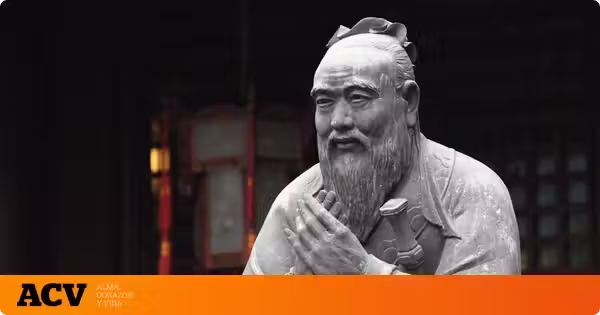
The ancient Chinese philosopher Confucius, a central figure in the establishment of Confucianism, offered a distinctive perspective on the aging process that reframes it not as a decline, but as a privileged stage of observation and reflection. According to a widely cited reflection attributed to him, old age is characterized by a gentle transition where the individual is removed from the active stage of life but granted a comfortable seat in the front row as a spectator. [1]
Born in Qufu in 551 B.C., Confucius is considered one of the greatest sages in history. His teachings, which emphasize social ethics, family harmony, and mutual respect, have influenced Eastern philosophy, education, and culture for over two millennia. His doctrine, which was later adopted as official ideology during the Han Dynasty, defended concepts such as filial piety, social order, and the importance of education as a tool for improving human coexistence. [1]
The life of Master Kong, as he was known, was marked by difficulties from childhood. Raised by his mother in a humble environment, he held various jobs before becoming a teacher and official in the State of Lu. Over time, he gained prestige as a wise man and eventually served as Minister of Justice. After leaving politics, he traveled across different territories in China to spread his teachings. Upon returning to his hometown, he focused his final years on teaching and compiling classic texts, much of which was recorded in *The Analects*. [1]
The quote regarding old age connects directly with this measured and reflective view of life that characterized much of his instruction. Rather than presenting aging as a negative period, Confucius interprets it as a shift in societal role. The idea of leaving the 'stage' to occupy a privileged position as an observer conveys serenity and experience, two concepts deeply present in classical Chinese philosophy. [1]
This perspective on maturity appears in other well-known citations by Confucius, including his emphasis on self-reflection and moral discipline. He stated, 'Demand much of yourself and expect little from others. Thus you will avoid grievances.' He also asserted, 'Where there is education, there is no distinction of classes.' These teachings underscore his belief in the importance of personal improvement and the relational nature of ethics, where each gesture impacts the family, community, and state. [1]
Confucius, the central figure of Confucianism and born in Qufu in 551 B.C., offered a distinctive perspective on the aging process that reframes it not as a decline, but as a privileged stage of observation and reflection. According to a widely cited reflection attributed to him, old age is characterized by a gentle transition where the individual is removed from the active stage of life but granted a comfortable seat in the front row as a spectator. [2]
His teachings, which emphasize social ethics, family harmony, and mutual respect, have influenced Eastern philosophy, education, and culture for over two millennia. His doctrine, which was later adopted as official ideology during the Han Dynasty, defended concepts such as filial piety, social order, and the importance of education as a tool for improving human coexistence. [2]
Known as Master Kong, his life was marked by difficulties from childhood. Raised by his mother in a humble environment, he held various jobs before becoming a teacher and official in the State of Lu. Over time, he gained prestige as a wise man and eventually served as Minister of Justice. [2]
After leaving politics, he traveled across different territories in China to spread his teachings. Upon returning to his hometown, he focused his final years on teaching and compiling classic texts, much of which was recorded in *The Analects*, a work gathering dialogues and thoughts that remain subjects of study worldwide. [2]
This perspective on maturity connects with his measured and reflective view of life. Rather than presenting aging as a negative period, Confucius interprets it as a shift in societal role. The idea of leaving the 'stage' to occupy a privileged position as an observer conveys serenity and experience. This outlook appears in other known citations, including 'Demand much of yourself and expect little from others. Thus you will avoid grievances' and 'Where there is education, there is no distinction of classes,' underscoring his belief in personal improvement and the relational nature of ethics. [2]
- Categories:
- History
Sources
- El Confidencial Confucio, filósofo chino: "Aquel que se exige mucho a sí mismo y espera poco de los demás, mantendrá lejos el resentimiento"
- El Confidencial Confucio, filósofo chino: "En la vejez te apartan suavemente del escenario, pero luego te dan un lugar tan cómodo en primera fila como espectador"