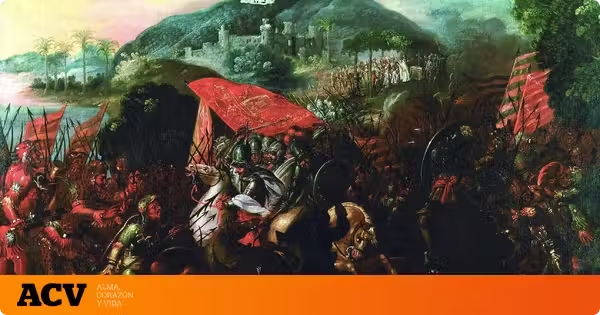
A recent historical account published on November 7, 2026, by El Confidencial titled 'Hernán Cortés, sin pólvora y rodeado de enemigos: La salvación vino del volcán' (Hernán Cortés, without gunpowder and surrounded by enemies: Salvation came from the volcano) examines a critical logistical episode during the Spanish conquest of the Aztec Empire. The narrative centers on the scarcity of gunpowder faced by Hernán Cortés' expedition and how this crisis was resolved through a dangerous mission to extract sulfur from a nearby volcano. [1]
Following their disembarkation near Cozumel and securing an alliance with the Tlaxcalans, who had long-standing conflicts with the Mexicas, Cortés' forces advanced toward Tenochtitlan. Despite resolving most skirmishes effectively, the expedition encountered a massive Mexica army approaching from the northwest. While the Mexica force numbered over 100,000 soldiers, their primary tactical method, known as 'War Flowers,' involved capturing opponents alive rather than killing them, which proved inefficient against the Spanish objective of decisive combat. The Spanish, relying heavily on arquebuses and light cannons (culebrinas), faced a critical shortage of gunpowder, their most effective deterrent in large-scale confrontations. [1]
The solution lay in obtaining sulfur, a key component of black powder mixed with pulverized coal and saltpeter. Located approximately 50 kilometers from Tlaxcala and nearly 5,400 meters high, a massive volcano stood as a geographic barrier and resource reservoir. Recognizing the strategic necessity, five volunteers, led by Francisco Montano, a skeptic who carried a crucifix to protect himself from the Inquisition, agreed to undertake a perilous mission to climb the volcano and gather the needed material. [1]
According to Francisco González de Salazar, a chronicler of the expedition, the volunteers established relay stations on the volcano's slopes, supported by indigenous carriers. Over the course of fourteen trips, Montano and his four companions hauled sulfur down from the summit. Each man transported approximately 30 kilograms of high-quality sulfur per trip, accumulating more than 400 kilograms in total. The physical toll was severe, likely requiring hyperventilation adjustments due to the thin air at high altitudes, but the group succeeded in bringing back what the author describes as 'apocalyptic' reinforcements. [1]
This influx of gunpowder supply allowed Cortés' forces, bolstered by roughly 1600 Spaniards and 12,000 Tlaxcalcan allies, to maintain their initiative against the superior numbers of the Mexica army. The article argues that this logistical victory was pivotal in enabling the Spanish to prevail in what it terms the most brutal battle of the long conflict. The success at Otumba and subsequent engagements are attributed by the author in part to this 'precious manna' that activated the Spanish military technology without which the conquest might have ended differently. [1]
- Categories:
- History
- Entities: