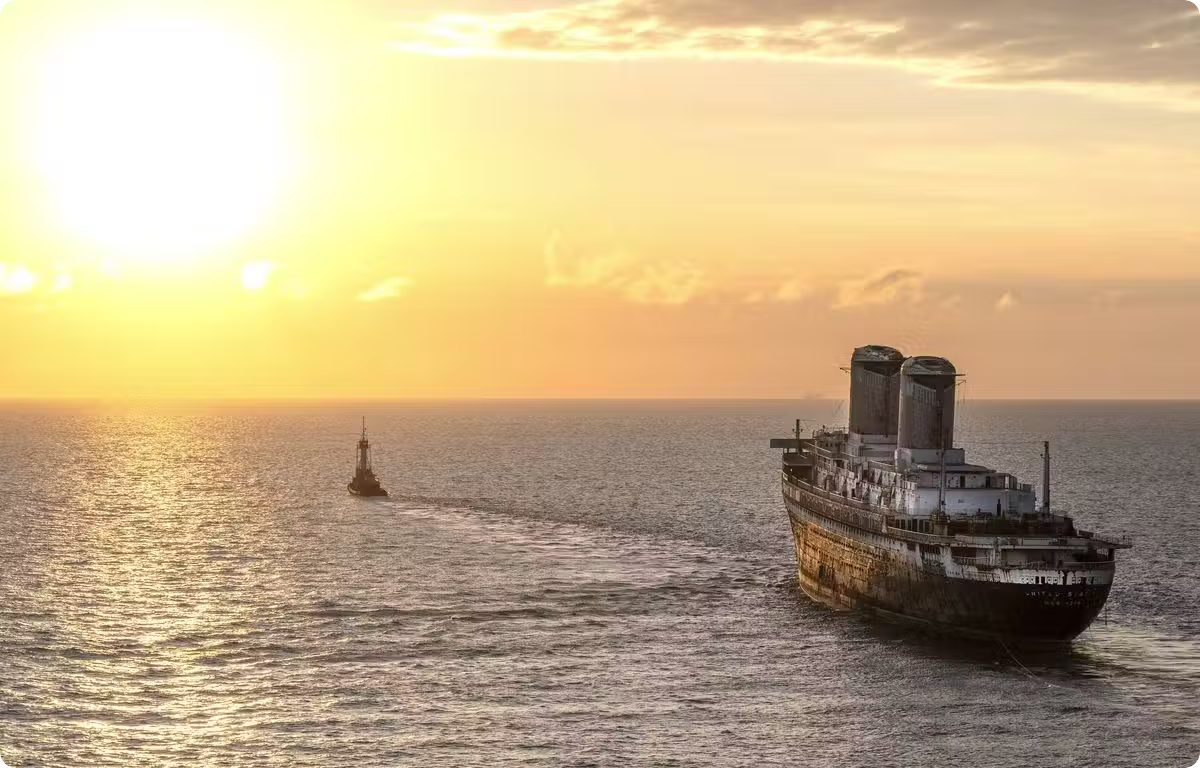
The SS United States, a monumental vessel exceeding 300 meters in length, has begun a new chapter as the world's largest submerged artificial reef. On Wednesday, the historic ocean liner was intentionally sunk off the coast of Florida, providing a permanent habitat for marine life and a premier destination for scuba divers. The decision to sink the ship followed decades of decline after the vessel, which once carried four U.S. presidents and legendary icons such as Marilyn Monroe, Marlon Brando, and Walt Disney, spent nearly thirty years moored in the port of Philadelphia, Pennsylvania [sursa:E1043159].
Renowned as the largest ocean liner ever constructed by the United States and remaining the fastest to this day—having completed a transatlantic crossing in three days, 10 hours, and 40 minutes—the SS United States performed over 800 Atlantic crossings during the 1950s and 1960s [sursa:E1043159]. Jennifer Adams, the Director of Tourism for Okaloosa County, explained that sinking the vessel was the only viable alternative to dismantling it for scrap metal, noting that projects to convert the ship into a hotel had failed [sursa:E1043159]. Adams emphasized that the wreck was entirely depolluted before being submerged to ensure environmental safety [sursa:E1043159].
The creation of this reef is part of a broader regional strategy in the Gulf of Mexico to stimulate biodiversity and revitalize tourism, which suffered a severe blow following the 2010 Deepwater Horizon oil spill that released approximately five million barrels of oil into the waters [sursa:E1043159]. Okaloosa County has transformed its sandy seabed into one of the region's most extensive artificial reef systems, now boasting more than 500 identified submerged sites [sursa:E1043159]. According to Adams, marine species such as fish and turtles typically begin colonizing such structures within twenty-four hours of immersion [sursa:E1043159].
Similar practices are employed further north in Delaware, where the state has spent over twenty years building a 'great barrier of scrap' in the Atlantic [sursa:E1043159]. Under the supervision of Colt Williamson, a scientist from the Delaware Department of Natural Resources and Environmental Control (DNREC), the state has sunk more than 1,000 New York City subway cars, roughly thirty ships, and nearly one hundred military tanks [sursa:E1043159]. To supplement these structures, Delaware has also deployed two million tons of rock and 100,000 tons of concrete [sursa:E1043159].
From a biological perspective, DNREC reports that these artificial structures attract a rich variety of invertebrates, including blue mussels and oysters [sursa:E1043159]. Scientists indicate that food is up to 400 times more abundant on these wrecks than on natural sandy bottoms, attracting species such as bass, flounder, and tautogue [sursa:E1043159]. These three-dimensional structures provide critical shelter for fish against predators, tides, and storms [sursa:E1043159].
However, the practice has faced strong opposition from environmental organizations. Jacky Bonnemais, founder of the NGO Robin des Bois, has warned about the presence of zinc chromate coating on the hull of the SS United States. He argues that this coating, designed for speed, may prevent the colonization of the hull by algae and shellfish while being recognized as a carcinogen banned in metal treatment [sursa:E1043159]. Additionally, the NGO expressed concerns regarding residual asbestos, which could clog the gills of fish and damage the lungs of marine mammals [sursa:E1043159]. Bonnemais contends that the decision to sink the vessel was driven by the diving lobby for commercial tourism rather than ecological necessity [sursa:E1043159]. Despite these warnings and various legal challenges, the project proceeded, with Okaloosa County confirming that the SS United States wreck would be open for business starting the following weekend [sursa:E1043159].
- Categories:
- Environment
- Entities: