The ongoing war in Ukraine has fundamentally altered the ecological and security landscape of the Black Sea, turning it into what is described as the world’s deadliest shipping lane. According to a recent Financial Times assessment, the region has seen 570 attacks on vessels since the beginning of the year, resulting in at least 40 fatalities. This toll exceeds that of other major maritime chokepoints, such as the Strait of Hormuz, where 24 deaths have been recorded. The escalating violence extends beyond high-seas collisions, directly impacting coastal regions of Romania, including the city of Constanta, where environmental monitoring operations face severe restrictions due to proximity to conflict zones.
In Constanta, the non-governmental organization Mare Nostrum, active in biodiversity protection since 1994, has encountered unprecedented challenges in conducting its annual waste collection and monitoring missions. Located just kilometers from the port where a cargo ship was struck by a drone in late October—an attack blamed on Russia that left one person dead and three missing—the NGO’s operational perimeter is now deemed too hazardous. Subsequent attacks on container ships traveling toward Romania further underscore the instability of the waters. As a result, Marian Paiu, director general of Mare Nostrum, stated that territorial waters are no longer considered safe for scientific data collection in certain sectors.
Before the conflict, Mare Nostrum teams routinely traveled to the Sulina area, near the Ukrainian border, collecting samples from floating structures. However, the lack of ports between Navodari and Sulina previously required two-night stays at sea, a risk now deemed unacceptable. 'Being out at sea, in total darkness, without knowing what might emerge—such as drones or drifting mines—has become impossible,' said Paiu. The security situation has effectively halted scientific exploration in sensitive ecological zones, forcing the NGO to pause critical assessments of how the war affects local biodiversity.
Despite these limitations, researchers continue to monitor marine life strandings along the Romanian coast. Since the start of the year, 170 cetacean beachings have been recorded, the highest number since 2010 and comparable to the spike observed at the onset of the war in 2022. The Black Sea hosts three species of dolphins: the harbor porpoise (Phocoena phocoena), the common bottlenose dolphin (Tursiops truncatus), and the Black Sea common dolphin (Delphinus delphis ponticus). While alarming, Paiu cautioned against prematurely linking these deaths to military activities, noting that proof would require analyzing chemical substance levels in seawater or examining internal organs within 24 hours of death.
One leading hypothesis involves underwater noise pollution. Military use of sonar can disorient cetaceans, potentially causing starvation or driving them toward fatal outcomes. Verification of this theory would require immediate post-mortem analysis of the inner ear, a procedure difficult to execute given that most washed-up animals are found in advanced states of decomposition. Mare Nostrum lacks the financial resources to conduct such specialized examinations, operating on an annual budget of only 1,000 euros for cetacean intervention despite handling dozens or hundreds of cases.
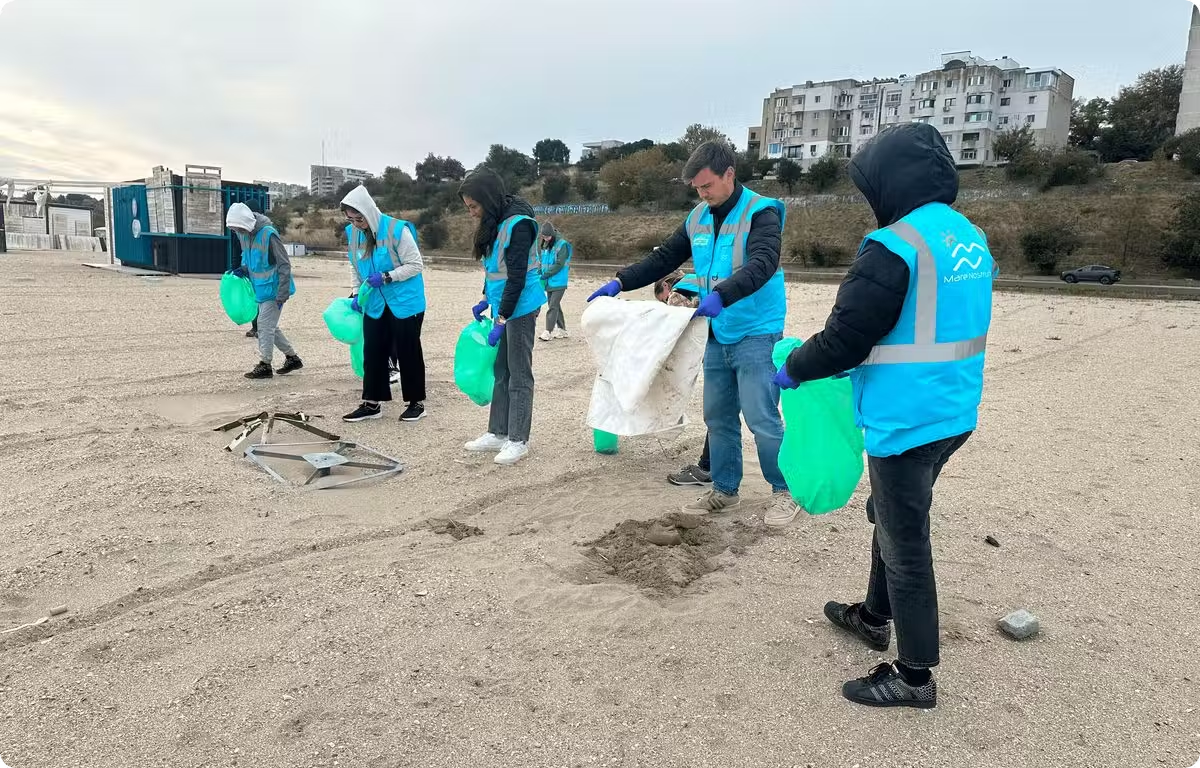
Constrained by security risks and limited funding, Mare Nostrum has focused its efforts on shoreline cleanup, gathering debris larger than 2.5 cm for office-based analysis. The team reported finding what they believe to be drone fragments, though military debris is handled exclusively by the Romanian army, keeping civil society at a distance. Meanwhile, an increase in stranded grain cargoes serves as indirect evidence of Ukrainian grain shipments navigating perilous routes. Local pollution remains a primary concern, with cigarette butts being the top waste item—over 6,000 collected in a single session—followed by plastic straws, bottle caps, and wipes. Occasional large items, such as refrigerators, cow carcasses, and old mattresses, also surface.
Despite the challenging environment, Marian Paiu highlighted the success of long-term awareness campaigns. In 2014, cleanup sessions yielded two cubic meters of waste per car trunk; today, volumes hover around half a cubic meter. As afternoon ended, the Constanta beach was cleared, leaving behind only scenic debris like a wooden chair facing the waves, preserved for aesthetic value. The contrast between the serene coastal image and the invisible naval patrols in the horizon underscores the dual reality of Romania’s Black Sea coastline: a region fighting to protect its ecology while caught in the crossfire of geopolitical conflict.
- Categories:
- Environment
- Entities: