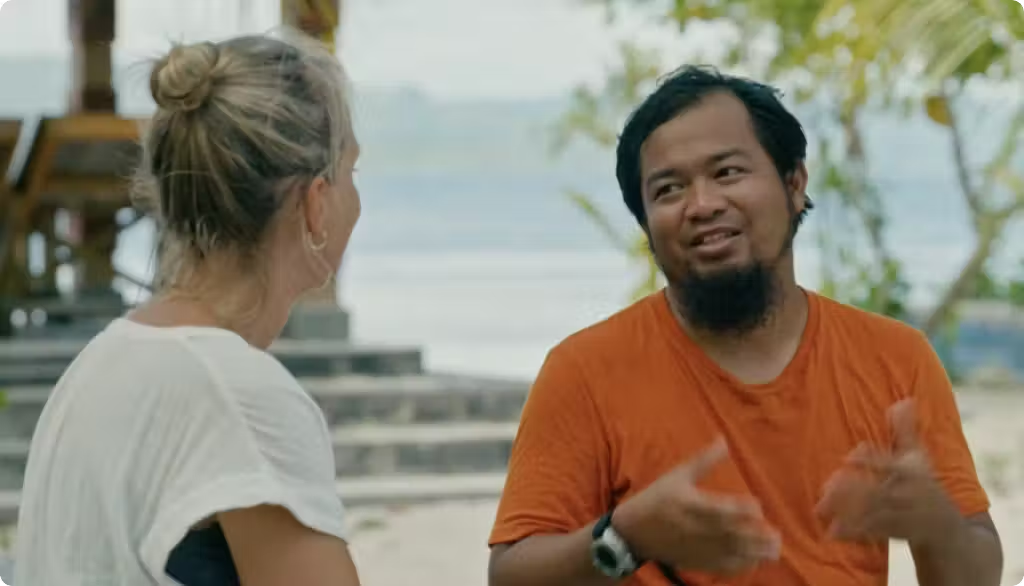
In the remote archipelago of Raja Ampat, located in western Indonesia, marine biologist Edy has dedicated his life to the study and protection of giant manta rays. His story is currently being brought to a wider audience through the Dutch television series 'Floortje over de Oceaan' (Floortje Across the Ocean), hosted by journalist Floortje Dessing. The series captures the intersection of scientific research and deep personal commitment in one of the world's most biodiverse marine environments. [1]
Edy operates from the small island of Arborek, where he has focused his efforts for approximately twenty years. His mission is clear: to research, monitor, and ensure the survival of the giant manta ray population in the region. The relationship between the local community and these magnificent creatures is profound. The animals are so integral to the island's identity that homes are frequently decorated with manta-themed art. According to Edy, the bond starts early, with children as young as five years old often swimming alongside the rays. [1]
The biological reality of the giant manta ray underscores the urgency of Edy's work. These creatures can reach a wingspan of five to seven meters and possess a unique physiological need: they must keep swimming constantly to breathe. Despite their majestic nature, the global population of manta rays is in decline. Threats include entanglement in fishing nets and hunting driven by misconceptions in traditional medicine, particularly in China, where it is wrongly believed that their gills possess healing properties. To combat these threats, Edy and his team engage in rigorous fieldwork to maintain the highest possible population levels. [1]
A key component of their research involves tracking the movements and behaviors of individual manta rays. In a recent segment featuring Floortje Dessing, Edy demonstrates the process of tagging a young manta. Using a spear, he attaches a satellite transmitter to the animal. Edy explains that while the process is not entirely painless, it is not harmful and serves as a necessary trade-off for the valuable data it yields. This data allows researchers to track how far and how deep the mantas swim, providing critical insights needed for effective conservation strategies. [1]
Beyond the technical aspects of conservation, Edy's work is deeply rooted in personal history and sacrifice. Raised in a poor family, higher education was not a given for him. It was only through the help of his brother and the steadfast support of his parents that he was able to pursue his studies. He is now officially a doctor and the first person in his family to complete such an education. He attributes much of his success to his family, stating, 'Without her [his mother], I would never have made it.' [1]
The cost of this dedication has been high. When discussing his family, Edy becomes visibly emotional. He reveals that he sacrificed significant time with his relatives to stay in Raja Ampat for his work. Tragically, his mother passed away while he was on the island, unable to be there for her final moments. The regret remains palpable, though Dessing offers comfort, suggesting that his mother would undoubtedly have been proud of his accomplishments. For Edy, the work has become a way to honor his family’s support and overcome the challenges of his upbringing. [1]
The episode also showcases the interaction between humans and mantas at cleaning stations, where smaller fish remove bacteria and dirt from the giants' skin. The team uses photography to monitor the health and population status of the rays at these sites. Edy’s connection to the animals is described as profound; he visibly thrives when swimming with them. This deep bond fuels his determination to protect a species that faces persistent threats despite its ecological importance. 'Floortje over de Oceaan' airs every Tuesday at 20:40 on NPO 1, offering viewers a glimpse into this vital conservation effort. [1]
- Categories:
- Environment
- Entities: