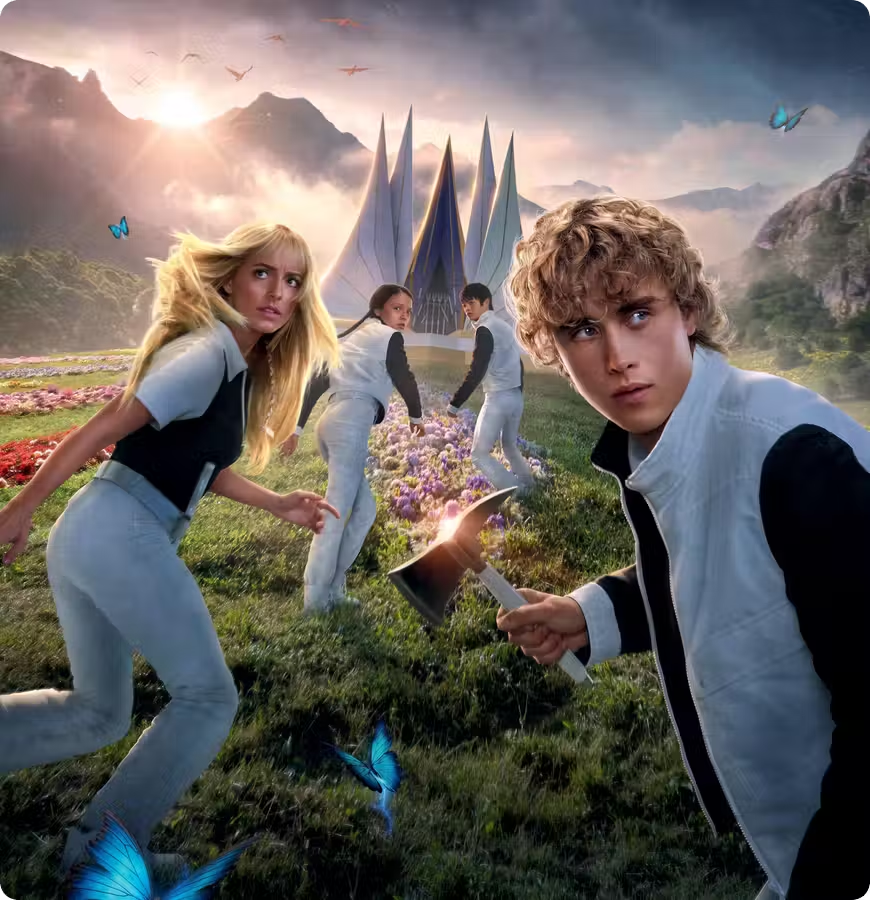
A few days before the scheduled world premiere on November 20, 2026, a review published in *Evi Mag* magazine offers a nuanced evaluation of the film 'Sunrise on the Reaping'. Although the reviewer identifies as a long-time fan of the franchise, stating that they have read the novel 'Sunrise on the Reaping' twice and watched the original trilogy in school, the final verdict is one of moderate appreciation, accompanied by sharp criticisms regarding how Hollywood adapted the source material for the screen. The reviewer concludes that while the film is not bad and features remarkable action performances, it 'loses its power' during the adaptation process, being 'diluted' and underestimating the audience's intelligence. [1]
One of the strongest criticisms addresses the portrayal of violence in the arena. While the book describes the death of the tribute Ampert as brutal and macabre—he was eaten to the bones by mutant squirrels—in the film, his corpse appears with minor injuries, which the reviewer considers 'adequately covered by a few plasters.' A similar problem is identified with the death of Louella, who is pulled by an overturned cart, but whose injuries do not seem to correspond to the intensity of the described impact, and with the death of Maysilee, attacked by pink birds, where the dried blood on her neck does not suggest an evident fatality. The reviewer argues that the franchise has already proven it can depict the deaths of children without resorting to typical graphic horrors of the genre, referencing the bodies lying on the ground in the first 'The Hunger Games' film or the brutality depicted in 'The Ballad of Songbirds & Snakes'. [1]
The crisis of emotion and depth is exacerbated by how relationships between characters are handled. The reviewer highlights a scene from the book in which Haymitch, Welly, and Silka share chocolate under a tree, a moment that underscores the humanity of the tributes, transforming them from competitors into fearful children who wish to return home. In the film, this development is rushed, leading to the misinterpretation of interactions between Haymitch and Maysilee as romantic, whereas in the literary source, the relationship was one of emotional siblinghood, explicitly described by Haymitch as 'not lover or friend, but sister.' Perspectives on resistance and the central theme of revolution, built upon small acts of individual defiance (such as Lenore Dove Baird's posters), are also eliminated or reduced, although visual elements of these posters were present in the official trailer. [1]
Another significant criticism concerns the narrative style and trust in the audience. The author of the review accuses the film of tending to 'underestimate the audience,' explicitly explaining the motives and plans of the main antagonist, Snow. Compared to the subtlety of the book, where Snow's threats were suggestive, in the film he 'announces his plans' openly, and moments of revelation (such as Snow's order to activate the volcano as punishment) are presented in too explicit a manner, which goes against the franchise's themes about propaganda and media manipulation. Furthermore, Snow's direct discussion of his past with Lucy Gray Baird is considered inappropriate and out of character, as Snow is a person who buries his passions and memories. [1]
Despite these substantial criticisms regarding the script and direction, the review praises the actors' performances. Joseph Zada, in the role of Haymitch, is described as the 'beacon' of the interpretation, bringing devastating emotional depth, especially in moments of reaction following the deaths of his colleagues. Elle Fanning, in the role of Effie Trinket, is applauded for her energy and natural continuity with the portrait made by Elizabeth Banks, while Jesse Plemons is considered perfect in the role of Plutarch. However, Kieran Culkin, in the role of Caesar Flickerman, fails to reproduce the atmosphere of 'oppressive sweetness' and artificiality of Stanley Tucci, being perceived more as a hyperactive sarcastic, far from the initial subtle terror. The aesthetic of the Capitol is criticized for the fact that, although it draws inspiration from the '70s, it does not sufficiently exploit the eccentric fashion and striking hairstyles, usually attributed to Capitol professionals. [1]