Automated license plate readers (ALPRs), once a niche tool for counter-terrorism efforts in the United Kingdom in the 1970s, have evolved into a ubiquitous component of American law enforcement infrastructure. Today, companies like Flock Safety leverage these high-speed camera systems to capture and store data on millions of vehicles daily, raising profound questions about privacy, surveillance scale, and governmental accountability. As of late 2026, Flock Safety remains the dominant vendor in this sector, with its network of cameras estimated to have assisted in more than one million law enforcement investigations in 2025 alone. However, this rapid expansion has coincided with documented cases of abuse, prompting renewed scrutiny from policymakers, civil liberties advocates, and the public. [1]
Flock Safety, founded in 2017, operates a vast network of ALPRs deployed across communities in the United States. The company itself claims to have over 120,000 cameras installed in approximately 6,000 communities as of August 2026. Independent analysis using data from OpenStreetMap, a crowdsourced mapping project, identifies roughly 110,000 Flock cameras, accounting for about 80% of all recorded ALPRs on the platform. It is important to note that OpenStreetMap relies on volunteer contributions rather than official government inventories, meaning these figures represent a lower bound; the actual number of devices in operation is likely higher. [1]
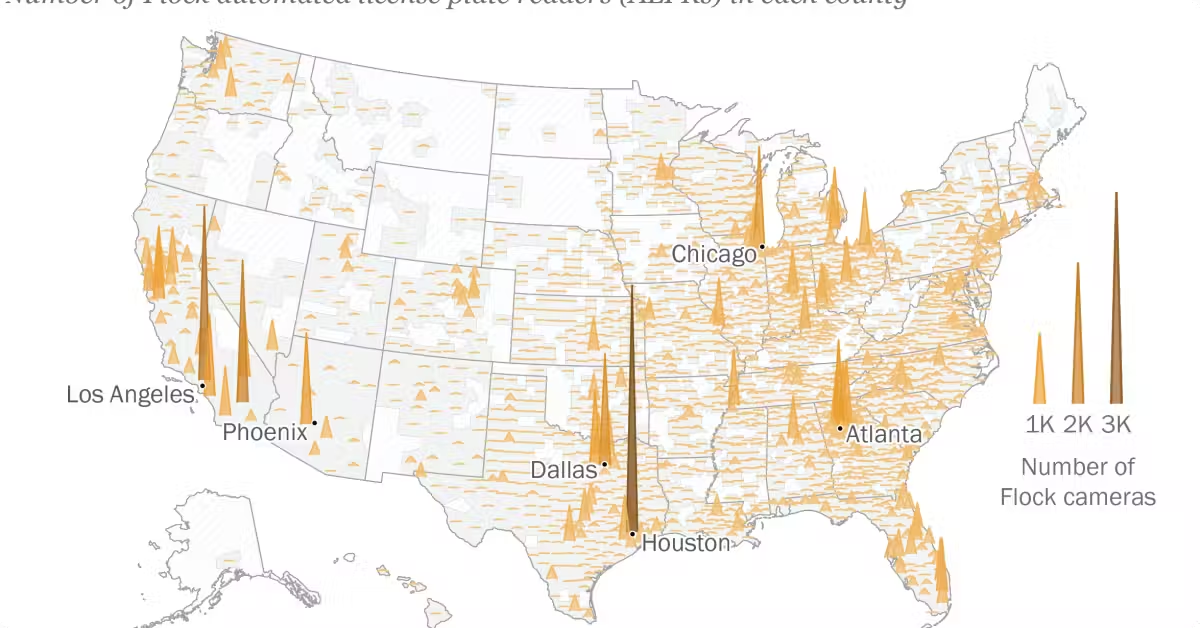
The geographic distribution of these cameras reveals a heavy concentration in specific states and urban centers. Half of all identified Flock cameras are located in just five states: California, Texas, Georgia, Florida, and Ohio, which collectively account for 49% of the total. When adjusted for population, Georgia leads with over 80,000 cameras per 100,000 residents, followed by Ohio and Texas. Urban areas show even denser deployments; the Atlanta and Houston metropolitan areas each host more than 4,000 Flock cameras, while Los Angeles, Chicago, and Dallas-Fort Worth each have more than 3,000. Roughly 80% of all Flock cameras are situated in urban environments. [1]
Beyond sheer numbers, the demographic profile of areas covered by Flock cameras has drawn attention. Analysis indicates that Flock cameras are slightly more prevalent in lower-income neighborhoods compared to higher-income ones, although the disparity is described as modest. These cameras operate across communities with diverse income levels and racial compositions, reflecting a broad, albeit imperfectly equitable, rollout of surveillance technology. [1]
Despite the extensive presence of these devices, transparency regarding their operation remains inconsistent. Only about 12% of the mapped cameras have publicly identifiable owners or operators on OpenStreetMap, and among those, most are operated by law enforcement agencies. Understanding actual usage requires looking at Flock’s 'transparency portals,' opt-in platforms where agencies share data on their practices. An independent watchdog group, EyesOnFlock, tracks these portals and reported that as of September 2026, 1,517 agencies maintained active pages. These agencies collectively listed 39,465 cameras—just 36% of the total identified on OpenStreetMap. Disclosure rates vary wildly by state; in California and Virginia, transparency portal data closely matches OpenStreetMap counts, whereas in Florida and Pennsylvania, less than 10% of cameras are accounted for in these portals. [1]
Among agencies that do utilize transparency portals, there is significant variation in what data they choose to disclose. Ninety-six percent disclose data retention periods, and 93% state their total camera counts. However, fewer than half provide information about individual searches, and only two-thirds disclose whether they share data with other organizations. The median agency retains data for 30 days—a period Flock reduced to seven days in August 2026—and shares information with a median of 217 other organizations, predominantly other law enforcement entities. While some states like California impose restrictions on cross-border data sharing, states like Florida and Ohio allow relatively unrestricted sharing across jurisdictional lines. [1]
The operational scale of searches conducted using Flock technology is staggering. A USA Today investigation obtained raw search logs from 120 agencies across 24 states, covering a three-and-a-half-year period. The data revealed that over 200,000 users conducted 75 million searches, encompassing nearly four million unique license plates—an average of 59,000 searches per day. Often, the justification for these searches was broadly categorized simply as 'investigation.' In response to concerns about vague queries, Flock has introduced a drop-down menu for search reasons and mandated that non-emergency searches include a case number by the end of 2026. [1]
The rapid proliferation of ALPRs has not gone unnoticed by regulators. There have been documented abuses of Flock’s technology, including multiple investigations into stalking and misconduct by law enforcement officers. These incidents have fueled legislative efforts to tighten regulations or even ban certain types of ALPR usage. Lawmakers in Congress have introduced bills aimed at establishing stricter safeguards for AI-powered cameras and protecting Americans from unchecked surveillance. As the technology continues to evolve and embed itself deeper into public safety infrastructure, the balance between security benefits and privacy rights remains a contentious and unresolved debate. [1]
- Categories:
- Technology