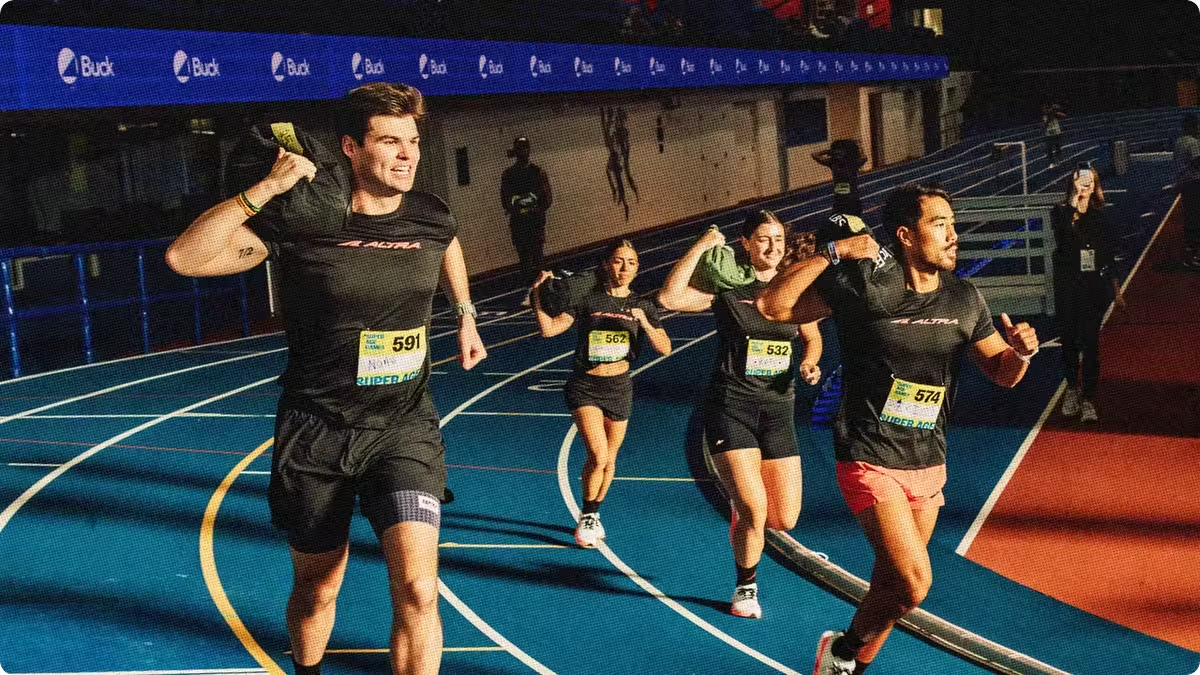
The inaugural Super Age Games were held on November 7th at the Armory Track in Washington Heights, New York. Organizers reported 530 athletes from 42 states and 15 countries, with about 70% of participants aged between 40 and 64. The competition featured eight trials intended to assess abilities associated with healthy aging, developed with input from researchers at the Buck Institute for Research on Aging in Novato, California.
Trials were designed around specific longevity markers such as functional strength, aerobic capacity, balance and cognitive skill. Examples include the Over Under agility test, which measures speed of changing levels and direction, and Synapse, a screen-based task where participants track moving balls and identify them after shuffling to gauge cognitive processing.
Unlike continuous-race formats such as Hyrox, the Super Age Games allows competitors to rest as long as they need between trials. Fitness program director Junior Kennedy said the approach is intentional: there is no rush and the goal is to get through each event as intentionally as possible to understand recovery.
The name references the longevity concept of a super ager, originally coined by Northwestern University researchers to describe adults over 80 whose memories rival those of people 30 years younger. The Games use the term more broadly to describe people who defy typical trajectories of cognitive and physical aging.
Founder David Stewart, media founder behind AGEIST and Super Age platforms, launched the event as a low-key counterpoint to extreme athletic challenges, emphasizing longevity metrics that are increasingly tracked by consumer devices such as Whoop and Apple Watch for VO2max, heart rate variability and resting heart rate.
Participants receive age-adjusted rankings and a Super Age score that compares physical fitness to the general U.S. population. The event drew a middle-aged crowd, with the youngest competitor reported at 21, reflecting an audience interested in measuring aging rather than purely maximal performance.
The competition included trials such as cargo net crawling, dead hang, assault bike VO2max test known as Inferno, and Tightrope, a balance challenge requiring walking a low beam while carrying a water-filled bag for as many consecutive steps as possible in two minutes.
As the story develops
Update
Super Age Games inaugural event tests longevity markers in athletes across age groups
At the first edition of the Super Age Games hundreds of people participated, including people aged 80 [2]
It doesn’t matter who arrives first, but how well you age: the unique competition in New York Photo source: Instagram screenshot / joinsuperage According to USA Today and the event’s website. The aim was not to establish an absolute winner, but to provide individual results that show what physical and cognitive abilities can be improved. [2]
Super Age Games: eight tests for assessing longevity The eight tests evaluated abilities such as: cardiovascular endurance and VO2 max; grip strength and muscle endurance; balance and stability; agility and coordination; functional strength; endurance to effort; working memory and cognitive capacity; ability to connect and relate to others. Participants had to complete tests including fitness bike, balance exercises, bar hanging and facial expression recognition. “The Super Age Games bring together all the healthspan indicators that matter in one place, in one day, so people can really see where they stand,” explained Dr. Eric Verdin, CEO of the Buck Institute, the first biomedical research institution in the world dedicated exclusively to increasing human healthspan. [2]
The Super Age Games event took place on 7 November 2026 at The Armory in New York [2]
At 80 years old, participants test their limits Among the participants was 80-year-old May McDaniel, who has maintained physical activity throughout her life. She practiced tennis, running, diving and sailing, and at 71 she walked the Appalachian Trail alone. After a period in which her physical activity decreased, the Super Age Games became a reason to return to training. “It became fun, even though it was exhausting,” McDaniel recounted. Another participant, Richard Graham, also aged 80, began to change his lifestyle after his wife was diagnosed with Parkinson’s disease. He wanted to be healthy enough to be there for her. “At 80, it is a blessing to be alive, fit and agile,” he said. Physical activity should not be seen only as a concern of youth. Maintaining strength, mobility and independence remains important at advanced ages. [2]
“The Games are not just about adding years to your life – they are about adding life to your years: more time to travel, to play with your children, to do what you love. It is worth training for that,” says Super Age founder David Harry Stewart. VO2 max and balance: what they can say about healthy aging One of the indicators tested at the competition was VO2 max, which measures the maximum amount of oxygen the body can use during intense effort. It is associated with cardiovascular health and exercise capacity. Researcher John Beard, aging specialist at Columbia University, however warns that results should not be interpreted simplistically. Analyzing research on VO2 max and longevity, he observed that achieving very high levels may require a considerable amount of training. His conclusion is that not everyone needs to spend hours in the gym to age healthily. “For most of us, we just need to stay active, have a healthy diet, not smoke and not drink too much,” Beard explained. Moreover, the tests at the Super Age Games are not an instrument that can predict with certainty how many years a person will live. They rather provide a picture of some capacities relevant to long-term health. [2]
Longevity is not just about living longer, but staying independent The Super Age Games bring to the forefront an important change in how longevity is viewed: the focus shifts from the number of years lived to the number of years in which a person can maintain autonomy and quality of life. Muscle strength, balance, cardiovascular capacity and cognitive health are important components of this perspective. The message of the competition is that preparation for healthy old age does not begin at 70 or 80 years. Constant movement and healthy habits can matter at any age. Subscribe to ȘTIRILE ZILEI to stay up to date with the latest information. SUBSCRIBE [2]
- Categories:
- Sport
- Entities: