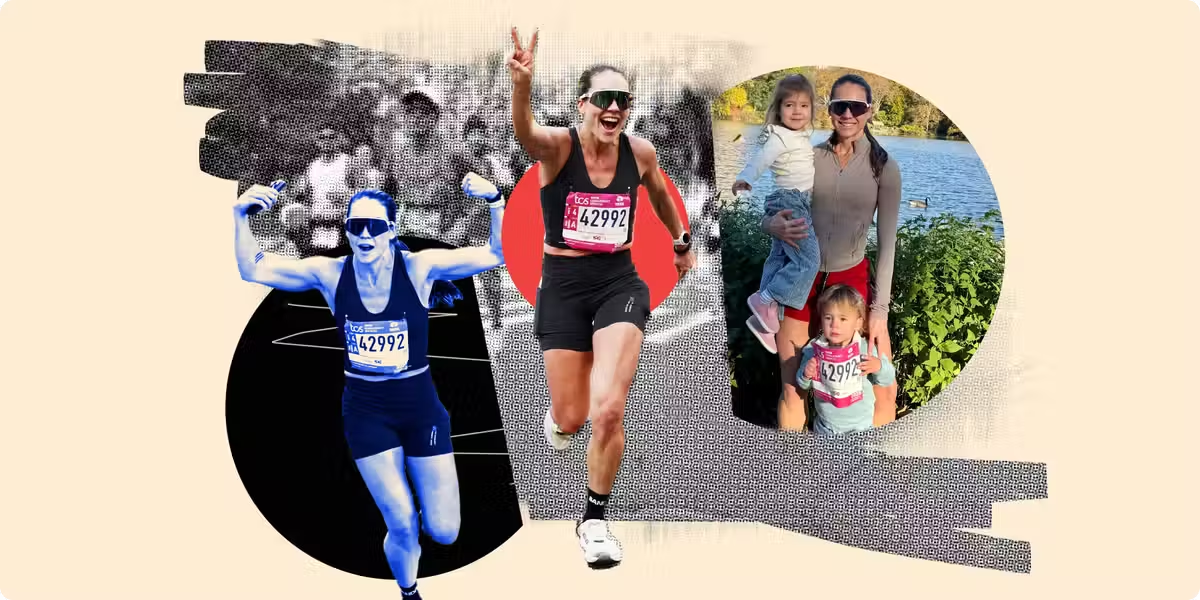
Laurel Skansi, founder of the fitness app Ladder and coach of the 'Team Body and Bell' team, participated in the New York City Marathon, describing the experience as one of personal transformation despite significant challenges. Skansi, who lives in Colorado, acknowledged that she had initially not planned to run a marathon, given the logistical difficulties of traveling such a long distance, as well as the challenging nature of the NYC Marathon route, known for its hills and constant bridges. The personal context includes a busy mother with two young children (3.5 and 2 years old), a full-time job, and sinus surgery she underwent six months prior. Registration for the race was motivated by the desire to choose her own 'hard' while facing unpredictable stressors from motherhood. [1]
The training process lasted three months and was supervised by a specialized coach, a member of her team with extensive experience at the NYC Marathon. Although training conditions were not perfect, influenced by family vacations, children's illnesses, and increasing professional demands, Skansi managed to accumulate the necessary kilometers, guided by the principle that performance must be consistent, not necessarily perfect. She described endurance as a new discipline, stepping out of the comfort zone of speed, strength, and power sports typical of her previous profile. Training provided a mental space for healing and autonomy, facilitating a deeper connection with herself and, paradoxically, greater availability towards her family. [1]
At the start of the marathon, Skansi realized she was sick, dealing with flu symptoms that were initially attributed to exhaustion and disorientation caused by travel. Full-body pain and chills appeared at approximately mile 6, in the Brooklyn area, forcing her to isolate from the crowd and avoid wearing music headphones to listen to the atmosphere. However, she managed to continue, reaching mile 17 near the Queensboro Bridge, where her family waited. She took medication, received brief hugs, and resumed the race, focusing on incremental progress, mile by mile, nourishing correctly to avoid energy depletion ('bonking'). The climb up Fifth Avenue towards Central Park at mile 22 marked a mental turning point, defined by a combination of adrenaline and gratitude for her body's ability to continue. [1]
The final stages of the race were marked by a subtle disappointment, not related to finishing time but to the sudden end of an experience that consumed months of effort and mental focus. Skansi's final reflection emphasizes that the marathon functions as a great equalizer and humanizer, regardless of performance level or speed. The 26.2-mile distance requires a complex strategy of hydration, salt intake, and carbohydrates, subjecting the body to extreme physical stress. The diversity of participants—from professional athletes to people with disabilities, nursing mothers, or individuals undergoing drastic weight changes—transforms the race into a spectacle of resilience and global solidarity. [1]
The central message of the article is that there is no perfect moment to start a major challenge; waiting for perfection is a perpetual trap. For busy mothers and ordinary people, signing up for a marathon is presented as a necessary act of self-affirmation to discover hidden inner potential. The 26.2-mile race functions as a test of character, forcing the participant to surrender to each mile in order to transform. Skansi concludes by emphasizing that the example set for her children—perseverance in the face of difficulties and pursuing personal desires, even when conditions are not favorable—represents the valuable legacy of a mother who 'chooses her own hard' and demonstrates her resilience every day. [1]
- Categories:
- Sport