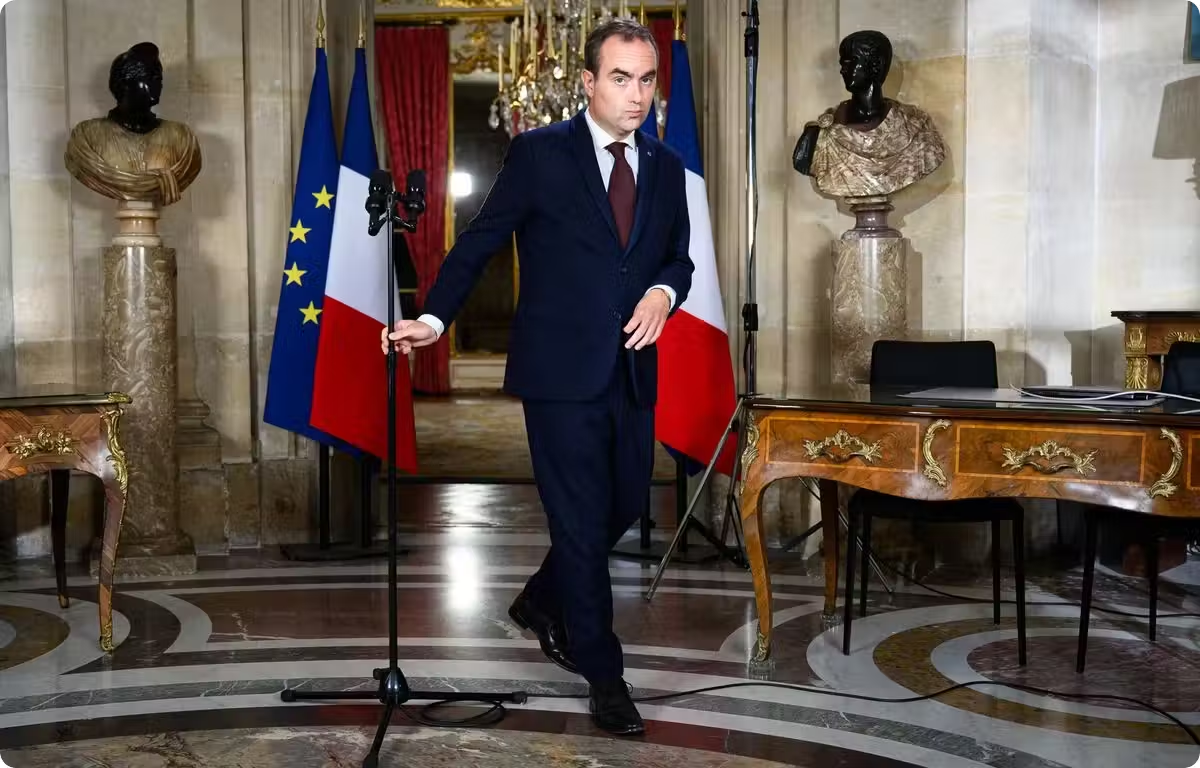
French Prime Minister Sébastien Lecornu announced on Friday that he is opening a rapid, one-month dialogue with public sector unions following a meeting at Matignon. The discussions will cover five key areas, including emergency measures to raise low wages, structural reforms to salary grids, pay equality between women and men, the covering of certain transport costs, and enhanced protection for agents who are injured or threatened, as well as the protection of civil servant neutrality. Lecornu stated on social media platform X that he will meet with union representatives again on December 11, after professional elections in the public service, aiming to seal progress by mid-December. [2] [3]
The announcement came as Prime Minister Lecornu received eight representative union organizations, including the CGT’s secretary-general, Sophie Binet, and the CFDT. The request for such a high-level meeting by the representatives of the 5.8 million public agents had long remained a dead letter but finally materialized after weeks of escalating social anger. Union leaders expressed frustration with the government's initial proposals. Sophie Binet, speaking on behalf of the inter-syndical committee which is calling for a strike on Tuesday, November 17, criticized the Prime Minister's announcements as being completely out of step with the urgency of the situation for public servants. She argued that by refusing to unfreeze the value of the index point, the government was failing to provide a structural response to wage urgency, career stagnation, and the attractiveness crisis within the public service. [2] [3]
The CFDT also denounced the government's position, stating that it continued to refuse unlocking budgetary means adequate to address the continuous loss of purchasing power for agents. The union highlighted that hundreds of thousands of agents would see their base salaries remain below the French minimum wage (Smic), describing the proposals as lacking real advancement. Despite these criticisms, the CFDT announced it would join the call for a strike and mobilization in the public sector on Tuesday, November 17, following the meeting at Matignon where the government signaled the opening of discussions on low wages. [2] [3]
Amidst these negotiations, tensions remain high around the education sector, where students have been mobilizing for nearly two months. Recent incidents included mortar launches in several high schools, causing injuries, and voluntary fires set with trash cans inside buildings in Montpellier. In the Île-de-France region alone, thirty mortar launches were recorded on Thursday, with more than ten occurring indoors, resulting in five injuries. High schools in Cugnaux and Toulouse were closed for the day due to similar incidents, leading to six arrests and three injuries. Similar scenes were reported in Pessac, Nantes, and Clermont, where a student was placed in custody after igniting a mortar launch. [2] [3]
Education Minister Édouard Geffray responded to the intensifying violence by threatening criminal sanctions against those targeting education personnel. Stating that 'the Republic is not impunity,' Geffray emphasized that all necessary judicial or disciplinary decisions would be taken. However, union representatives condemned remarks by Prime Minister Lecornu regarding possible complicity of staff in the violence surrounding high schools. Sophie Vénétitay, secretary-general of the Snes-FSU, described the PM's declaration as a provocation that could only exacerbate tensions in an already critical situation. She noted that while procedures exist if colleagues are implicated, such accusations lack precise evidence and risk polarizing the environment further. [2] [3]
Internal conflicts within the teaching profession also surfaced, as exhausted principals called for a demonstration on Friday. Gérard Heinz, a principal from Cholet and member of the SNPDEN-Unsa executive board, criticized the violence faced by educators and urged a return to classes. Union leader Bruno Bobkiewicz highlighted that assemblies of management personnel across France, including in front of the Collège de France in Paris and the rectorate in Aix-en-Provence, represented an unusual display of professional distress. These representatives were scheduled to be received by the Ministry of Education later that day. [2] [3]
Beyond the immediate crisis at Matignon, broader social movements are coalescing. The Yellow Vests coordination, supported by youth organizations and other groups, organized a march between the Republic and Nation squares in Paris, authorized by the police prefecture. Meanwhile, Interior Minister Laurent Nuñez announced that approximately 70,000 police and gendarmes would be mobilized for the 'Act V' protests against the cost of living, planned for Saturday nationwide. Nuñez described the security deployment as mobile and reactive, designed to adapt to groups attempting to bypass law enforcement lines. Inflation in France stood at 3.4% year-on-year in October, driven largely by a 24.1% surge in energy prices, marking the fourth consecutive month of increases. [2] [3]
As the story develops
Update
French Government Tightens Sanctions Amid Public Sector Tensions and 'Act V' Protests
In response to intensifying violence, the French government requested on Friday that prefects and rectors strengthen and systematize disciplinary sanctions against students and National Education personnel involved in school blockades and vandalism 20 Minutes. Interior Minister Laurent Nuñez and Education Minister Édouard Geffray issued a telegram on Friday urging authorities to ensure a very early presence in front of establishments prone to blockades and to systematically arrest troublemakers 20 Minutes. [4]
Minister Nuñez noted on Friday that the situation for Saturday's protests was unusual because representative professional unions had not declared any official routes 20 Minutes. Nuñez expressed concern that the lack of declared routes meant processions would not be framed, leaving organization to student and high school unions who possess less experience and do not always declare their paths 20 Minutes. For the fifth consecutive Saturday, youth organizations and the 'Yellow Vests' coordination called for nationwide demonstrations against the high cost of living and study conditions in high schools and universities 20 Minutes. Between 30,000 and 60,000 protesters were expected in Paris for a single procession from Place de la République to Place de la Nation, with 50 to 60 parades anticipated across France TF1 Info. The 'Act V' mobilization combined several causes: the Yellow Vests' fight against the cost of living, youth demands for better education, the 'enfantiste' collective's protest against violence toward children and adolescents, and human rights organizations opposing a proposed law on the presumption of legitimate weapon use by security forces, which critics describe as a 'license to kill' TF1 Info. Additionally, climate march organizers from September 26 had also designated this date for demonstrations concerning the future of children TF1 Info. A collaborative map from the Yellow Vests coordination listed 164 demonstrations across the country as of Thursday morning TF1 Info. Minister Nuñez confirmed the security deployment of 70,000 personnel remained consistent with the levels seen since October 24 TF1 Info. Previous protests on the prior Saturday had drawn 146,000 people nationwide, including 46,000 in Paris, marking a decline compared to earlier mobilizations TF1 Info. [4] [5]
- Categories:
- Society
- Entities:
Sources
- 20 Minutes EN DIRECT Colère sociale : Avant la grève de mardi, Lecornu reçoit les syndicats de la fonction publique…
- 20 Minutes EN DIRECT Colère sociale : Lecornu annonce une discussion d'un mois avec les syndicats, notamment sur une « revalorisation des bas salaires »…
- 20 Minutes EN DIRECT Colère sociale : Lecornu annonce une discussion d'un mois avec le…
- 20 Minutes EN DIRECT Manifestation du 14 novembre : 70.000 policiers et gendarmes mobilisés pour l’acte V, jusqu’à 60.000 manifestants attendus à Paris…
- tf1info.fr EN DIRECT - Colère sociale : un acte V "contre la vie chère" ce samedi, 70.000 policiers et gendarmes mobilisés