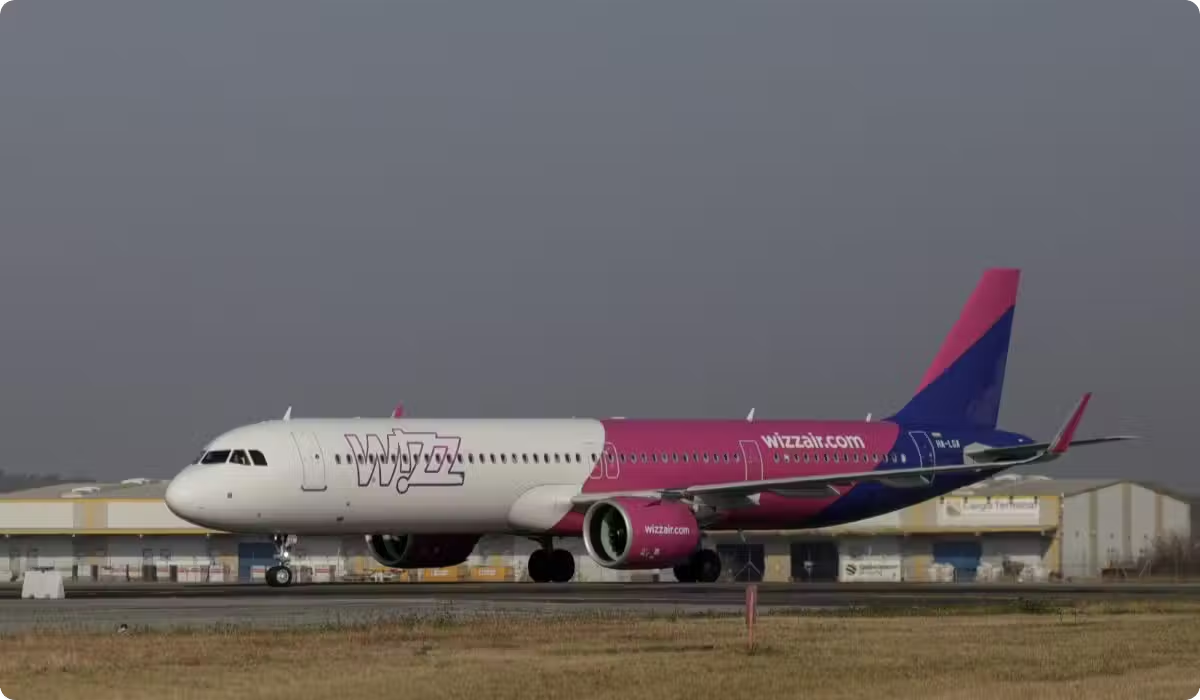
A crisis cell was activated at Henri Coandă International Airport after a Wizz Air aircraft, arriving from Milan and landing at 11:09, was reported with a bomb threat, according to the SRI. The 182 passengers and 7 crew members will be disembarked and brought into the terminal, followed by specific investigation procedures. The wave of bomb alerts targeting European flights also included diversions or forced landings of Air Lingus, Ryanair, and Finnair aircraft earlier in the day. [1]
As the story develops
Update
Massive bomb alert in Europe: Wizz Air, Ryanair, and Finnair flights diverted or forced to land
The SRI confirmed that the control tower of Henri Coandă International Airport in Bucharest was notified by the crew of the Wizz Air aircraft, originating from Milan and landing at 11:09, regarding a bomb threat. Airport representatives informed that air traffic continues to operate fully safely, according to the normal flight schedule, without further incidents. Among the incidents recorded throughout the day was the forced landing of an Air Lingus plane, which had departed from Dublin with the destination of Rome, at the Évreux military air base in France. The Wizz Air flight W4 6387 from Milan (Malpensa) to Warsaw was redirected to Vienna. A Finnair flight from Helsinki to Rome landed under the escort of Italian fighter jets after an explosive device was reported on board, but ground checks did not affect airport operations. The detailed list of affected planes includes, along with the previously mentioned flights, several Ryanair flights diverted to Sofia or Plovdiv (from Madrid, Copenhagen, and London), a LOT Polish Airlines flight diverted to Brussels, and that of Finnair from Helsinki to Rome. [3]
Update
Bomb alert at Otopeni and European panic: Diversions and emergency landings
On November 5, a series of aircraft operating flights in Europe were targeted by bomb threats, leading to diversions to other airports or emergency landings for some of them. The central incident occurred at Henri Coandă Airport in Bucharest, where a crisis cell was activated after the crew of a Wizz Air plane, originating from Milan, reported a potential explosion on board. Immediately after landing, SRI pyrotechnics began checks to determine if there was any real danger, guaranteeing the safety of passengers and ground staff. According to information confirmed by the SRI, the aircraft performed the landing maneuver at 11:09. On board were 182 passengers and seven crew members, who were immediately disembarked and led to the terminal area to be identified and secured, according to anti-terrorism protocols. Representatives of Henri Coandă International Airport made clarifications public regarding the impact on local infrastructure, stating that air traffic continues to operate in conditions of maximum safety and that the rest of the flights progressed according to the normal schedule. The alerts concerned a significant number of airlines and European routes, creating a complex situation managed simultaneously by multiple civil aviation authorities. Details regarding the scale of the incident are supported by a list published by The Guardian, which enumerates the numerous flights that were marked with the red light of an explosive threat on board. In France, an Aer Lingus Airbus A320, which had departed from Dublin with the destination of Rome, was urgently diverted to the Évreux military air base. The convoy was escorted by a Rafale fighter jet. On board were 151 passengers and six crew members, and military engineers immediately triggered procedures to check the suspicious devices. A similar alert targeted a LOT Polish Airlines flight transiting through Romanian and European airspace, with the final destination being Brussels. The aircraft landed safely at Zaventem Airport, where Belgian authorities put in place strict procedures for checking baggage and the interior of the aircraft, in response to a suspicious report. In Bulgaria, three Ryanair flights were the target of separate threats. Two of the aircraft, coming from Madrid and Copenhagen, were forced to land at Sofia Airport, while a third plane, originating from London Stansted, suffered a diversion to Plovdiv. Among the events marking the day of November 5 was also the diversion to Vienna of a Wizz Air flight from Milan Malpensa with the destination of Warsaw. Other significant alerts concerned a Finnair flight transiting between Helsinki and Rome. The series of events does not represent an isolated incident but is part of a broader context of tensions and acts of informational sabotage against air transport. The threats from this Thursday trace back to a series of similar alerts recorded at the beginning of the week, directly targeting companies such as Ryanair, Wizz Air, LOT Airlines, and SAS. Preliminary analyses indicated that in all previous cases, the dedicated checks carried out by pyrotechnics teams resulted in false alarms, without the existence of real explosive devices. The dynamics during the week were intense: on Tuesday, seven commercial flights were involved in emergency procedures distributed across several states. In Poland, the LOT and SAS planes were checked at the airports in Warsaw. In Spain, a Ryanair aircraft coming from Manchester landed under special protection in Murcia, and in Italy, two flights aiming for the capital Rome received comparable threat communications. Bulgarian authorities consolidated their protocol on Tuesday as well, verifying two aircraft arriving from Dublin and Bergamo. The recent history of this country in this context also includes a Wizz Air flight that came from London with the destination of Sofia, an incident that was subsequently diverted to Budapest the previous day. To date, no extremist group or organization has legally or politically claimed responsibility for these coordinated threats. Authorities in several EU member states are actively collaborating to identify the sources and physical persons who transmitted the terrorist messages. [2]
Update
Bomb alert at Otopeni: Crisis cell activated for a Wizz Air flight from Milan
Wall-Street.ro source (S9) continues to confirm the verification result: 'The threat is not confirmed,' adding that no pyrotechnic elements were found on board. The checks carried out by the SRI revealed the absence of a real danger, the threat being invalidated. The central incident in Bucharest ended with negative results, no explosive devices were found, air traffic continuing normally, as confirmed by the SRI. [4]
Additional details about the incident in France were provided by the Economica.net source (E934747), which specifies that the Air Lingus Airbus A320 aircraft, which departed from Dublin with the destination of Rome, was urgently diverted to the Évreux military air base. The convoy was escorted by a Rafale fighter jet, and on board were 151 passengers and six crew members. For the case of LOT Polish Airlines, the Wall-Street.ro source (S12) mentions that the Belgian press reported the forced landing at Zaventem Airport in Brussels, according to information provided by THE GUARDIAN, without discovering any suspicious object. The situation in Bulgaria was detailed by the Wall-Street.ro source (S14), citing the Bulgarian Minister of Interior and the bTV channel: two aircraft coming from Copenhagen and Madrid landed in Sofia, and a third one, from London, in Plovdiv, without explosive devices being identified. The Spotmedia.ro source (S17) adds that four planes landed in Prague, the checks carried out by the Czech police having negative results, and the investigation being taken over by NCTEKK. According to the ANSA news agency (cited by the Spotmedia.ro source S18), two more bomb threats targeted aircraft heading to Malpensa, Milan: the A3552 flight of Aegean Airlines from Thessaloniki and the FR8953 flight of Ryanair from Porto, both landing safely. [4]
Update
Wave of bomb alerts in planes: Second day of tension over European skies
Thursday, November 5, saw several commercial flights in Europe targeted by bomb or security threats, causing some aircraft to be diverted to other airports or to land under military escort. [5]
The first publicized incident concerned an Aer Lingus Airbus A320 plane, operating the Dublin-Roma route. The aircraft was urgently redirected to the military airbase in Évreux, in northern France, after the crew reported a threat, according to Adevărul. The French air force sent fighter jets to escort the aircraft until landing, which took place safely. The office of French Prime Minister Sébastien Lecornu confirmed that the situation was monitored in real time, respecting security procedures. [5]
In Italy, local media reported bomb alerts targeting two flights destined for Rome and other routes departing from Milan. An aircraft coming from Helsinki landed at the capital's airport, escorted by Italian fighter jets, while traffic at Fiumicino was not affected at the time of reporting. The complex situation was corroborated by data from the Flightradar24 monitor, which highlighted disruptions at the regional level, although no aircraft had taken off from Fiumicino at the time of the major alerts. Another alert concerned a flight from Helsinki to Vienna, operated by Jettime. The aircraft landed in the Austrian capital without incidents, a confirmation given by a spokesperson for Finnair, which originally operated the previously mentioned route. [5]
In the Czech Republic, the police announced that four flights destined for Prague were targeted by threats, with airport authorities preparing for their landing and opening an investigation that was subsequently taken over by NCTEEK. Bulgaria also faced similar alerts; the Ministry of Transport announced that three Ryanair flights destined for Sofia were targeted. Two aircraft, coming from Copenhagen and Madrid, landed in the Bulgarian capital, while a third plane, leaving from London, was redirected to Plovdiv. [5]
Among the targeted flights was a Milan-Bucharest route, which received a bomb threat before landing at Henri Coandă Airport. Following the checks carried out by specialized SRI teams, the threat at Henri Coandă International Airport was not confirmed, air traffic continuing normally. Intervention teams did not identify any pyrotechnic interest items on board the aircraft. [5]
The Wizz Air aircraft operating the Milan-Bucharest route (subsequently coded WMT3064) was targeted by a bomb threat on Thursday, after landing at Henri Coandă International Airport. The plane landed safely at 11:08, and the crew immediately notified the control tower, triggering the activation of the crisis cell. On board were 182 passengers and seven crew members. They were disembarked and led to the airport terminal for verification procedures. [5]
Representatives of the National Company Bucharest Airports specified that, despite the incident, air traffic was operating in safe conditions and without further issues, according to the flight plan. [5]
This series of events adds to a previous series, from the past days, when four bomb threats on board aircraft had already disrupted flights in Europe. [5]
Update
Massive wave of bomb alerts in Europe: 16 flights diverted, all part of a coordinated campaign
A wave of bomb threats affected Thursday, November 5, at least 16 passenger flights in Europe, according to the Polish press. The incidents resulted in the diversion of several aircraft from their path and the intervention of police and anti-terrorism authorities for checks. Experts and airport operators warn that these events are part of a coordinated campaign intended to disrupt European air transport. [6]
The threats targeted aircraft that landed in Italy, Poland, France, Austria, Bulgaria, Romania, and the Czech Republic. To date, all alerts have been confirmed as false, authorities finding no explosive devices. [6]
Among the airline companies affected by this series of incidents are Ryanair, easyJet, Wizz Air, Aer Lingus, Aegean, Finnair, and the Polish operator LOT Polish Airlines. [6]
The number of incidents reported on Thursday represents a significant escalation compared to Tuesday, when seven flights were held on the ground following similar threats. Another incident had been recorded on Monday. [6]
Several planes were diverted during flight to avoid potential risks. [6]
An Aer Lingus plane operating a route from Dublin to Rome was diverted on Thursday to the Évreux airbase in France, where it was subjected to rigorous security checks. [6]
Also, a Wizz Air aircraft flying from Milan to Warsaw was diverted to Vienna after the company received a bomb threat during the flight. [6]
The air carrier confirmed that the decision to divert was taken following the alert received while the aircraft was airborne. [6]
Experts suspect that these events are part of a coordinated criminal or political campaign, aimed at disrupting transport systems. [6]
Security analysts had already warned airlines that new threats might follow in the coming days, indicating a potential persistence of tensions. [6]
According to experts, the European aviation sector appears to be the target of a coordinated campaign, whose purpose would be to disrupt air traffic and cause panic among passengers. [6]
Although bomb threats are not unusual in aviation, the scale and apparent coordination of the incidents this week are unprecedented, attracting the attention of the international community. [6]
'I don't think we have ever seen such a level of coordination before,' said Ben Smith, CEO of Air France-KLM, on Thursday, reflecting the shock generated by the intensity of the incidents. [6]
Air France-KLM transmitted that passengers should not change their travel plans in the context of these alerts. [6]
Ben Smith specified that Air France-KLM group flights have not been targeted by the threats of this week so far. [6]
He emphasized that the operator has solid security protocols and that there is no need to modify existing procedures to ensure safety. [6]
According to the director general, the incidents should not lead passengers to postpone or reduce their travel plans. [6]
'We are confident that we have all the necessary measures to ensure that the impact on our operations will be minimal or non-existent,' Smith stated. [6]
'We are at the highest level of vigilance permanently,' added this one, confirming the company's commitment to customer safety. [6]
Update
Wave of alerts at European airports: 25 aircraft targeted last week
Approximately 25 aircraft in Europe were targeted by bomb threats in a period of one week, according to reported data, of which at least 16 flights were affected on Thursday, November 5. Police and anti-terrorism authorities conducted searches on at least 17 aircraft landing in Italy, Belgium, Poland, France, Austria, Bulgaria, Romania, and the Czech Republic, some flights being redirected due to threats during flight. Police and anti-terrorism authorities conducted searches on at least 17 aircraft landing in countries such as Italy, Belgium, Poland, France, Austria, Bulgaria, Romania, and the Czech Republic, and some flights were redirected after receiving threats during flight. The incidents targeted companies such as Ryanair, easyJet, Wizz Air, Aer Lingus, Aegean, Finnair, and LOT Polish Airlines. To date, all threats have proven to be false, authorities declaring that no explosive devices were found. [7]
Work at a shipyard in Italy was marked by a fatal incident: a 34-year-old Romanian worker died, suspected of being intoxicated with toxic fumes, while three other employees were hospitalized. [7]
Political analyses focus on the ability of American President Donald Trump to implement his policies, even if he does not hold a majority in Congress. [7]
The wave of November 5 represents an escalation compared to the false alerts of Tuesday, November 3, when seven flights were affected. In the context of the week, we also remember the diversion on November 2 of a Wizz Air plane on the London-Sofia route to Budapest, due to a similar threat. [7]
Security analysts warned airlines about the possibility of new threats, describing a coordinated action aimed at disrupting air traffic and creating unrest among passengers. [7]
'I don't think I have encountered such a level of coordination before,' said Ben Smith, chief executive officer of Air France-KLM, surprised by the intensity of the Thursday events. [7]
The Air France-KLM group, whose services were not directly targeted, has solid protocols and does not intend to make major modifications. The chief executive informed passengers that there is no reason to postpone or reduce their travel plans. [7]
'We are fairly confident that we have everything we need to ensure that the impact on our operations will be minimal or nonexistent,' said Smith. 'We are at the highest level of vigilance permanently.' [7]
An Aer Lingus flight from Dublin to Rome was diverted to an airbase in Évreux, France, before searches. Also, a Wizz Air flight from Milan to Warsaw was redirected to Vienna 'following a bomb threat received during flight'. [7]
Another Wizz Air plane, traveling from Milan to Bucharest, was checked following landing in the Romanian capital. [7]
In Bulgaria, a Ryanair flight from Stansted to Sofia was diverted to Plovdiv after receiving a threat. Two other Ryanair planes, departing from Copenhagen and Madrid with the destination of Sofia, were searched upon landing. [7]
A Ryanair plane from Porto to Milan Malpensa was also checked. Two Aegean Airlines planes – one from Athens to Vienna and another from Thessaloniki to Milan – were searched before takeoff. [7]
A LOT flight from Warsaw to Paris was held for security checks after a threat; the company specified that no threat was confirmed and that flights continued according to the schedule. Another LOT plane, with the destination of Brussels, was searched after landing, being targeted by an in-flight alert. [7]
A Finnair plane from Helsinki to Rome was escorted by Italian fighter jets after receiving a threat. A Finnair flight to Vienna, operated by JetTime, received a false threat and landed safely. [7]
The Czech police announced the receipt of threats regarding four flights that were to land at the airport in Prague. [7]
'After receiving a threat concerning the placement of an improvised explosive device on board of four aircraft destined for Prague, we are preparing together with our colleagues from the Prague airport for their landing,' the police wrote on the X platform. 'We consider the degree of severity of the threats to be low.' [7]
Two of the flights that landed in Prague were easyJet flights from Glasgow and Newcastle, the airline company confirmed. [7]
On Thursday, bomb alerts were triggered on two Alegean Airlines planes, from Thessaloniki to Milan and from Athens to Vienna. [7]
In the first case alert, the company was informed shortly before landing, and the crew was noted upon arrival. Checks did not find anything suspicious. The second plane landed normally in Vienna, without being diverted and without problematic discoveries. [7]
The second plane from Athens landed normally in Vienna, without being diverted, and nothing suspicious was noted. [7]
According to the Financial Times, receiving any warning determines airline companies to immediately order landing at the destination or redirection to a safe airport, where specialized police search ships, a process that can take hours. [7]
Security analysts believe that the pattern of threats received at short intervals indicates a coordinated action, although false calls are common. [7]
'The frequency of threats suggests the existence of a link, either with a person or a campaign of a group, rather than with a series of isolated imitation incidents,' said Matt Borie, director of Osprey Flight Solutions. [7]
'The lack of a clear target – whether it is a state, an airline company, or a route – indicates that the goal is the general disruption of aviation operations.' [7]
Update
EU activates information exchange mechanism regarding aviation security after wave of bomb threats
The European Union has activated the information exchange mechanism regarding aviation security, following a series of threats that targeted passenger flights across Europe, the European Commission announced on Thursday to the Xinhua press agency, cited by Agerpres. During a press conference held in Dublin, Ireland, Apostolos Tzitzikostas, European Commissioner for Sustainable Transport and Tourism, declared that it is too early to establish whether the reported incidents are related to each other, adding that, for now, there is no information allowing the establishment of involvement of a cyber attack. 'Any threat against civilians is unacceptable. Ensuring the safety and security of citizens remains a priority,' he stated. The Commissioner specified that the EU is closely monitoring the situation and maintaining contact with affected member states. He added that, during the same day, he discussed with the European Union Agency for Aviation Safety (EASA) about the possible implications of recent incidents on aviation safety. Tzitzikostas emphasized that the responsibility for assessing threats to security, investigating incidents, and applying adequate aeronautical security measures lies primarily with national authorities, which act in cooperation with airport operators, airline companies, and law enforcement institutions. National investigations into these incidents are still underway, he specified. A new wave of false bomb threats affected on Thursday at least 12 European flights and airports from Austria, Belgium, Bulgaria, the Czech Republic, Denmark, France, Italy, Poland, Romania, and Spain, after Tuesday several alerts led to the activation of extended security devices. [8]
Update
Bomb alert at Otopeni: Crisis cell activated for a Wizz Air flight from Milan
At least 12 flights and airports from Austria, Belgium, Bulgaria, the Czech Republic, Denmark, France, Italy, Poland, and Romania were affected by this wave of false alerts. The crisis cell was instituted at Otopeni as soon as the Romanian Intelligence Service was informed about the received message. The environment was described as having 182 passengers and 7 crew members, disembarked from the aircraft targeted by false alerts. [9]
The aircraft operating the Dublin-Rome route was diverted towards the Évryx airbase, located about 100 km east of Paris, after an alert was signaled in French airspace. The crew consisted of 151 passengers and six crew members, all getting down safely to allow intervention by specialist teams. [9]
Three Ryanair flights destined for Bulgaria, departing from Madrid, London, and Copenhagen, were targeted, but no explosive devices were found. The planes from Madrid and Copenhagen landed at the Vasil Levski airport in Sofia, being diverted to isolated zones for search. The flight from London was diverted to Plovdiv, 120 km away from Sofia, to undergo the same security protocols. Finnair confirmed that two of its flights received threats: one from Helsinki to Rome and another from Helsinki to Vienna. The Finnair plane transporting 144 passengers landed in Rome under the escort of Italian fighter jets, the checks not discovering anything suspicious. The Finnair flight operated by Jettime landed in Vienna, while a Wizz Air plane made an emergency landing in the same area, normal functioning being maintained. [9]
Four planes traveling to Prague landed successfully, the police declaring that they did not identify suspicious objects. A LOT Polish Airlines plane landed at Brussels-Zaventem airport under the suspicious alert, confirming the operational safety of the landing. Three flights were also targeted at the Madrid airport, all possibilities of danger being excluded by security forces. At Chopin Airport in Warsaw, a runway was temporarily closed because another LOT flight, with the destination of Paris, was targeted by a possible threat. Standard checks, including aircraft and passenger inspections, were followed by the opening towards operational normality, no threat being confirmed. Copenhagen Airport handled an incident classified as a false alarm, requiring the presence of special bomb disposal teams. [9]
Update
EU activates information exchange mechanism regarding aviation security
The European Union has activated the information exchange mechanism regarding aviation security, after a wave of bomb threats targeted passenger flights across Europe. The European Commission announced the decision on Thursday, according to the Xinhua agency. Apostolos Tzitzikostas, European Commissioner for sustainable transport and tourism, declared in Dublin that it is too early to establish whether the incidents are related to each other or if there is evidence of a cyber attack. 'Any threat against civilians is unacceptable. Ensuring the safety and security of citizens remains a priority,' the commissioner said. Tzitzikostas mentioned that the EU is monitoring the situation and has discussed with the European Union Agency for Aviation Safety (EASA) about the implications of these incidents. He emphasized that the responsibility for investigating and taking security measures lies with national authorities, which collaborate with airport operators and airline companies. A new wave of false threats affected at least 12 flights and airports from Austria, Belgium, Bulgaria, the Czech Republic, Denmark, France, Italy, Poland, Romania, and Spain, continuing the trend starting from Tuesday, when similar alerts led to the activation of extensive security measures. [10]
Update
Bomb alert in Europe: 15 planes targeted by false threats
The total number of airplanes affected by bomb threats reached 15 in the morning of November 5, 2026, according to a list published by The Guardian. [11]
EU Transport Commissioner, Apostolos Tzitzikostas, declared that it is 'too early to draw conclusions regarding the possible link between the reported incidents'. 'Any threat against civilians is unacceptable' and 'Ensuring the safety and security of citizens remains a priority,' emphasized the commissioner. He mentioned that the EU is closely monitoring the situation and asked national authorities to cooperate with airport operators and airline companies. National authorities are responsible for assessing threats, investigating incidents, and applying aeronautical security measures, in cooperation with airport operators and airline companies. [11]
The list of the 15 targeted planes includes flights affected in several EU member states. The Guardian published the detailed list of aircraft that received alerts on the third consecutive day of the coordinated threat campaign. Two more bomb threats were signaled against planes heading to Malpensa airport in Milan. The Italian news agency ANSA identified the targeted aircraft: the A3552 flight of Aegean Airlines, coming from Thessaloniki, and the FR8953 flight of Ryanair, coming from Porto. Both planes landed safely and are currently being checked by authorities. With these two new incidents, the total number of affected airplanes in this morning reaches 15. The Bulgarian Ministry of Transport confirmed that all three planes that landed on airports in the country following threats were checked, without confirming the existence of any real threat. Security procedures were activated for three Ryanair aircraft operating regular flights to Sofia from Madrid, Copenhagen, and London. The flights from Madrid and Copenhagen continued their route to Sofia Airport, while the flight from London was diverted to Plovdiv Airport. Upon landing, inspections did not identify problems, according to statements from the Bulgarian ministry to The Guardian. The airline organizes the transport of passengers from Plovdiv to Sofia, and airport operations at Sofia and Plovdiv have returned to normal. [11]
Aer Lingus and FinnAir planes registered no problems after the checks carried out. Aer Lingus confirmed the diversion to France of flight EI402 from Dublin to Rome as a 'security precautionary measure', towards a French base in Normandy. 'The flight landed safely, and Aer Lingus will make efforts to ensure the transport of passengers to the final destination as soon as possible,' the company stated. Fiumicino Airport in Rome confirmed that no threat was noted following the investigation regarding a bomb alert against a FinnAir plane heading to the Italian capital. The airport operator ADR declared that 'All verification and authorization operations ended with negative results, without any impact on the normal operations of the airport.' The Ansa Agency, citing police sources, specified that the warning regarding the Helsinki-Rome and Dublin-Rome flights came from an anonymous email written in Italian and sent on Thursday morning to the Rome airport company, ADR, and other affiliated companies. [11]
SRI confirmed the verification results for the Wizz Air aircraft that landed at Otopeni. 'The threat is not confirmed,' announced the SRI after controlling the Wizz Air aircraft that left from Milan and landed at Henri Coandă Airport Bucharest. Airport representatives announced that the checks have concluded and no elements confirming the existence of a real threat were identified. Air traffic at the airport operated in full safety, aircraft taking off and landing according to flight plans. The inspection of planes in Prague ended with negative results. 'No explosives were found in the four planes that received bomb threats before landing in Prague,' said a police spokesperson, according to the CTK agency, picked up by Reuters. LOT Polish Airlines announced that 'no suspicious objects were found' following the bomb threat on Thursday on board of one of its planes. 'After receiving information regarding a potential threat to the safety of flight LO235 from Warsaw to Brussels, the flight crew was informed and carried out an inspection on board... No suspicious objects were found.' The plane landed at Brussels Airport, where authorities carried out an additional inspection which 'did not reveal the presence of any dangerous or suspicious object,' the company told The Guardian. Wizz Air confirmed that its flight Milan Malpensa – Warsaw was diverted to Vienna following 'a bomb threat received during flight'. 'The diversion was initiated in accordance with established security protocols and procedures, passenger and crew safety being the absolute priority,' the company stated. Wizz Air added that the incident arises 'against the background of a series of similar bomb threats that have affected several European airlines in recent days'. Wizz Air fully cooperates with the competent authorities and takes all necessary measures to ensure the safety of passengers and crew, declaring that this remains the absolute priority. [11]
The Czech police received reports regarding 'an improvised explosive device' addressed to four planes destined for Prague. 'We are preparing for their landing. We consider the credibility level of the threats to be low,' announced the source cited by The Guardian. 'We do not underestimate the threat, which is why all necessary security measures have been activated, with as little impact as possible on passengers and airport operations. Upon landing, pyrotechnic inspections will be carried out on all aircraft,' said the Czech authorities. The list of affected planes today by bomb threats includes several flights from various companies and destinations. A crisis cell was constituted at Henri Coandă Airport Bucharest, after a bomb threat in a Wizz Air plane that left from Milan. 'The control tower of Henri Coandă International Airport Bucharest was notified by the crew of the Wizz plane arriving from Milan, which landed at 11:09, regarding a bomb threat,' announces on Thursday, SRI. The crisis cell was instituted at Henri Coandă Airport. SRI specifies that the 182 passengers and 7 crew members will be disembarked and brought into the terminal, and specific procedures for this situation will be carried out at the scene. Airport representatives declared that air traffic is operating in full safety, without problems, according to the normal flight plan. [11]
Update
EU activates information exchange mechanism regarding aviation security
The European Commission announced on Thursday the activation of the information exchange mechanism regarding aviation security, in response to a series of bomb threats targeting passenger flights in multiple European countries. European Commissioner for sustainable transport and tourism, Apostolos Tzitzikostas, declared that it is too early to establish whether the reported incidents are related to each other and that there is no information indicating the involvement of a cyber attack. The European official emphasized that any threat against civilians is unacceptable and that ensuring citizen safety remains a priority. [12]
Update
Second bomb alert at Otopeni: Air Serbia flight from Belgrade checked by authorities
Henri Coandă International Airport was targeted for the second time in a single day by a bomb alert, on Thursday, November 5, 2026. The Air Serbia aircraft, flight JU102 on the Belgrade-Bucharest route, landed safely, and authorities launched checks. This incident occurs after, earlier on the same day, a Wizz Air plane from Milan had been signaled with a similar threat. The wave of alerts affected a significant part of European air traffic, certain aircraft being diverted or escorted by military air forces. The final balance for Thursday estimates at least 21 aircraft targeted by threats, and the total of incidents recorded over the last 72 hours reaches approximately 30 cases. Updates transmit that the Air Serbia incident was signaled on November 5. The Air Serbia plane incident constitutes the second case of bomb alert signaled for the Bucharest destination that day. The episode precedes that linked to the Wizz Air aircraft arriving from Milan, which transported 182 passengers. After the safe landing on the runway at Otopeni, passengers on board the Air Serbia flight were disembarked, and law enforcement agencies began the investigation to establish the circumstances of transmitting the threat message. The number of reported incidents underwent an increase during the day. Initially announced being 16 targeted aircraft, the 17:30 update modified the balance to a minimum of 21 cases. Among the additional cases identified are three aircraft in Madrid, a Ryanair flight diverted to Cork from Dublin, and the aforementioned Air Serbia route. The first incidents on Thursday targeted a plane on the Dublin-Rome route, diverted and escorted by armed forces. The following alerts spread quickly into several states. Following the series of alerts, the European Union activated the information exchange mechanism regarding aviation security. This European decision was confirmed on Thursday by the Commission, according to information provided by the Xinhua agency and picked up by Agerpres. The European official, Apostolos Tzitzikostas, was present in Dublin to comment on the situation. He appreciates that it is premature to draw conclusions regarding links between incidents or the hypothesis of a cyber attack. The official statement emphasized that 'any threat against civilians is unacceptable' and that the maximum priority remains citizen safety. Community institutions monitor the evolution of the crisis, maintaining dialogue with involved member states. Tzitzikostas discussed with the European Union Agency for Aviation Safety (EASA) about possible residues of incidents on air transport. The responsibility for investigating alerts and establishing security measures remains with national authorities, which must cooperate with airport operators and airline companies. Investigation procedures are in full swing in each of the affected states. The list of countries where extended security procedures were activated includes Austria, Belgium, Bulgaria, the Czech Republic, Denmark, France, Italy, Poland, Romania, and Spain. This escalation continues the trend observed earlier, especially on Tuesday, when false alerts forced the activation of similar mechanisms. [13]
Update
Bomb alert at Otopeni: Crisis cell activated for a Wizz Air flight from Milan
What was initially signaled as an isolated alert proved to be the central part of a coordinated campaign of false bomb threats, which that week targeted at least 25 commercial flights in Europe. In Bucharest, the Wizz Air aircraft arriving from Milan was checked by authorities, while the analysis of experts, cited by PRO TV News, suggested the existence of a unique entity, likely the Russian government, with the interest of causing chaos by this efficient method, forcing airlines into costly safety procedures. [14]
Update
Coordinated campaign of bomb threats: Wizz Air flight diverted to Vienna
The Wizz Air flight with code W4 6387, which took off from Milan Malpensa with the destination of Warsaw, was diverted to Vienna following a bomb threat, becoming part of a coordinated campaign to disrupt European air traffic, in which at least 25 aircraft were targeted within a week. [15]
A second alert occurred at Otopeni a few hours later, when emails arrived announcing that a Bulgaria Air plane would explode, but these threats also turned out to be false, confirming the nature of psychological warfare of the incidents. Authorities confirmed the verification result: 'The threat is not confirmed,' saying that no pyrotechnic element was found on board the Wizz Air flight from Milan, and air traffic continued normally after the 182 passengers and 7 crew members were disembarked. [15]
The wave of alerts targeted flights in Central and Eastern and Western Europe, reaching cities such as Dublin, London, Copenhagen, Helsinki, Madrid, Warsaw, Brussels, Rome, Vienna, and Prague, events starting at the beginning of the week with the diversion of a London-Sofia route to Budapest. Although no country has formulated public accusations, European officials have identified Russia and Iran as supposed authors of these hybrid attacks and acts of sabotage, at a moment of high geopolitical tensions. External political security expert, Cristian Barna, qualified the incidents as 'another facet of the hybrid war' waged by the Russian Federation against Europe, with the aim of frightening the population and putting pressure on authorities by demonstrating the vulnerability of crisis management systems. The bomb threat emails that diverted two flights in Italy were claimed by a nationalist group called 'Warriors of the Masculine State,' an extreme-right movement founded by a Russian blogger, confirming the link with the Russian origin of the psychological terror campaign. [15]
- Categories:
- Security
- Entities:
-
- Paris
- Financial Times
- Madrid
- Sébastien Lecornu
- Wizz Air
- Helsinki
- Dublin
- Ansa
- Finnair
- Aer Lingus
- Evreux
- EI402
- Ryanair
- Sofia
- Fiumicino
- Plovdiv
- The Guardian
- Agerpres
- Trump
- Franța
- Europa
- Congres
- Belgia
- Rusia
- UE
- Milano
- Aeroportul Henri Coandă
- Polonia
- Bulgaria
- Italia
- Roma
- Londra
- Spania
- SAS
- Copenhaga
- Budapesta
- LOT
- Ministerul Transporturilor
- Uniunea Europeană
- Chopin
- SRI
- Wmt3064
- Normandia
- Viena
- Manchester
- Cehia
- Austria
- Air Serbia
- Aeroportul Otopeni
- Belgrad
- Apostolos Tzitzikostas
- Otopeni
- Aeroportul Henri Coandă
- Bruxelles
- LOT Polish Airlines
- Reuters
- UK
- Danemarca
- Spotmedia.Ro
- Salonic
- BNT
- Aeroportul Henri Coandă Bucureşti
- EI402
- Milano Malpensa
- Londra Stansted
- Bergamo
- Zaventem
- Airbus
- Malpensa
- Air Lingus
- W4 6387
- LO235
- bTV
- Aeroportul Henri Coandă București
- Praga
- Adevărul
- Jettime
- Easyjet
- Air France-KLM
- Aegean
- Ben Smith
- Porto
- Stansted
- Xinhua
- EASA
- Agenția Uniunii Europene Pentru Siguranța Aviației
- Aegean Airlines
- ADR
- A3552
- Fr8953
- Cork
- Bulgaria Air
- Federatia Rusă
- Luptătorii Statului Masculin
Sources
- observatornews.ro Celulă de criză pe Otopeni, după o alertă cu bombă pe o cursă Wizz Air, sosită de la Milano
- Wall-Street.ro Amenințare cu bombă la bordul unui avion pe Otopeni, în timp ce mai multe avioane din Europa sunt vizate de amenințări similare
- Economica.net Alertă cu bombă pe Aeroportul Otopeni – Henri Coandă. Celulă de criză. Lista avioanelor afectate în toată Europa
- SpotMedia Alertă în Europa: Amenințări cu bombă la bordul mai multor avioane de pasageri. Unul a aterizat la Otopeni
- Profit.ro ULTIMA ORĂ Val de alerte cu bombe în avioane. A doua zi de tensiune
- Ziarul Financiar Alertă pe aeroporturile din Europa: Cel puţin 16 avioane au primit ameninţări cu bombă într-o singură zi, inclusiv spre România. „Nu cred că am mai văzut până acum un asemenea nivel de coordonare”
- Gândul Val de alerte pe aeroporturile din Europa. 25 de aeronave au fost vizate de amenințări cu bombă în decurs de o săptămână. Ce avertizează experții
- G4Media UE activează mecanismul de schimb de informaţii privind securitatea aviaţiei în urma valului de amenințări cu bombă care au vizat zboruri de pasageri în întreaga Europă
- Evenimentul Zilei Val de amenințări false cu bombă în Europa. Avioane deviate și alerte de securitate
- AGERPRES UE activează mecanismul de schimb de informații privind securitatea aviației în urma unor amenințări la adresa zborurilor
- PRO TV Chișinău Alertă în spațiul aerian european: 15 zboruri, inclusiv unul spre București, vizate de amenințări cu bombă. E a treia zi cu astfel de incidente
- Bursa Xinhua: UE activează mecanismul de schimb de informaţii pentru securitatea aviaţiei
- Evenimentul Zilei Încă o alertă cu bombă pe aeroportul Otopeni. 21 de aeronave, vizate de amenințări în Europa. UE a activat un mecanism de securitate
- stirileprotv.ro 25 de amenințări cu bombă au dat peste cap zborurile din Europa. Analist: „Există o singură entitate care ar avea interesul”
- observatornews.ro Ameninţări cu bombe în avioane, noul război psihologic. Ruşii de la Luptătorii Statului Masculin le revendică