Municipalities across Romania have begun setting local taxes and fees for 2027, sparking citizen concern regarding the new Urban Planning Code. The law mandates doubling the taxation of the entire property in case of enclosed balconies without permits, a measure aimed at regularizing unregulated constructions carried out over many years. [1]
The pessimistic financial impact is confirmed by citizens' statements. 'I enclosed it 20 years ago. It wasn't really like that back then... I cannot afford the costs now; my pension is 1,800 lei,' stated a retired woman, highlighting the difficulty of bearing new fiscal obligations. [1]
Justifications for the measure are divisive. One man opined: 'It seems fine to me; it’s a way to bring money to the budget. But why is it my fault if I bought an apartment 20 years ago that already had an enclosed balcony? This illustrates resentment toward attributing responsibility to owners for preexisting situations.' [1]
Another retired woman considered it impossible to cover the additional costs, arguing that her income is already insufficient, reflecting heightened tension among people with fixed incomes. [1]
Millions of Romanians risk double taxation for properties with unauthorized balconies, according to the harsh provisions of the new Urban Planning Code. Although the problem has been flagged for a long time, the Minister of Development has promised that there will be no repressive sanctions and that people will have time until August 2027 to legalize them, before parliament potentially amends the law. [1]
The phenomenon of unregulated integrations has roots in three decades of improvisation; many owners installed double-glazed windows without permits to isolate buildings or create extra space. Experts acknowledge that this practice has become an unwritten rule, fueled by institutional passivity. [1]
Architect Vladimir Grigorov interpreted the measures as an attempt to 'rectify a de facto situation,' explaining that 90% of balconies are enclosed without permits due to residents' desires and the historical weakness of authorities in managing this trend. [1]
Announcements regarding the doubling of property tax for the entire building due to unauthorized works have sparked panic and revolt among tenants, who question the correctness of the measure. [1]
Citizens' dissatisfaction is based on long-term personal experience. 'It wouldn't be right for them to take our money. Because some people have had their balconies enclosed for 30 years, just like me! So I don’t know if it can actually apply... There are too many; the vast majority of apartments have enclosed balconies!' a resident said. [1]
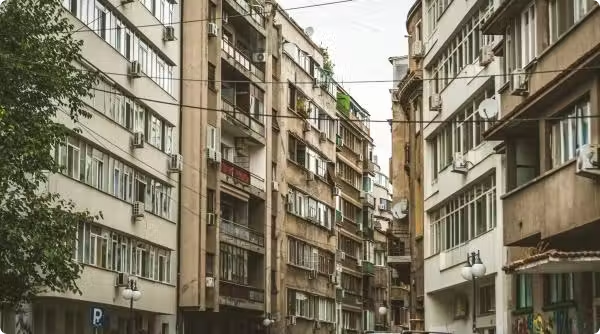
Urban reality reflects compromises between comfort needs and the lack of clear rules, with each facade telling the history of these practical negotiations between owners and administrative constraints. [1]
The regularization procedure involves obtaining a technical expert report or designer's opinion, submitting documentation with the survey and façade plan to the city hall, registering new data in the cadastre, and in the land book. [1]
The lack of documents for enclosed balconies will lead to blockages in housing transactions. The expert report notes that the law provides a window of opportunity until 2027 for regularization, a period essential for avoiding penalties and obstacles to selling. [1]
As the story develops
Update
Minister of Development: Owners will not pay double tax for enclosed balconies
The Minister of Development, Marcel-Alexandru Stoica, issued a clarification order, ensuring that owners will not be forced to pay double tax or tenfold fees for enclosed balconies without permits, nor spend thousands of lei for legalization. [2]
Update
Minister of Development: No one will pay double tax for enclosed balconies without permits
The Minister of Development, Public Works and Administration, Marcel-Alexandru Stoica, issued a clarification order excluding the application of double tax or tenfold fees for balconies enclosed without permits. The document specifies that the 100% tax increase targeted by the new Urban Planning Code applies exclusively to buildings constructed entirely illegally (without a building permit), not to minor interventions such as enclosing balconies in legally built blocks. [3]
Through the order, the government ensured that the expense of thousands of lei for legalization would not be necessary, as fines are not applicable retroactively to acts prescribed within the general statute of limitations of 3 years. The lawmaker defined enclosing balconies as a work of low importance, for which owners may request regularization at any time, and the additional 10-times tax intended for major construction indiscipline does not apply to these interventions. [3]
Update
Minister of Development: No one will pay double tax for enclosed balconies
The Minister of Development, Public Works and Administration, Marcel-Alexandru Stoica, clarified through an order the controversial provisions of the Land Use Planning, Urbanism, and Construction Code, ensuring that no one will be forced to pay double tax, tenfold fees, or spend thousands of lei to legalize enclosed balconies without permits. [4]
Update
Minister Stoica clarifies the fiscal regime for balconies enclosed without permits
The Minister of Development, Public Works and Administration (MDLPA), Marcel-Alexandru Stoica, announced on Thursday that no one will be required to pay double tax, tenfold fees, or spend thousands of lei to legalize enclosed balconies without permits. 'I issued an order today to clarify the interpretation of the legal provisions. No one will be forced to pay double tax or tenfold fees, nor will they have to spend thousands of lei to legalize their balcony,' Marcel-Alexandru Stoica specified. According to the order, the issued instructions ensure the application of clear and uniform norms at the administrative level, and this clarification is considered sufficient to manage the situation without requiring a change in the law. The order makes an essential legal distinction: a building is not considered illegally constructed if unauthorized interventions were made on it, such as enclosing balconies. The sanction of increasing the tax on buildings by 100% was conceived by the lawmaker exclusively for buildings constructed entirely illegally (without a building permit). The tax increase is not applicable to minor extensions or secondary adaptations (such as enclosing a balcony) added to a legally built building. It is necessary to distinguish between buildings constructed without respecting the legal authorization regime and those legally erected, upon which subsequent point works were performed. Interventions on balconies do not change, by themselves, the legal situation of the building regarding the legality of its initial construction and do not lead to classifying the entire building as ones executed without a permit. Therefore, the tax increase does not apply to enclosing balconies in legally built buildings. The document emphasizes that doubling the tax on the entire surface area of a legal apartment of 70-80 sqm due to an unauthorized modification of 3-4 sqm of balcony represents a disproportionate, abusive, and unconstitutional measure, which distorts the intent of the law and cannot be applied. The Ordinance also establishes the impossibility of applying fines retroactively to acts that have been prescribed. The general statute of limitations for offenses related to executing works without a permit is 3 years from the completion of the act. For balconies enclosed more than 3 years ago, the state's right to apply fines or punitive measures is prescribed. Law No. 169/2026 does not operate retroactively and cannot transform a prescribed act into a reason for fiscal penalty on a legally built building. According to Article 301(2) of Law No. 169/2026, enclosing balconies or loggias in multi-story residential buildings is considered a work of low importance (except for extensions onto public domain at ground level). Owners have the right to request an authorization for regularization for these works of low importance at any time, without a time limit and without being conditioned by the one-year transitional term provided for other categories of construction. Paragraphs (7) and (8) of the law create a one-year transitional regime (until August 25, 2027) dedicated exclusively to other categories of illegal constructions with major impact (major construction indiscipline). The increased additional taxes by 10 times provided in paragraph (8) apply strictly to cases under the transitional regime. For balconies provided in paragraph (2), one does not pay increased taxes of 10 times, but standard authorization fees. 'Regularization aims exclusively at verifying the safety of the building; the law aims at the safety of tenants, not abusive penaltying. Local tax and duties directorates have no legal basis to apply the increased rate of 100% on the apartment tax for the simple existence of an enclosed balcony. The entry into force of Law No. 169/2026 does not impose the obligation of a general inventory of enclosed balconies without permits by local public administration authorities,' the order specifies. [5]
- Categories:
- Real Estate
Sources
- antena3.ro Haosul dublării impozitelor din cauza balcoanelor închise. Primăriile calculează deja taxele pe 2027, iar oamenii sunt îngrijorați
- stirileprotv.ro Ministrul Dezvoltării anunță că românii nu vor plăti impozit dublu pentru balcoanele închise fără autorizație
- AGERPRES Ministrul Dezvoltării referitor la balcoanele închise: Nimeni nu va fi obligat să plătească impozit dublu sau taxe înzecite
- Bursa Ministrul Dezvoltării a clarificat printr-un ordin aspecte controversate din Codul amenajării teritoriului
- Digi24 Ce spune ministrul Dezvoltării despre impozitele pe balcoanele închise ilegal