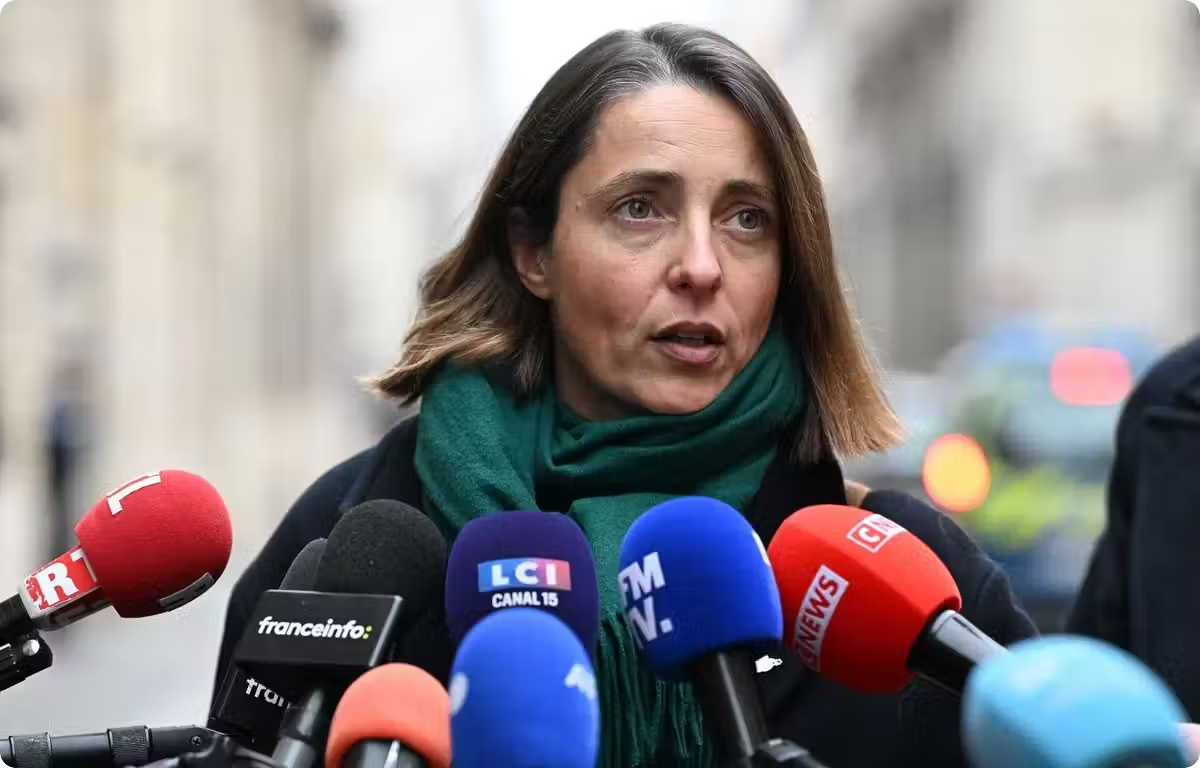
On Monday, November 9, the controversy surrounding CNews escalated at the French government level as prominent labor and youth leaders actively refused to engage with the channel's journalists. At a press conference outside Matignon (the Prime Minister's office), Sophie Binet, the secretary-general of the CGT trade union, interrupted her statement upon seeing a CNews microphone. She demanded that the journalist remove the equipment, declaring, “I do not speak to CNews.” When the reporter resisted, Binet issued an ultimatum: she would not continue the briefing if the microphone remained. The journalist argued he was covering the news, but Binet insisted the channel confused information with opinion. After a minute-long standoff, she resumed her speech while ostentatiously turning her back to the camera. [1]
A similar boycott occurred later that day involving the youth intersyndicale, comprising representatives from Fage (High School Students' Federation), Unef (National Union of French Students), Union Étudiante, and the USL (Student Union). They had organized a press conference ahead of a meeting with Junior Minister Sébastien Lecornu but cancelled the media session entirely after repeatedly demanding the CNews team leave. Ryad Rani, president of the USL, stated, “We still do not speak to CNews,” accusing the channel of acting as a “distribution belt for far-right ideas.” Louis Létoublon, vice-president of Lycéens!, also cited concerns about the “quality of the debate” due to CNews's presence. The student unionists withdrew to hold their internal meeting instead. [1]
These actions drew sharp condemnation from right-wing and far-right politicians, who framed the boycotts as attacks on press freedom and union neutrality. Eric Ciotti, a prominent right-wing figure, criticized Binet for stepping “outside her role” and questioned the political neutrality of public-funded unions. He asserted that refusing to speak to CNews journalists amounted to trampling on press freedom. Bruno Retailleau, the Les Républicains (LR) presidential candidate, similarly expressed support for newsrooms targeted by the “far-left,” labeling the unions' stance as censorship. Jean-Philippe Tanguy, a National Rally deputy, dubbed Binet “Facho Binet” in her works. The tensions arise against a backdrop of a petition, launched in June and gaining momentum after the racist attack in Trappes on October 23, which recently surpassed one million signatures demanding CNews be removed from French audiovisual media. [1]
During the confrontation at Matignon, Sophie Binet provided explicit reasoning for her refusal to engage with CNews. When pressed by the journalist, who claimed he was merely reporting on the reality of the situation, Binet retorted, “You know very well that it is always like that; there is no need to come making provocations.” She emphasized that the CGT did not mix information with opinion, implying that CNews’s coverage crossed that line. The exchange lasted for over a minute before Binet cut it short. She concluded her statement by noting that while she continued speaking because she represented workers, the situation constituted another lack of respect from CNews. This incident mirrors a broader pattern where CNews, owned by conservative billionaire Vincent Bolloré, is frequently accused by opponents of promoting far-right themes, allegations the channel denies by asserting it defends freedom of expression. [3]
The boycott of CNews by trade union and student leaders on November 9 highlighted the deep polarization surrounding the channel. Sophie Binet’s refusal to speak to the channel’s journalist at a government press conference outside Matignon was followed in the afternoon by the youth intersyndicale’s decision to cancel their own press event. The groups argued that CNews served as a platform for hate speech, referencing the recent attack in Trappes. This coordinated refusal to engage has sparked intense debate, with critics alleging censorship and supporters arguing that the channel’s editorial stance aligns too closely with extremist ideologies. The incident underscores how viewing and interacting with CNews has become a potent social and political marker in France. [2]
CGT Secretary-General Sophie Binet explicitly declared her refusal to interact with CNews during a press conference outside Matigon on Monday. Quoting her direct statement: “Can you please remove the microphone? I do not speak to CNews.” The remark was made while addressing the government's social conference. Binet further justified her stance by asserting that the CGT “does not mix information and opinion,” contrasting the channel's output with journalistic standards. Her declaration was delivered in the presence of a CNews reporter who contested the exclusion. [2]
In response to the journalist's insistence on remaining, Sophie Binet reiterated her position, stating: “You know very well that it is always like that. I do not speak to CNews; there is no need to come making a provocation.” This exchange highlighted the tension between the union's leadership and the channel, with Binet maintaining that her organization distinguished clearly between factual reporting and opinion-driven content, which she attributed to CNews. [2]
Following the confrontation, Sophie Binet resumed her speech by deliberately turning her body away from the CNews camera. This physical gesture underscored her symbolic rejection of the channel. The move was interpreted by observers as a direct affront to the network, reinforcing the narrative that CNews is not merely a news provider but a political actor whose presence is contested by significant segments of French civil society. [2]
The backlash from conservative and far-right figures against the unions' boycott was immediate and fierce. Eric Ciotti took to social media to state: “Full support for CNews. The general secretary of a major national union should not say this.” He argued that Binet was exceeding her role and raising questions about the political neutrality of unions funded by public money. This critique positioned the boycott as a violation of traditional press freedoms and an attack on the right to report on controversial issues. [2]
Further emphasizing the political divide, Bruno Retailleau, a candidate for Les Républicains, echoed Ciotti’s sentiments. He expressed his “support” for “all the newsrooms that are the target of the far-left.” Retailleau asserted that “politicians or unionists who refuse to speak in the presence of a CNews microphone trample on freedom of the press.” This statement framed the boycott not as a critique of journalistic quality but as an ideological assault on media independence. [2]
The afternoon saw the youth intersyndicale, representing the Fage, Unef, Union Étudiante, and USL, cancel their planned press conference. The event was originally scheduled to precede a meeting with Sébastien Lecornu. The decision to cancel was a direct result of the presence of CNews journalists, whom the union leaders refused to address. This cancellation marked a significant escalation in the protests, moving beyond verbal refusals to a complete disruption of media engagement. [2]
Ryad Rani, president of the USL, publicly declared: “We still do not speak to CNews,” surrounded by leaders of the other youth organizations, including Manon Moret (Unef), Suzanne Nijdam (Fage), and Éloïse Lefebvre-Milon (Union Étudiante). Their unified stance demonstrated a broad consensus among student and youth groups regarding their opposition to the channel. This collective action signaled that the controversy extends beyond trade unions to affect the younger generation’s political engagement and media consumption choices. [2]
Ryad Rani elaborated on the reasons for the boycott, stating: “We speak to those who do real journalism. That’s not what you do. You are just a distribution belt for far-right ideas.” He further added, “We do not speak to the far-right; we do not speak to people who are today responsible for spreading hate, as we saw in Trappes.” The reference to Trappes highlights how the channel’s coverage of social unrest is perceived by critics as exacerbating tensions. [2]
After demanding the departure of the CNews team for several minutes, the student and union representatives ultimately left the press area to attend their internal meeting. This withdrawal symbolized the breaking point in the dialogue between the protesters and the media outlet. It also underscored the futility of the media's attempt to capture statements from these groups under conditions that the groups deemed hostile and biased. The episode served as a potent visual metaphor for the disconnect between CNews and its critics. [2]
Louis Létoublon, vice-president of Lycéens!, offered a slightly more nuanced criticism, stating: “The presence of CNews here poses us a problem in terms of the quality of the debate.” Unlike the blanket refusal of the other groups, Létoublon continued to engage with other journalists, suggesting a distinction between refusing to engage with CNews specifically and rejecting media access altogether. His comment highlighted concerns about how CNews’s presence might skew or degrade the substance of political discussions. [2]
CNews, owned by conservative billionaire Vincent Bolloré, continues to face accusations of promoting far-right opinions and themes, which the channel denies. CNews maintains that it defends freedom of expression and provides a platform for diverse viewpoints. However, critics argue that its editorial line favors extremist narratives, particularly in the context of rising social tensions and political polarization in France. This ongoing dispute reflects broader debates about media responsibility, freedom of the press, and the influence of ownership on journalistic integrity. [2]
A petition titled “Remove CNews from French Audiovisual Media,” hosted on the French National Assembly’s website, has surpassed one million signatures. Launched in June by an individual and gaining significant traction after the racist attack in Trappes on October 23, the petition compares CNews to a “propaganda machine” akin to Fox News in the United States. The petition’s reach underscores the magnitude of public discontent with the channel, influencing political discourse and legislative considerations regarding its future in French media. [2]
- Categories:
- Politics
- Entities:
Sources
- 20 Minutes Colère sociale : « Nous ne parlons pas à CNews »… Sophie Binet et les lycéens refusent les micros de la chaîne
- fr.news.yahoo.com Face à un micro de CNews, Sophie Binet proteste, l'intersyndicale de la jeunesse garde le silence
- tvmag.lefigaro.fr «Je ne parle pas à CNews» : Sophie Binet exige le départ d’un journaliste de son point presse