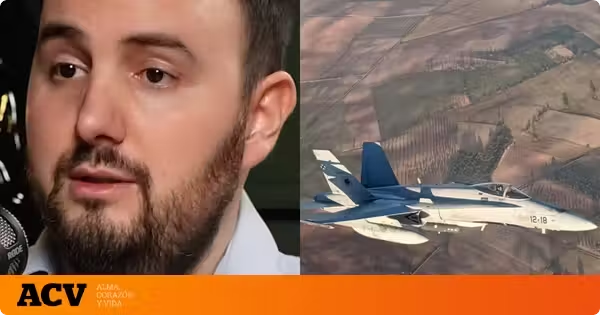
Enrique Gil, a pilot within the Spanish Air and Space Force, has provided a detailed look into the professional and emotional trajectory of operating F-18 fighter jets. Speaking on the podcast 'La fórmula del Éxito', Gil described the initial sensation of flying a combat aircraft alone for the first time at the age of 23 as feeling like the 'king of the world.' However, he noted that over time, this euphoria evolves into professional tolerance, shifting from an emotional peak to a disciplined professional routine El Confidencial.
The path to becoming a combat pilot is marked by extreme academic rigor. Gil explained that the curriculum is equivalent to a degree in aerospace engineering, encompassing mathematics, physics, calculus, avionics, and thermodynamics. In addition to these technical subjects, pilots must master military tactics, aviation regulations, and flight-specific courses. He noted that the program previously consisted of 500 credits spread over five years, though this workload has recently been reduced to prevent student saturation El Confidencial.
Psychologically, the transition to an operational unit involves a significant adjustment of ego. Gil admitted that while a certain level of self-confidence is necessary to believe in one's capabilities, it must be balanced with humility. He remarked that upon arriving at a unit, a pilot's ego may be inflated, but superiors typically work quickly to ground them, as excessive pride can become a dangerous liability in a high-stakes environment El Confidencial.
Regarding the technical side of flight, Gil emphasized the importance of mental resilience over perfection. He argued that while communication errors may occur, the primary danger is 'blocking'—a state where a pilot becomes fixated on a mistake, leading to a 'domino effect' of subsequent, more grave errors. During his tenure as an instructor, Gil observed this phenomenon in students who fell 'behind the airplane,' unable to keep pace with the aircraft's demands. He cited common mistakes, such as misidentifying a runway due to shifting wind patterns, noting that instructors generally allow students to make and correct these mistakes themselves, provided there is no immediate safety risk El Confidencial.
Gil also touched upon the influence of simulation technology. He mentioned that his own vocation began with the game Battlefield 2 and acknowledged that modern simulators like Digital Combat Simulator (DCS) help individuals understand flight logic. While he clarified that mastering DCS does not qualify someone to pilot a real F-18, it would allow a co-pilot to understand the processes occurring within the cockpit El Confidencial.
Addressing the destructive nature of military aviation, Gil stated that pilots are explicitly trained for the reality of their role, which includes deploying bombs and causing casualties. However, he asserted that these actions are conducted within the framework of defense values. He compared the necessity of a military force to that of a police force, arguing that wanting peace does not justify the absence of an army, just as wanting a lack of crime does not justify the absence of police El Confidencial.
Currently not in active flight status but expressing a strong desire to return, Gil likened the experience of leaving a fighter jet to transitioning from driving a Ferrari at 23 to driving a Renault or a silent electric vehicle. He concluded by emphasizing the importance of public outreach, noting that many people are unaware of the specifics of a pilot's duties and that explaining these roles is an integral part of the job within the Spanish Air and Space Force—an entity whose name was updated to reflect its expanded jurisdiction over outer space and cyberspace El Confidencial.
- Categories:
- Military
- Entities: