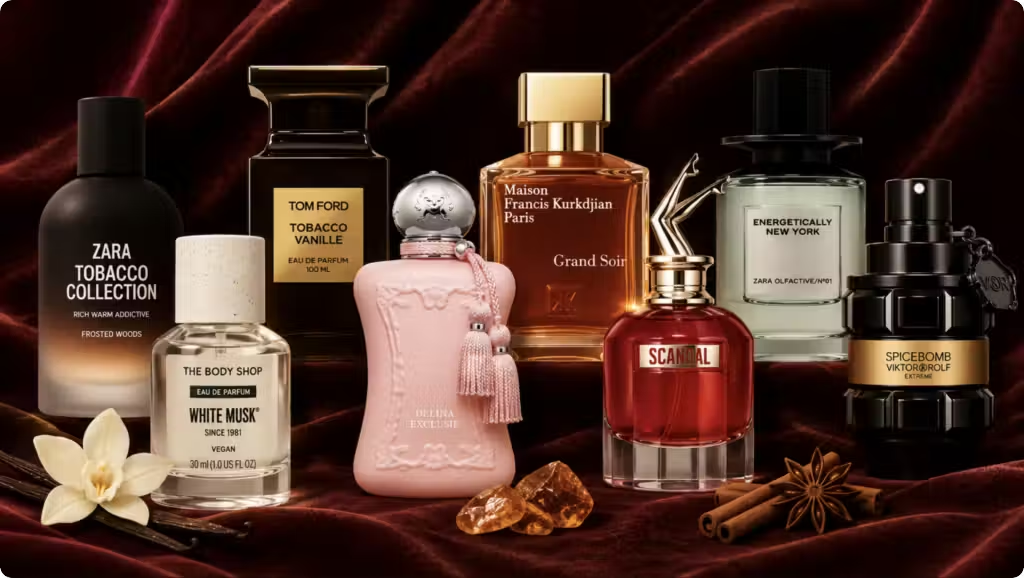
Winter fragrances lean towards warm notes, such as vanilla, amber, sandalwood, or spices, which create a comfortable and intimate atmosphere. In contrast to summer, where fresh, citrus, and floral scents predominate, the cold season attracts a preference for more intense, sweet, and warm compositions. Changing fragrances does not follow a strict rule but is influenced by olfactory preferences, temperature, and environmental context. Choosing a winter fragrance follows the logic of changing one's wardrobe, replacing light fabrics with denser, warmer ones. Fragrance acts as an invisible accessory, influencing others' perception and the wearer's personal state. The cold season offers ample opportunities for olfactory exploration and discovering new scents. [1]
Temperature plays an essential role in the behavior of fragrance, determining the evaporation rate of volatile substances and how the scent develops. Heat accelerates the evaporation of molecules, making the perfume appear more intense immediately. Cold slows down evaporation, potentially leading to a more discreet perception of compositions worn outdoors. The longevity of a perfume in winter is not automatically superior; it depends on the formula, ingredients used, concentration, and application surface. The contrast between cold outdoor air and indoor heating continuously modifies how the fragrance is perceived throughout the day. [1]
Compositions with woody, amber, resinous, or gourmand notes are attractive in winter, evoking feelings of warmth and comfort. A fragrance with warm notes offers a sensory impression but does not have the ability to effectively warm the body. [1]
Vanilla is the olfactory note most frequently associated with winter perfumery. Its sweet, creamy, and comforting character transforms a composition into a warm and sensual one. The scent profile of vanilla varies significantly from product to product. Vanilla can be present in gourmand forms (evoking images of desserts) or sophisticated forms, combined with wood, tobacco, amber, or spices. Vanilla's versatility makes it a common presence in both feminine and masculine or unisex perfumery. For the cold season, vanilla is best recommended when balanced by woody or spicy notes. Proper balance produces an elegant scent, avoiding the risk of becoming excessively sweet. These recommendations can be illustrated by various examples of popular compositions. [1]
Amber is a central accord family in intense perfumery. In contemporary perfumery, amber often describes an accord that includes labdanum, vanilla, benzoin, and other warm, sweet, or resinous materials. Amber fragrances can be sensual, elegant, and sometimes mysterious. They are indicated for people who prefer perfumes with personality, especially in the evening or on special occasions. Not all amber fragrances are powerful; there are also delicate variants balanced by flowers, musk, or powdery notes. A well-constructed amber fragrance is a viable alternative to classic floral compositions. [1]
Sandalwood is appreciated for its creamy, velvety, and woody character. Its formula can offer milky nuances, slightly sweet or powdery. Unlike very intense gourmand fragrances, sandalwood-dominant compositions offer a subtle elegance. This note is suitable for both women and men, being present in numerous unisex compositions. Combinations of sandalwood, musk, and vanilla create comfortable and sophisticated fragrances. These scents complement a winter wardrobe based on knits, coats, and classic pieces. [1]
Oud is a prominent raw material in Eastern and luxury perfumery. Obtained naturally from the resinous wood of trees of the genus Aquilaria, its production process is biologically complex. Both natural oud and accords that reproduce its olfactory characteristics are used in the perfumery industry. The scent of oud can be woody, resinous, smoky, animalic, or medicinal. It is not recommended for everyone, especially those who prefer fresh fragrances. For lovers of intense compositions, oud is an interesting choice for the cold season. Combined with rose, amber, vanilla, or saffron, oud creates fragrances with a strong identity. [1]
Spices are associated with the cold season, this being based on memories and positive experiences linked to them. Cinnamon recalls hot drinks and desserts, cardamom brings sophistication, and cloves offer depth. These notes are not exclusively used in sweet formulas. Cardamom can be combined with woody or citrus notes to create modern fragrances. Cinnamon adds warmth to amber compositions, while cloves introduce an intense and spicy character. This combination is recommended for those who want a winter fragrance different from floral or fruity scents. [1]
Fragrances with tobacco and leather accords are associated with classic elegance and olfactory maturity. The note of tobacco in perfumery should not be confused with the smell of cigarette smoke. We can have facets of sweetness, honey, hay, wood, or dry leaves. In combination with vanilla, amber, or spices, tobacco creates warm and complex fragrances. Leather accords vary from soft interpretations, similar to suede, to smoky and intense compositions. These notes do not belong to a specific gender and are used in both feminine and masculine perfumery. A fragrance with leather and vanilla can be interesting in feminine collections, and the tobacco-flower combination offers an unexpected contrast. [1]
Gourmand fragrances, reminiscent of food and desserts (caramel, chocolate, coffee, pralines), have become very visible recently. In winter, these fragrances are attractive due to associations with comfort. There is a distinction between a well-balanced gourmand perfume and one dominated by sweetness. Formulas in which sweet notes are complemented by wood, musk, spices, or amber are preferred for their depth. These combinations make the fragrance suitable for multiple contexts. [1]
Floral fragrances should not be abandoned in the cold season, even though they are frequently associated with spring. Floral scents can remain very suitable for winter. Rose, combined with oud or amber, can become intense and sophisticated. Jasmine, associated with vanilla or woody notes, takes on a warmer character. White flowers can be integrated into complex fragrances with a strong presence. It is not necessary to give up favorite floral notes along with dropping temperatures. The solution lies in choosing different interpretations of beloved notes. [1]
Not all winter fragrances need to be intense, sweet, or spicy. People who prefer clean, delicate scents close to the skin are recommended compositions with musk. Modern musk is primarily synthetic, having varied profiles: powdery, clean laundry, or warm-subtle. Combined with sandalwood, iris, or vanilla, musk notes create elegant fragrances suitable even for the office. Musk is an interesting alternative for those who avoid very intense Oriental fragrances. [1]
Frankincense, myrrh, and benzoin are ingredients associated with resinous perfumery. They add depth and complexity to the composition. Frankincense can have a mineral, smoky, or refreshing character. Benzoin is appreciated for its sweet, balsamic, and vanilla facets. Myrrh brings resinous, slightly bitter or spicy notes. These choices are ideal for those wanting a less conventional fragrance. In winter, such compositions create a sophisticated and distinct olfactory impression. [1]
The question regarding the advantage of Eau de Parfum vs. Eau de Toilette for winter does not have a universal answer. Although the names refer to different concentrations, longevity and intensity depend on the actual composition. There are Eaux de Toilette with strong presence and Eaux de Parfum that remain discreet. The experience of testing on skin and observing the fragrance's evolution over several hours is crucial before deciding. For investments in premium perfumery, personal experience is more relevant than the concentration stated on the packaging. [1]
In the cold season, thick clothes can cover application areas, and the cold influences diffusion. Perfume should be applied to clean skin, in moderate amounts, for a pleasant experience. Adequate skin hydration influences how the fragrance settles. Application on clothes requires caution, as certain formulas can stain or damage delicate materials like silk or leather. Direct spraying on expensive coats or furs should be avoided. There is no need to apply large amounts just because of the cold. In heated rooms, an intense fragrance can become overwhelming, especially in closed spaces. [1]
Choosing a fragrance should be guided by context, not by strict seasonal rules. Daily activities and the office can benefit from compositions with musk, sandalwood, iris, delicate floral notes, or subtle woody accords. Evenings, dinners, or events suit fragrances with vanilla, amber, oud, tobacco, or spices. Application intensity matters just as much as the type of fragrance. A gourmand perfume can be worn discreetly during the day, and a floral one can be sophisticated enough for a special occasion. There is no mandatory separation between daytime and nighttime fragrances. [1]
It is not necessary to own a very large collection of fragrances. For many people, two fragrances are sufficient: one fresh for summer and one warm/intense for winter. There are versatile fragrances suitable for the entire year. It is important to choose compositions that truly please you, not just popular ones. [1]
A fragrance smells different on each person, and olfactory preferences are deeply subjective. It is not recommended to buy an expensive fragrance solely under the status of 'the perfect winter fragrance.' It is necessary to test it, observe its evolution, and check if it represents you. [1]
Fashion and perfumery share personal expression, trend influence, and integration into identity. Just as not all women wear the same coat in winter, fragrances should not be chosen according to predefined rules. Vanilla, amber, sandalwood, oud, and spices are frequently associated with winter, but this does not justify abandoning citrus or floral perfumery until spring. [1]
A successful fragrance is one that complements your personal state and desired image, regardless of the season. Winter is an ideal time to discover warmer and more complex scents, but the final choice depends on personal preferences. The right fragrance is not necessarily the most expensive or popular one, but the one you enjoy wearing and see yourself in. The illustrative images of the article were modified using artificial intelligence. [1]
As the story develops
Update
How to choose a winter fragrance: warm notes, layering, and practical rules
“Heaven’s Reserve” by House of Theôm is a Perfume available at the German drugstore chain dm and is composed of nut topoia phases, vanilla, cognac, orange blossoms, and ambroxan. It is a unisex fragrance found on shelves worldwide. [2]
- Categories:
- Fashion
- Entities: