The winter season, known in popular culture as 'cuffing season,' appears as a real cultural pattern, but scientific research does not prove that cold directly causes the formation of temporary relationships. Interest in this term peaks in autumn, and peer-reviewed research shows that seasons and major holidays can influence certain forms of human behavior. Evidence supports seasonal shifts in attention and social context, not the existence of a universal biological 'dating season' during winter. The term describes the period in autumn and winter when people seem to have increased interest in finding a partner. The clearest data shows that this online search activity increases significantly during that period. However, there is no definitive study proving that people broadly enter short-term relationships solely due to falling temperatures. Cuffing season should be treated as a useful description of seasonal social pressure, not as a law of human behavior. [1]
Search data proves that attention to the concept is seasonal, but does not show how many relationships actually start or how long these relationships last. Holiday pressure, social comparison, and couple-focused traditions can make the desire for companionship feel more urgent for some people. Academic research supports seasonal and holiday-related changes in certain forms of social, sexual, and reproductive behavior, but this is not equivalent to proving the existence of cuffing season. Culture, celebrations, available leisure time, social comparison, and changing routines can explain this pattern as well or better than simple cold weather. A match made in November can become a lasting relationship. The year matters less than shared intentions, consistent behavior, and compatibility once the holidays end. [1]
Cuffing season is a popular dating term for the period of autumn and winter, when bachelors are considered more interested in engaged or semi-engaged relationships. The word suggests attachment to a person for company during cold weather and holiday events. The usual time frame runs between October and Valentine's Day in the Northern Hemisphere, although there is no official start date. The idea is less relevant in tropical climates and oddly reverses in the Southern Hemisphere, where November marks the beginning of warm weather. This geographic discrepancy is a timely hint that cuffing season might be partially cultural rather than a universal biological cycle. The term also describes several different behaviors that should not be confused. One person may genuinely feel ready for a long-term relationship. Another may want company for holiday activities. Someone else might simply spend more time messaging because the evenings are quieter. Increased attention, the desire for exclusivity, and a short winter relationship are not the same outcome. [1]
Does cuffing season really exist? What independent data can tell us. The most convincing evidence that cuffing season exists as a cultural trend comes from search behavior. Google reported that searches for 'cuffing season' tend to peak in October or November. The term first appeared in Google Trends data in 2004 and grew exponentially in November 2016. This proves that curiosity about cuffing season is seasonal. It does not prove that more relationships begin, become exclusive, or end when spring arrives. Search data measures attention, not romantic outcomes. News coverage, memes, dating app campaigns, and conversations on social media can drive people to search for a term without changing how they find partners. [1]
Human intimate behavior has seasonal patterns, but they are complex. Academic research shows that some intimate behaviors vary throughout the calendar. A study that used data regarding health services and sales in the United Kingdom found increases in sexual activity and unsafe sex around Christmas and a smaller increase during the summer holiday. This study refers to sexual behavior, not dating app matches or winter temporary relationships, and used data from the 1990s. It cannot be used to support the claim that modern adults biologically seek a 'winter partner.' However, it shows that calendars, holidays, relationships, and social opportunities can create measurable seasonal patterns. [1]
A representative national American study with participants aged 57 to 85 examined nine measures of social connection across the calendar. Only the mean closeness with network members varied significantly by month. Most social network resources remained stable. The study focused on older adults, not online dating users, so it cannot establish the cuffing season issue based on it alone. It still offers a useful reality check: the calendar does not automatically transform every part of people's social lives. Therefore, claims about seasonal dating should be treated as a possibility affecting some people, not as a universal rule. [1]
Currently, there is no strong, peer-reviewed evidence demonstrating a distinct population-level increase in short-term romantic relationships that start in autumn and end in spring. This exact story is central to the popular definition of cuffing season, but most available numbers measure searches, messages, opinions, sexual activity, or reproductive outcomes, not the formation and duration of relationships. Even broader seasonal research offers a mixed picture. A major review in Perspectives on Psychological Science concluded that seasons can influence many aspects of psychology and human behavior. However, the authors insisted that mechanisms vary. Temperature, daylight, school calendars, clothing, holidays, and local social environments can each play a role. Seasonal effects also differ by geography and culture. [1]
The most accurate conclusion is that cuffing season is real as a recurring cultural conversation and can describe genuine shifts for some daters. It is not established as an automatic biological impulse or a predictable relationship cycle for everyone. [1]
Why might dating feel different in November? Holiday culture changes what people observe. November begins a period full of invitations, travel plans, family conversations, couple-focused advertising, and questions about the future. Having a partner can become more visible, while being single can suddenly seem like information others are waiting to learn about. This contrast can make companionship feel more urgent even if your core relationship goals haven't changed. [1]
Collective state may be more important than temperature. A large cross-cultural analysis examined online interest in sex, birth patterns, and collective state around major religious celebrations. Interest peaked around culturally important holidays in both hemispheres, which does not fit a simple cold weather explanation. Researchers found that collective states associated with holidays were linked to the pattern, although the study could not prove that the state caused the behavior. This is important because the 'winter makes us unite' story is an attractive but incomplete narrative. Holidays, expectations, work free time, and common cultural rituals can influence attention and behavior even when November is warm. [1]
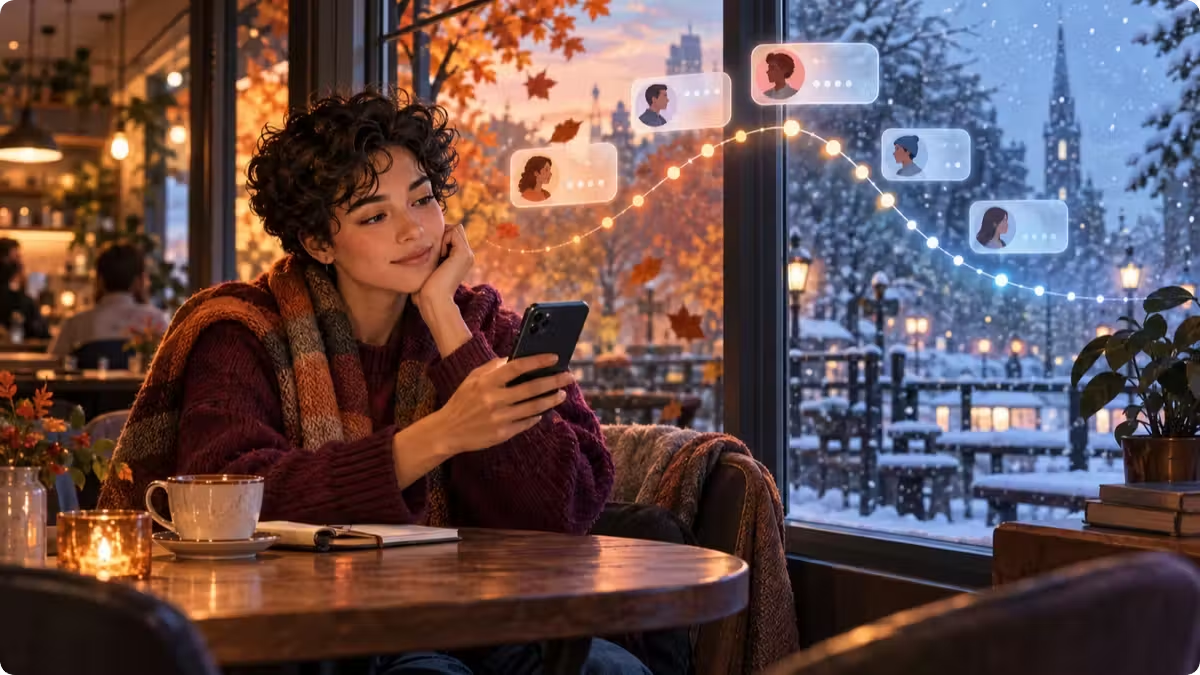
Online dating makes seasonal curiosity easier to act on. Before online dating, a seasonal increase in romantic curiosity might have remained within a person's social circle. On a dating platform, someone can update their profile, meet new people, and start conversations without waiting for a social event. Technology does not create the desire for company, but it can make acting on this desire easier. If a new match appears, these practical ways to continue an online conversation can help you overcome seasonal small-talk swaps. [1]
Labels can influence the behavior they describe. Once people expect cuffing season, they may notice more winter couples, joke about finding a 'cuffing partner,' or adjust their dating profiles. This does not make the experience false. It means cultural labels can organize attention and give people a scenario for interpreting ordinary shifts in mood or availability. Seasonal motivation is not automatically unhealthy. A relationship starting in November can be sincere and lasting. The useful question is whether the connection still makes sense without the holiday atmosphere. If you notice urgency, slow down instead of abandoning a promising match. Ask what you want, maintain existing friendships and routines, and see how the connection handles usual inconveniences. When you're ready to meet, choose a simple public date that allows conversation. Principles from online dating guides remain useful every season: communicate honestly, protect your boundaries, and let trust develop through consistent behavior. [1]
Cuffing season clearly exists as a cultural trend because interest in the term rises in autumn. Peer-reviewed research also confirms that certain human behaviors can vary around seasons and major holidays. Evidence does not establish a universal biological impulse to form temporary winter relationships. No strong independent study has directly tracked a population-wide wave of relationships starting in autumn and ending in spring. Treat the season as context, not destiny. A November connection deserves the same evaluation as any other: clear intentions, mutually comfortable pacing, consistent communication, and compatibility that remains visible once decorations are put away. It is commonly said that cuffing season starts in October or November and continues until Valentine's Day, but there is no scientific or official calendar. Google search interest usually peaks near the start of that period. The time frame mainly reflects weather in the Northern Hemisphere and Western holiday culture, so it does not describe every country or person dating equally well. Do more people use dating apps during cuffing season? There is insufficient independent, industry-level evidence to give a reliable yes or no answer. Individual services may observe seasonal changes, but their internal figures may reflect promotions, member changes, age groups, locations, and measurement choices. Even if activity increases, more profile views or messages do not necessarily imply that more successful or lasting relationships begin. Are cuffing season relationships always temporary? No. 'Cuffing season relationship' is a popular label, not a relationship diagnosis. A couple meeting in November may build a lasting partnership, while a summer relationship may end quickly. Longevity depends more on compatible intentions, respectful communication, trust, and how the connection works outside special events than on the month two people meet. Why do I want a relationship more during holidays? Possible influences include family questions, couple-focused traditions, social comparison, more time indoors, year-end reflection, and a genuine desire for company. The desire for connection is not proof that your feelings are false. It is worth asking whether you want this specific person or rather comfort from seasonal loneliness, as these reasons can lead to different decisions. Is cuffing season caused by cold weather? Cold weather can change routines in some places, but evidence does not support a simple temperature explanation. Research on seasonal psychology identifies several possible influences, including daylight, calendars, holidays, and local social environments. Cross-cultural data also show holiday-related changes in intimate interest in both hemispheres, suggesting that culture and collective state may matter independently of winter. How can I avoid rushing into a seasonal relationship? Decide what you want, ask what the other person wants, and avoid using holiday invitations as proof of commitment. Keep your normal routines, observe if communication remains constant, and discuss plans beyond the season. If slowing down causes pressure, guilt, or sudden withdrawal, that response provides useful information about whether the connection can respect your limits. [1]
- Categories:
- Entertainment
- Entities: