For collectors and enthusiasts seeking deeper insights into the world of watches, GQ offers its newsletter 'Box + Papers,' providing insider watch coverage delivered every Friday. For the first time in horological history, the prestigious Concours d'Élégance format, traditionally reserved for vintage automobiles, has been adapted for haute horlogerie. The Vacheron Constantin Concours d'Élégance Horlogère represents a global competition dedicated exclusively to timepieces. Aurel Bacs, the renowned auctioneer whose partnership with Phillips has long shaped the watch collecting world, initiated the project. 'It began with a meeting where I said, “I have a dream,”' Bacs recounted. To bring this vision to life, Bacs and Phillips collaborated with Swiss heavyweight Vacheron Constantin. Although the organizers anticipated receiving only 100 to 200 submissions, the overwhelming response forced the jury to narrow down 550 entries to just 34 finalist watches. Owners of these selected timepieces were flown in from across the globe for the inaugural Concours held at the prestigious Hôtel Président in Geneva. Bacs described the evening as the 'most beautiful evening in the field ever.' Around 200 attendees gathered at the Hôtel Président, joined by a distinguished jury of 14 watch-industry experts. The panel included Bacs himself, Ben Clymer of Hodinkee, writer and historian Nick Foulkes, and long-time watch journalist Roberta Naas, among others. Each submitted watch could compete in only one of seven categories: Chronographs, Métiers d’Art, Chronomètre Royal, Astronomical Complications, Multiple Complications, Design, and Chiming Mechanisms. The judges evaluated the pieces based on nine strict criteria: authenticity, elegance, rarity, historical impact on Vacheron Constantin or the watchmaking industry in general, provenance, technicality, métiers d’art (artisanal crafts), state of preservation, and emotional dimension. After hours of deliberation, the jurors announced the winners for each of the seven categories as well as a coveted Best of Show award. Following a cocktail reception, the guests gathered on the lower floor of the Hôtel Président to witness the results from what is considered the watch world’s first true Concours d'Élégance. [1]
Chronographs: The first category featured several significant wristwatches from the maison, including a highly rare 1940 stainless steel ref. 4072. However, the day belonged to a yellow gold pocket-watch chronograph from 1929. The result caused audible gasps from the audience, many of whom were intimately familiar with the historical importance of pocket watches in the industry. This outcome prompted speculation that vintage pocket watches might regain their status as the pinnacle of watch collecting. The winning piece justified the enthusiasm: in excellent condition, it featured a white enamel dial with dual registers in an “up-down” configuration, making it a stunning timepiece. [1]
Métiers d’Art: This category celebrated handcrafts such as enameling and gem-setting. The entrants included a smattering of spectacular pieces, mostly sub-40mm wristwatches in precious metals featuring wild cloisonné or Grand Feu champlevé enamel dials depicting landmasses or animals. Despite the strong wristwatch entries, the winner was a stunning pocket watch set with blue sapphires around the bezel and Roman indices. When an older American gentleman stepped on stage to collect his prize, he revealed a dramatic provenance to the stunned crowd. He explained that his great-grandfather, Dr. Otto von Frangeš, had received the watch from His Majesty Alexander I of Yugoslavia, its original owner. Dr. von Frangeš wore the timepiece while seated in the motorcade during the king’s assassination in France in 1934. Otto’s middle son, Nikola, eventually smuggled the watch out of Yugoslavia by sewing it into the lining of his wife’s jacket as they fled the Iron Curtain in the late 1940s. [1]
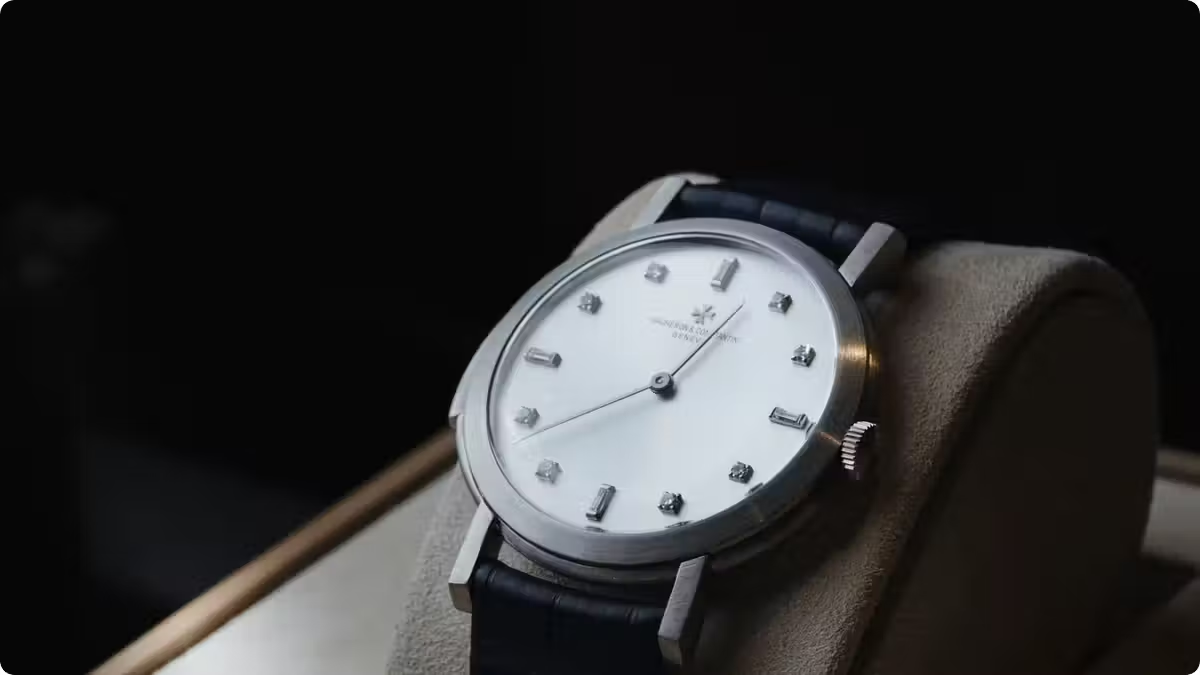
Chronomètre Royal: In 1907, Vacheron Constantin launched the Chronomètre Royal sub-brand, specifically engineered to endure the rigors of life at sea. The model’s parts were anti-magnetic and resistant to rusting, while the enamel dials could withstand moist atmospheres without corroding. Given their critical role in maritime navigation, timing precision was paramount, and models from this line frequently won observatory trials that tested for accuracy from the 1800s to the mid-1900s. In a surprising twist, the winner of this category was a 1976 ref. 2215. This modern interpretation exemplified the line's qualities while updating them significantly; it did not even feature a full set of numerals, having traded them for diamond-set indices. The owner noted in his acceptance speech that he wore the watch on weekends with jeans. [1]
Astronomical Complications: The Astronomical Complications category appealed to those who appreciate moonphase displays, and also included timepieces equipped with triple-calendars, complete calendars, or perpetual calendars. While more modern pieces, such as a skeletonized QP wristwatch from 1987, made it to the final round, the winner was a uniquely neat platinum-cased “Cioccolatone” from 1957. Housed in a 34mm x 43mm rectangular case and equipped with a complete calendar, the watch was owned by a dapper Italian collector who beamed as he collected the prize alongside his grown son. This was not the pair’s first time on the podium. [1]
Multiple Complications: This was a highly competitive category for Vacheron Constantin, a brand that famously produces the most complicated pocket watch (57 complications) and wristwatch (41 complications) in the world. To be eligible in this category, watches required at least two complications—considered child’s play for the maison. Spanning everything from an enamel-dialed, minute-repeating, split-seconds chronograph pocket watch from 1901 to several Patrimony watches from the 1990s, the winner was dubbed the “Don Pancho.” Delivered in 1940, this diminutive yellow-gold timepiece featured minute repeater, day, and retrograde date indications. Once the world’s most complicated wristwatch, it was double-signed by Brooking in Madrid and sold for roughly $740,000 at auction back in 2019. [1]
Design: Perhaps more subjective than the other categories, Design focused on watches 'featuring Vacheron Constantin’s signature design, either in the case or through the time display.' One notable entrant, a wild time-only ref. 4695 dress watch, featured incredibly intricate lugs and a Maltese Cross-type dial. However, the ultimate winner was something revelatory. Owned again by the tall Italian gentleman mentioned earlier, the possibly unique ref. 6213 is an automatic world timer from 1957 in yellow gold. Based upon Louis Cottier’s famous system, it is so rare that even Ben Clymer admitted he had never heard of it before the competition. The owner’s son recounted the excitement of his father returning home with the watch as a boy, thrilled to have finally tracked it down after years of searching. [1]
Chiming Mechanisms: This category included pocket watches or wristwatches fitted with a minute repeater, quarter repeater, half-quarter repeater, or grand sonnerie—a mechanism that automatically strikes the hours and quarter-hours every 15 minutes. Among the entrants was a red gold quarter-repeater pocket watch from the early 1820s with a stunning guilloché dial. However, the winner was another pocket watch, this one dating to 1926 and cased in platinum. Its ultra-thin design, black Breguet numerals, Breguet blued steel handset, and simple silver dial belied the complex mechanism within. The visibly emotional American gentleman who owns it recalled how, as a boy, he would open a chest of drawers, remove his grandfather’s pocket watch, and listen to its minute repeater. [1]
Best of Show: A bonus category, Best of Show went to a truly spectacular wristwatch: a ref. 6448 in platinum with diamond-set indices. Seemingly a simple time-only dress watch, this tremendous piece was produced in just three examples in the early 1960s and boasts a hand-wound, 13-ligne minute-repeater movement. Housed in a brushed-finish case with incredible teardrop lugs, it is the only known example in this metal and was notably the last minute-repeating reference produced by the brand for nearly 30 years. [1]
While the crowd nominally attended the awards ceremony to judge the merits of the watches, the narrator left emotionally moved by the personal stories each watch owner shared about their timepieces. As the very first concours for watches, this innovative format will undoubtedly be repeated in the future, whether by Vacheron Constantin, adopted by other brands, or executed as a more traditional multi-brand event akin to the Concours d'Élégance at Pebble Beach. [1]
- Categories:
- Entertainment
- Entities: