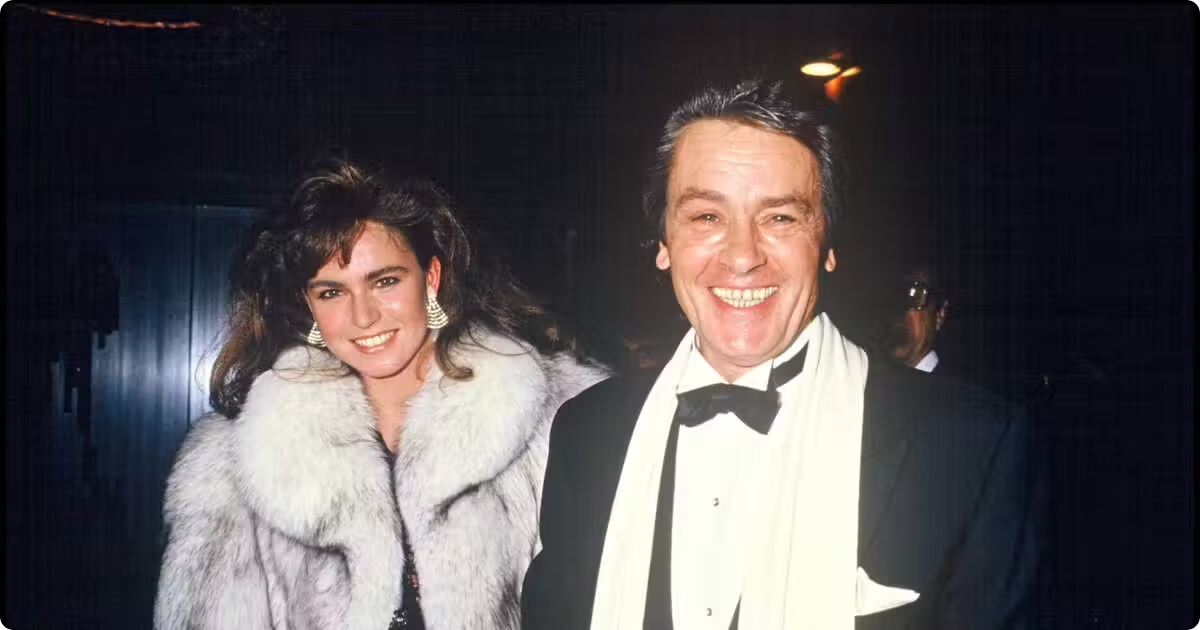
In the wake of the publication of her memoir, *Amour Fou*, Rosalie van Breemen has provided harrowing new details regarding her relationship with the late French icon Alain Delon. The book, which was released on November 12, 2026, by Robert Laffont Editions, has served as the primary channel for revealing the nature of her fifteen-year partnership with the actor. In fragments previously shared by *Paris Match* on November 10, the former Dutch model recounted a deeply troubling and severe episode of physical violence. According to van Breemen, Delon broke her nose on two separate occasions within the span of a single day. Before ascending to her role as the mother of Delon's youngest children, Anouchka and Alain-Fabien Delon, Rosalie van Breemen's life intersected with the French cinema legend almost entirely by chance. In 1987, living and working as a model in Paris, she was selected to appear in the music video for the song 'Comme au cinéma.' The song belonged to the man who would soon consume her world, Alain Delon. The stark 31-year age difference between the young Dutch newcomer and the established movie star did not prevent an immediate and powerful connection. What began in a studio quickly evolved into a deep, complicated romantic relationship that endured for fourteen years, officially ending in 2001. Despite having largely kept the private details of those years quiet, van Breemen chose to break her silence in *Amour Fou*, providing readers with a firsthand account of the harsh realities hidden behind the glamour. The timeline of *Amour Fou*'s public debut highlights the strategic rollout of its most controversial elements. The initial extraction of the text focusing on the interaction between Delon and Darc was distributed by the prominent French magazine *Paris Match* on their social media channels on November 10, 2026. The striking nature of the encounter—a breakfast tray arriving in the middle of the night, an unexpected physical imposition by the ex-partner, and the subsequent forced integration of that person into their newly formed family—sparked immediate conversation. The viral spread of these excerpts underscores the public fascination with the hidden architecture of Delon's domestic life, especially now that the primary witnesses are documenting it for posterity. The public reception of the book's extracts demonstrates how modern media environments shape the discourse around historical relationships. As soon as the *Paris Match* post went live, the internet became an arena for debates on the morality of writing about deceased individuals, the nature of Darc's actions, and the validity of long-suppressed trauma. Some observers pointed out the tragedy of Delon's departure from Darc, speculating if it was due to her inability to restrain herself in intimate spaces, or attributing his eventual distancing to other women such as Nathalie Delon or Anne Parillaud. While such speculation exists outside the memoir, *Amour Fou* remains grounded in van Breemen's specific experiences: it is a story about surviving a highly guarded figure and navigating a space where the lines of privacy were constantly blurred by the shadows of a legendary past. By placing her story within the widely known framework of Delon's past with Darc, van Breemen offers a dual revelation. She not only exposes the domestic violence she endured but also reconstructs the bizarre social ecosystem of the Douchy estate. For years, the media had constructed an image of Delon as an untouchable, solitary god. Through van Breemen's eyes, the reader sees him as a man bound by the magnetic pull of his previous history, unable to sever ties even when they became oppressive to his current partner. The memory of finding an ex-lover sitting on her bed, commenting on their nakedness and morning afterglow as if witnessing a tableau vivant, serves as a perfect metaphor for the way Delon's history literally occupied the same room as his present. The framing of the Darc incident as 'the worst moment to come crashing in' captures the essence of the violation felt by van Breemen. It was an intrusion of staggering audacity. Darc's words— Ultimately, *Amour Fou* functions not only as a memoir of domestic abuse but also as a stark documentary of celebrity isolation. Van Breelen's account of walking into a space owned by an old guard that refused to let her replace the ghost of Mireille Darc offers a fresh perspective on the burdens placed on the partners of France's most reclusive male stars. It is a narrative that refuses to allow Delon to remain solely the object of public mythologization, instead portraying him as a deeply flawed individual whose inability to draw firm boundaries ultimately corrupted his closest personal relationships. Van Breemen’s journey from a relatively unknown Dutch model in 1987 to a central figure in French cinematic history was rapid but fraught with peril. Her willingness to address the physical battering—the broken noses that required medical attention and the terrifying moments spent alone in a house with an angry, powerful man—speaks to a commitment to truth-telling that outweighs the risk of public backlash. It lays bare the fact that behind the polished exterior of the 'Le Guépard', there existed a very dark, suffocating reality for the women who lived with him. The book also highlights the psychological manipulation inherent in such abusive environments. Delon's insistence that Darc was 'just being kind' when she invaded their most intimate moments is a classic gaslighting tactic. By reframing a severe boundary violation as an act of generosity, Delon attempted to invalidate van Breemen's legitimate feelings of discomfort and make her appearance as the instigator of conflict. Accepting Darc into their lives, van Breemen admits, was a survival mechanism. With no real choice in the matter and eventually recognizing some sincerity beneath Darc's eccentricities, she adapted to the situation. Yet, the scars of those initial shocks remain vivid in her memory. Through *Amour Fou*, Rosalie van Breemen reclaims her agency. She no longer exists merely as 'Alain Delon's ex' or 'Anouchka's mother,' but as a writer and witness who has successfully documented the truth. The details provided—from the physical violence to the deeply uncomfortable social dynamics—serve to dismantle the untouched myth of the French actor, revealing a man who struggled profoundly with the passage of time and the inevitability of his aging stars moving on. It is a story of trauma, yes, but also of endurance. The reactions online, ranging from disdain for speaking ill of the dead to genuine shock at Darc's behavior, highlight how divided the cultural memory of Alain Delon remains. He is remembered simultaneously as a romantic hero and a notoriously cruel man. Rosalie van Breemen's memoir firmly inserts itself into the latter category, adding her own voice to the chorus of those who experienced his toxicity firsthand. It challenges readers to hold space for both his cinematic genius and his deeply destructive private behavior. As the dust settles from the initial releases of *Amour Fou*, the narrative has solidified around a few undeniable facts: Delon was physically abusive, he failed to protect his partner from his past associates, and he maintained an unnervingly close tie to Mireille Darc long after their romance ended. Rosalie van Breemen provides the essential missing pieces of the puzzle, transforming anecdotes scattered in past interviews into a cohesive, devastating, and undeniable account of her life alongside one of Europe's greatest and most complicated male stars. In doing so, *Amour Fou* stands as a testament to the power of survivorship and narrative reclamation. Rosalie van Breemen gives the audience the tools to understand why Delon's romances often crumbled: they were constrained by his own unyielding grip on the past and fueled by a volatility that could shatter bones and hearts in equal measure. It is a heavy read, but an essential one for anyone trying to comprehend the full magnitude of Alain Delon's legacy. The story of Delon and Darc has been told a thousand times. The story of Delon and Nathalie Delon has been told a hundred times. But the story of Delon and Rosalie van Breemen has remained largely veiled, protected by the silence of a woman who cherished her children and feared her husband. Now, that veil has been lifted, revealing a woman who fought to survive, a man who failed to grow up, and an ex-lover whose actions continue to ripple through the decades, leaving an indelible mark on everyone she touched. This era of Delon's life, once obscured by his intense control over media narratives, is finally breathing on the open page. The allegations of double-nosed fractures and the discomfort of a breakfast tray delivered by a rival are not just gossip; they are chapters in a long history of domestic turmoil. Rosalie van Breemen ensures that the narrative of Alain Delon will never be completely singular again. In conclusion, the release of *Amour Fou* marks a pivotal moment in contemporary pop culture biography. Rosalie van Breemen's detailed recollections of the violence inflicted by Alain Delon, including the specific and horrifying account of his breaking her nose twice in one day, provide the most comprehensive look yet at the darker side of their union. Furthermore, the revelations concerning Mireille Darc's unwelcome intrusions—such as sitting on their bed in the early morning light and refusing to accept the boundaries of the new relationship—add a surreal dimension to the drama. The clash between Darc's possessive nostalgia and van Breemen's struggle for independence in the Douchy estate illuminates the immense pressure Delon exerted on his partners, forcing them to share not just his bed, but the lingering shadow of a legendary past that refused to fade. The combination of severe physical abuse and emotional erosion creates a harrowing portrait of a relationship far removed from the romanticized screen images Delon famously cultivated. Throughout 1987, when the unlikely romance between the 52-year-old French icon and the 21-year-old Dutch model began, Darc was a monumental figure in the French consciousness. Her continued weekend visits to their estate in Douchy, the very property she had helped design with the intertwined M and A on the gate, signaled her absolute refusal to accept the end of her era with Delon. To van Breemen, entering this dynamic was akin to stepping into a museum dedicated to her lover's past. Darc's insistence on being recognized not just as a former love, but as a central, accepted member of their daily routine, highlights the deeply entrenched nature of their bond. It left van Breemen constantly negotiating her place in the household, forever measuring her worth against the enduring memory of the 'Belle et le Guépard'. The raw honesty of van Breemen's account in *Amour Fou*—published by Robert Laffont—forces the public to confront the reality that behind the cinematic perfection of their image lay a chaotic domestic sphere. Her recounting of feeling trapped by the weight of Delon's reputation and the uncouth familiarity of Darc's unscheduled visits underscores the lack of autonomy she experienced. Whether facing a slap in the kitchen or waking up to an ex-star commenting on her nudity over a bed tray, the constant theme is violation. Violation of physical safety and violation of marital privacy. In giving voice to these deeply buried traumas, Rosalie van Breemen achieves the ultimate goal of a memoir: she writes her own history, unapologetically and definitively, breaking the silence that surrounded her fifteen years with one of the most formidable men in French history. [1] [5] [4] [3] [2]
Describing the violent altercation that took place at the couple's private residence in Douchy, located in the Loiret region of France, van Breemen paints a picture of escalating brutality and profound denial. She writes directly to Delon, recounting the events with chilling precision. After he broke her nose the first time, she notes his immediate reaction: 'You denied it when I asked why you did it.' It was this denial, van Breemen explains, that triggered a second wave of violence. Shortly after, he broke her nose a second time. She recalls a moment of intense physical assault in the presence of their children and household staff, and a subsequent attack that occurred late that night. During this second incident, she describes being assaulted against the wrought-iron bars of their bed, all while Delon verbally threatened and intimidated her. The memoir makes no attempt to soften the blows or defend the actor's legacy. On the contrary, it details the psychological toll of constant surveillance and the physical consequences of Delon's temper. The two incidents where she suffered broken noses are described not just as physical injuries, but as manifestations of a deep insecurity and possessiveness. She questions the severity of each blow in her writing, noting, 'Two times, and I don't know which one was the worse... Was the first one in front of the children?' These accounts align closely with previous interviews Delon's older son, Anthony, had given regarding his father's volatile nature, highlighting the stark contrast between Delon's public persona and his private conduct within the home. [1] [5]
Beyond the documented violence directed at her, the memoir sheds light on the complex and uncomfortable dynamics within the household. Van Breemen speaks candidly about the pervasive and highly intrusive presence of Mireille Darc, the actress who was Delon's most famous partner between 1968 and 1983. Despite having been separated from Delon for over a decade by the time van Breemen entered his life, Darc maintained a stubborn attachment to her former lover and the property they had co-created in Douchy. Van Breemen describes Darc's desire to be integrated into her life with Delon in unsettling ways, recalling that Darc immediately wanted to become 'my best friend, my sister,' albeit in a manner that felt highly unnatural. [1]
One particularly memorable encounter occurred early one morning in the 'La Brûlerie' wing of their estate. Van Breemen recalls waking up in an intimate setting, naked after having made love with Delon that same morning, feeling completely vulnerable. Darc arrived without warning, sat on the edge of the bed where Delon was lying beside van Breemen, and casually placed herself directly on top of the model's foot, cutting off her circulation. Far from being offended, Darc presented them with a large white wicker breakfast tray filled with delicacies they rarely ate for breakfast, commenting cheerfully, 'How beautiful you both are, how happy I am to see you like this. It is wonderful.' The sheer unexpectedness of the intrusion left van Breemen stunned. She recalls thinking: 'It is quite suspicious to find yourself at dawn, eyes barely open, with the ex of your Jules sitting on the edge of the bed!', adding later, 'It must have been the worst moment for you to intrude, wasn't it?' When van Breemen expressed her discomfort to Delon, pointing out that Darc was crossing boundaries, Delon minimized the incident, insisting simply that Darc 'just wants to be nice.' Over time, van Breemen felt she had little choice but to accept the arrangement, though she eventually came to perceive Darc's intentions as sincere. [1]
- Categories:
- Entertainment
- Entities:
Sources
- Femme Actuelle "Le pire moment pour s’incruster" : Rosalie van Breemen revient sur sa rencontre avec Mireille Darc alors qu'elle était au lit avec Alain Delon
- parismatch.com « On venait de faire l’amour » : Quand Mireille Darc débarque dans la chambre d’Alain Delon et Rosalie Van Br…
- voici.fr Rosalie van Breemen critique Mireille Darc, très intrusive au début de son histoire avec Alain Delon, « Avec l’ex de son Jules sur le rebord du lit ! »
- x.com Paris Match (@ParisMatch) on X
- melty.fr Alain Delon au lit avec Rosalie Van Breemen, Mireille Darc débarque à leurs côtés : "J’avais les seins à l’air, pas de string"