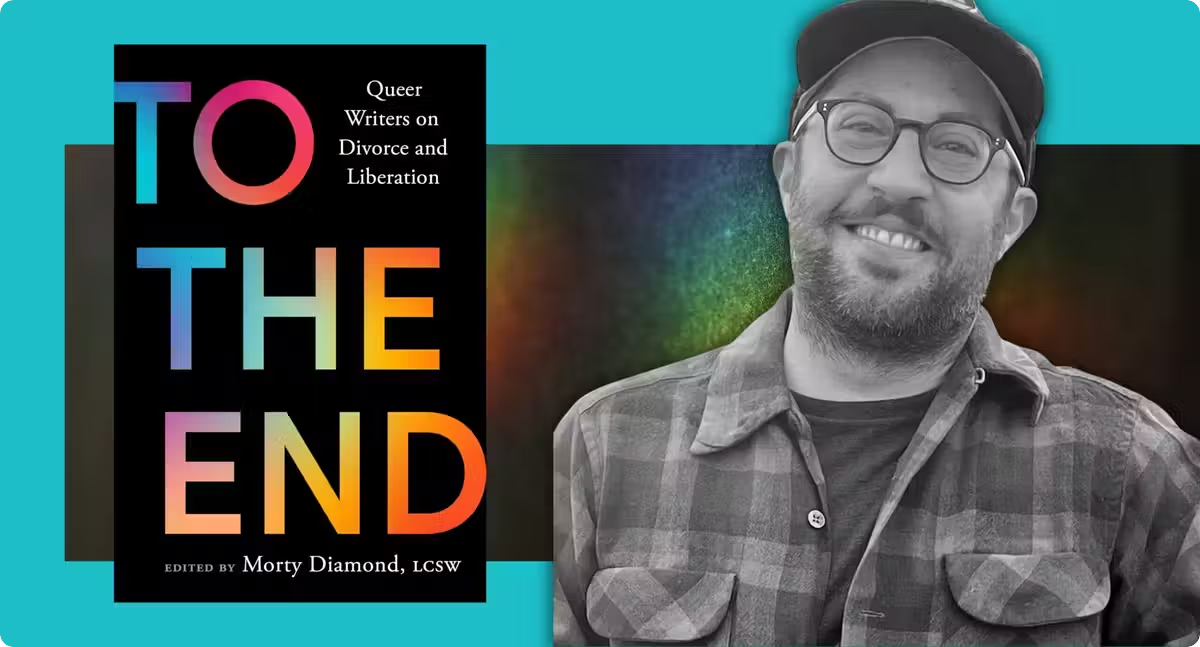
Morty Diamond, an author and queer and trans therapist, is called by friends the 'Prince of Queer Divorce,' a persona defined by his transparency in discussing divorce in social spaces—a stance that underpins his narrative collection. [1]
The article highlights the lack of popular narratives about queer divorce, contrasting it with the era when heterosexual memoirs about divorce dominated bestseller lists. [1]
In 2023, Diamond launched 'To the End Salon,' a weekly virtual event designed for queer and trans individuals to share their divorce and breakup stories within a supportive community setting. [1]
The narrative collection 'To the End: Queer Writers on Divorce and Liberation' features 24 LGBTQ2S+ authors and was inspired by the lack of concrete resources available for navigating the end of a marriage. [1]
The interview with Diamond explores the necessity of including divorce in discussions about marriage and the freedom that can be found at the end of a marriage. [1]
To create the collection, Diamond drew upon his own experiences with queer divorce and marriage. [1]
Diamond observed that existing resources regarding queer divorce are limited and primarily oriented toward the cisgender white community, largely ignoring BIPOC and Latinx writers. [1]
The author's solution was to create an anthology, considered an ideal starting point for facilitating conversations about divorce, the challenges encountered, and the lessons learned. [1]
Press coverage suggests a much broader audience for the book than just those who are divorced, anticipating that the volume will be useful to anyone navigating romantic relationships. [1]
The author views divorce as an intrinsic component of marriage and suggests that the book be read even before the wedding to provide a complete picture of the marital institution. [1]
'To the End' serves as a catalyst for debates on how the community supports divorced individuals and is recommended to therapists working with the queer population. [1]
The anthology documents the specific legal, financial, social, and emotional consequences of divorce within the queer community. [1]
Queer divorce is distinct because it avoids the interpretation of a referendum on the entire institution of marriage, as often happens with heterosexual divorces. [1]
The formalized process of divorce often exposes queer and trans individuals to more conservative institutions, unvetted attorneys, doctors, and judicial systems that may be hostile. [1]
Marriage offers a refuge from homophobia, transphobia, legal vulnerability, and housing instability, but divorce proceedings often reverse these protections by placing individuals at the mercy of unvetted, conservative institutions. [1]
It is very easy to lose power or have things go very wrong in these systems, according to testimonials gathered in the book. [1]
There is constant pressure to stay together, and the failure of marriages can leave queer individuals without any safety net if their families of origin reject them. [1]
For many, queer marriage was a survival strategy or a way to demonstrate self-worth, rather than a natural desire. [1]
Internal narratives regarding love, marriage, and the idea of relational failure play a crucial role in decisions to enter into marriage. [1]
It is difficult for queer individuals to openly discuss what does not work in their marriages and the consequences thereof. [1]
There is significant cultural silence surrounding queer divorce, fueled by the pressure to appear 'put-together' and to conform to dominant social norms. [1]
Divorce stories include experiences of trans individuals who realized they could no longer live authentically in heterosexual marriages. [1]
The book also encourages conversations about intimate violence and abuse in queer relationships, a topic rarely addressed sufficiently by the public. [1]
Some community leaders asked authors not to share their stories out of fear that they might be used by the far-right as arguments against the LGBTQ community. [1]
Due to the current political situation in the United States, 30% of the anthology's writers published under pen names. [1]
Although there is a risk that the information may become outdated, storytelling remains essential for the queer community. [1]
The experience of divorce led Diamond to reconsider his perspective on the institution and his own misconceptions about marriage. [1]
He does not oppose queer marriage but emphasizes the importance of understanding all the possibilities and risks involved. [1]
Diamond does not intend to marry again, preferring to live and support his current family in a cohabiting framework. [1]
Divorce stories reveal the possibilities of freedom that can be found after the end of a marriage. [1]
Divorce forces confrontation with vital aspects such as relationships, families, parenting, housing, and finances, offering the opportunity for rediscovery. [1]
The virtual salon becomes a space where individuals clarify their future and rediscover their identity after divorce. [1]
The author advocates for creating community-based arenas for listening and testimony, essential for healing. [1]
People want to be heard and seen fully, in a judgment-free environment, regardless of the meeting format. [1]
Dedicated spaces are needed for sharing ideas, tools, and practical information, such as finding an attorney after divorce. [1]
The interview has been edited for length and clarity. [1]
- Categories:
- Entertainment