On November 12, 2026, the Dutch channel RTL 5 broadcast the first episode of the reality show 'De Frogers', a production depicting the life of the large Froger family. In this premiere episode, the narrative focuses on the extensive network of relatives and family dynamics, noting that the family structure has grown significantly over time. Today, the core family includes not only original members but also close relatives, forming a group of sixteen people, along with grandchildren. The series captures both moments of joy and humor characteristic of family reunions, as well as spaces dedicated to memory and suffering, offering a complex picture of intergenerational relationships. The central emotional context of the first episode is tied to a recent loss suffered by one of the clan's important members. Natasja Froger talks about her close friend, Monique, who recently died after a battle against ALS (amyotrophic lateral sclerosis). Highlighting this tragedy sets the melancholic tone of the series, contrasting with the entertainment atmosphere typical of the reality show genre. The death of a close friend represents an emotional turning point, marking the beginning of a publicized grieving process transformed into a driving force for future actions. [1]
The practical action stemming from this emotional context is Natasja Froger's mountaineering initiative. In the debut episode, Natasja is presented as a participant in an ascent of Mont Ventoux, an iconic landmark in French mountain sports. This activity is not just a physical achievement but has direct social and charitable implications. Her participation in Mont Ventoux becomes a symbol of resilience and solidarity, transforming a physical challenge into an act of commemoration and support for the cause of her deceased friend. The charitable mission of the climb is clearly defined: fundraising for Stichting ALS, the foundation dedicated to combating amyotrophic lateral sclerosis. Natasja Froger states that this cause is personally relevant to her, a motivation that drives her to actively engage in mobilization efforts. Alongside Natasja, the climbing team includes her widowed friend's husband, Maurice, his stepdaughter Charlie, and her partner, Dean. This informal alliance, formed around shared grief, transforms the physical effort of the climb into a collective ritual of healing and solidarity, uniting those connected to Monique through love and loss. [1]
The history of the bond between Natasja Froger and Monique is revealed through Natasja's testimony. Their friendship began unexpectedly, starting from an initial charitable intervention. Natasja recounts how Monique, then a 33-year-old young woman, approached her directly, asking her to express gratitude toward her husband, who together with their daughter were participating in a charity bike ride on Mont Ventoux. The presence of a public figure in such an initiative was considered crucial for attracting media attention and, consequently, for the success of fundraising. This initial contact, though formal and cause-oriented, opened the door to a deep human connection. The evolution of their relationship surprised both parties through its intensity and unexpected nature. Curious and moved by the young woman's determination, Natasja immediately asked for whom Monica would attempt to climb the mountain. The answer received, 'For myself,' had a major emotional impact on Natasja, who describes the moment as 'a knife in the heart.' Recognizing Monique's personal suffering and vulnerability, visible in a young and apparently strong woman, created a solid bond. Unwilling to leave this situation emotionally unresolved, Natasja acted quickly: she took a train and went to visit Monique, transforming a superficial charitable interaction into a deep and lasting friendship. [1]
Joint ascents of Mont Ventoux formed the backbone of their friendship, becoming an annual ritual. Natasja explains Monique's increasing physical difficulty. During their first joint ascent, Monique managed to complete the route using her own physical strength. The following year, conditions imposed by the illness made the traditional physical effort impossible. Adaptation was necessary: Monique walked part of the way, requiring constant physical support, and the rest on a recumbent bicycle (ligfiets), a technology specific for people with motor disabilities. This adaptation demonstrates Monique's perseverance and desire to remain active and part of the mountaineering community, regardless of the physical limits imposed by the illness. The final tragedy of this story is marked by Monique's short lifespan; she died at just 38 years old. Beyond the sad numbers, the moment of ascent becomes a symbolic monument of human resistance. Climbing Mont Ventoux was not just a sport, but a metaphor for fighting against the impossible. Reaching the summit, even with adaptive aids, remained as proof of Monique's fearless spirit, a proof that continues to inspire those left behind, especially Natasja and her extended family. [1]
The annual ritual is perpetuated through the event called 'Tour du ALS', a special edition of the climb explicitly dedicated to the fight against amyotrophic lateral sclerosis. Natasja Froger decides to retake the mountain path, not as a physical test, but as an act of remembrance. Participants in this special edition include, besides Froger family members, Monique's widowed husband, Maurice. Maurice's presence transforms the climb from a simple charitable excursion into an active commemoration. Natasja describes the event's atmosphere warmly, recalling live music, the military choir, or the wind band sounding the starting horn, and enthusiastic volunteers creating a festive setting. For her, this event is a celebration of life, a way to honor memory through positive energy, in contrast to the sad silence of death. [1]
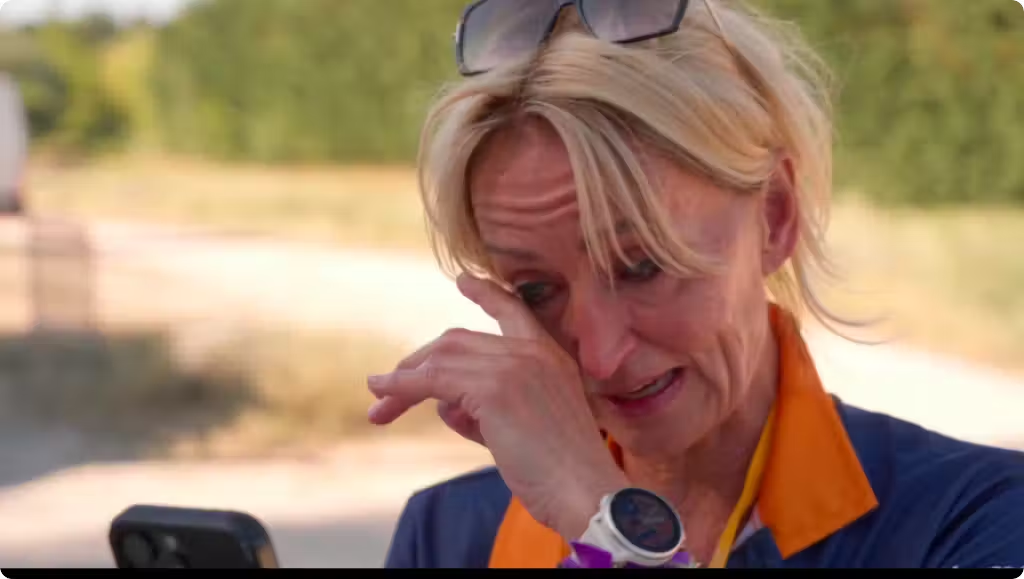
The summit cap is successfully reached, but the moment at the top is accompanied by an emotional outburst. Descending from the difficult trail, Natasja feels the overwhelming weight of Monique's absence. At this moment of spiritual and physical closure, her natural gesture is to contact her closest family member: her husband, René. René was in a completely different context, occupied with preparations for a massive concert by the popular Dutch band 'De Toppers'. This juxtaposition of realities—a silent and heavy mountain peak while the other spouse prepares for much noise and light—accentuates the loneliness of Natasja's critical moment. On the phone, Natasja communicates the results and feelings of the climb. She mentions that it was a painful and demanding climb, but the joy of victory is much stronger. At the same time, she expresses deep regret at not being beside her husband in that moment of triumph, feeling a need for her usual comfort. Furthermore, crying, Natasja confesses that the material result of the effort is remarkable: the team raised over two million euros for ALS research and combating ALS. This huge number of donations validates the immense physical effort made. Natasja describes the experience as extraordinary ('zo gaaf') and boasts about achieving this feat alongside Charlie and Dean, highlighting the importance of family support in the grieving healing process. [1]
The series 'De Frogers', documenting these intimate and public events, officially premieres on channel RTL 5 starting November 12, with daily scheduling on Thursdays at 8:30 PM. Also, for consumers who prefer streaming platforms, all episodes will be available early on the Videoland platform, a week before television broadcast, allowing viewers to anticipate the development of the Froger family dramas and charitable succession. Additional information and articles related to the series and the family's charitable campaigns can be accessed by subscribing to the LINDA publication's newsletter, which offers a curated selection of relevant content for the interested public regarding the lifestyle and social aspects of these Dutch media personalities. [1]
- Categories:
- Entertainment
- Entities: