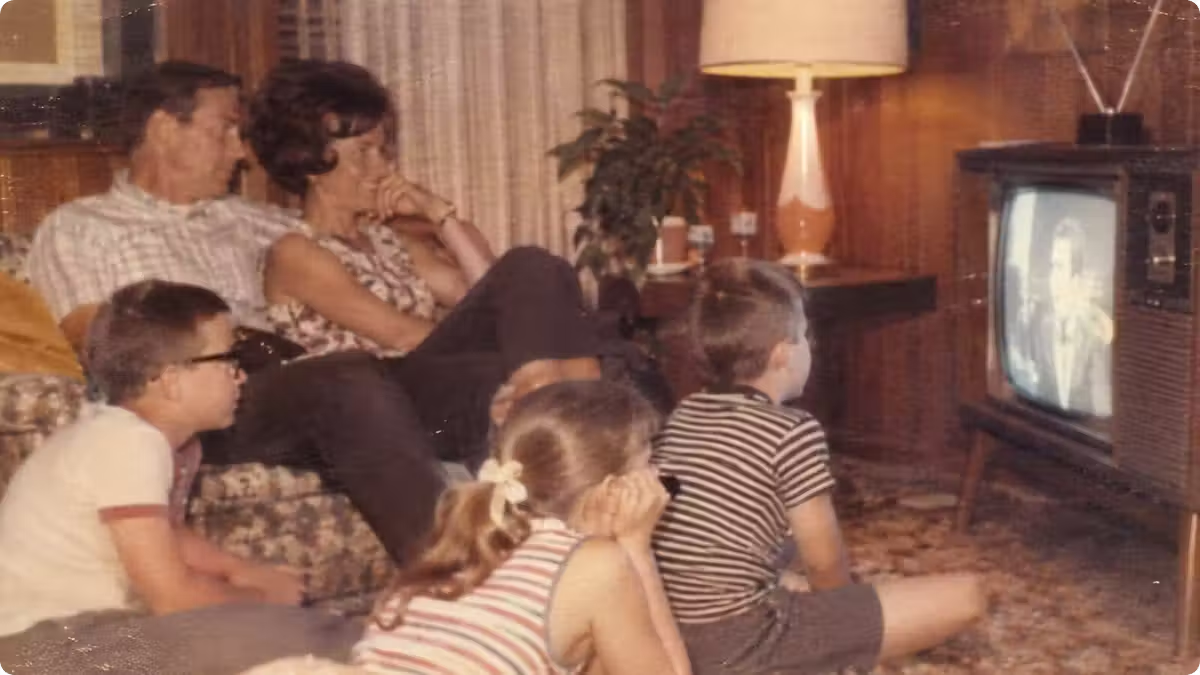
In the last two decades, a single television was the norm in most American households, a bulky device that dominated the living room. To change channels, one had to stand up, cross the room, and manually turn a dial, while other family members watched this action, turning the choice of program into a public act. According to Nielsen data reported by the Associated Press in 2006, the share of households with only one TV had already fallen to 19%, and the average home had more televisions than inhabitants. Socialization through mini-compromises was imposed by the reality of a single screen. There were no explicit lessons on the value of negotiation; the single TV set forced thousands of small spontaneous negotiations, building a resilience and tolerance that survived the arrival of the second and third televisions in the house. This tolerance for rejection manifests today in behaviors such as accepting the choice of restaurant or movie time that were not the first choices, or accepting someone else’s playlist. Individuals registered losses by remaining present in the group, without retreating into digital isolation. The second distinct aspect is the ability to follow a single thing to the end with full attention. The lack of a second screen meant that if programs were slow or boring in the middle, the viewer had to stay engaged, because leaving the room meant missing the ending. In the contemporary context, this skill contrasts with the tendency to keep a phone within reach to check sports scores or details about an actor while watching a scene. People who grew up with a single television practiced total attention on what was in front of them, without being forced to make this transition through the absence of digital alternatives. Watching a single program entirely was the only way any household member consumed media content at that time. These psychological traits developed in the context of a single television—patience, the ability to accept the minority role, and focused attention—suggest that the common experiences of previous generations shaped behaviors that are lost in the era of modern digitally multiplexed devices. The article analyzes how television technology influenced the structure of family interactions and the development of social coping mechanisms, such as tacit negotiation and frustration tolerance, while highlighting the discontinuity of these experiences in younger generations. Sources mentioned in the original text include Nielsen for television penetration data and the Associated Press for 2006 reports, strengthening the statistical validity regarding the shift from single-television households to multi-device setups. The analysis emphasizes that, as the single TV disappears from households, the informal learning mechanisms for compromise and collective patience also disappear, making way for heightened digital individualism. The historical context of 1975, with 57% of households having a single television, represents the peak of an era of collective attention concentration, which gradually dissolved until it reached 19% in 2006. The authors suggest that these experiences are not just nostalgia, but form the core of concrete social skills, visible in the adult behavior of those who lived through that era. The text also includes references to other subjects of popular psychology, such as night-time rumination or strategic optimism, but these do not constitute the core of the main argument regarding the impact of the single television. These secondary mentions serve as general editorial framing for the Bolde platform, within the broader discussion of generational personality traits. [1]
This dynamic was a stable presence for approximately twenty years. In 1975, 57% of households owned exactly one television, and the decision on what to watch was made democratically in the common room, by the person physically present in that room. The first distinct trait was the ability to accept defeat in a vote and remain involved. In the typical situation with four people and a single screen, not everyone could have their preferences satisfied simultaneously. Those who lost the vote learned this publicly, in front of the entire family, without receiving immediate consolation or access to another screen. This physical constraint on attention created the ability to focus on a single element for a long time, regardless of its pace. This included stabilization periods, uninteresting subplots, or long advertisements. [1]
Children who did not get what they wanted did not retreat to separate rooms, but remained on the sofa or on the floor, watching the program chosen by the majority. This exposure to direct disappointment, without it being treated as a personal injustice, developed the ability to register loss and continue active participation, rather than isolating oneself. [1]
- Categories:
- Entertainment
- Entities: