Bill Hader, known for his collaborations with HBO and NBC, offers a perspective on his elevated cinematic taste through the lens of children's films. The SNL actor and comedian, who has provided voices for major animated projects such as 'Inside Out' and 'Cloudy With a Chance of Meatballs', is the center of a discussion dedicated to his talent for interpreting roles intended for young audiences. The immediacy of this focus is tied to the weekly release of the recent adaptation 'The Cat in The Hat', based on Dr. Seuss's 1957 children's literature classic, in which Hader brings the central character, the mischievous cat, to life. [1]
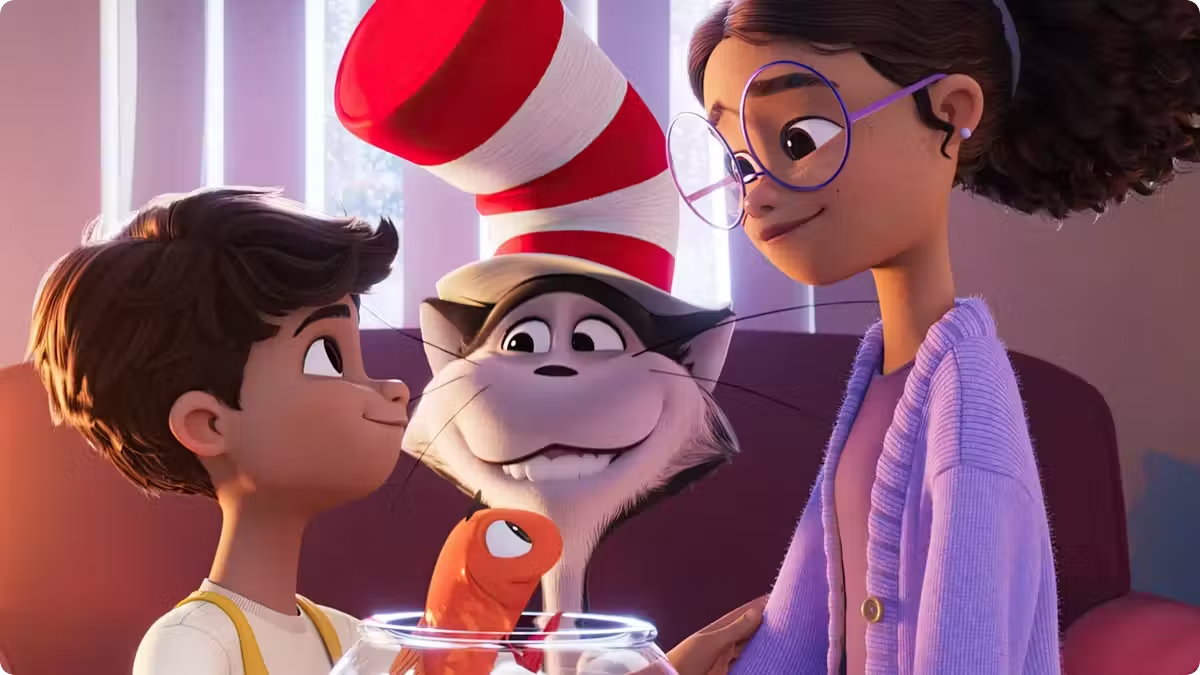
The adaptation of 'The Cat in The Hat', directed by Alessandro Carloni with a screenplay by Erica Rivinoja, is described as a seductive journey that balances the nonsense necessary for children with a solid story for adults. The cast includes names such as Quinta Brunson, Matt Berry, and Giancarlo Esposito, in a vision that is family-friendly yet amusing. This current approach contrasts with Hader's previous involvement in the role of the cat, specifically a 2014 sketch on Saturday Night Live, which had a different tone. [1]
As a father of three daughters, Hader states that his parenting experience has exposed him to a wide range of children's films, from 'Frozen' and 'Tangled' to more obscure productions. He highlights the difficulty of sharing his cinephilic culture without irritating his children, quoting the actor as saying: 'You don't want to push it too hard.' For every classic film he tries to introduce to his girls, they reject an average of ten other titles, finding them boring. This parental dynamic serves as the framework for the subsequent selection of films the actor recommends to a broader audience. [1]
Among Hader's elite cinematic preferences is the 1953 classic western 'Shane', directed by George Stevens. This film holds a special place in the actor's memory, not so much through its traditional genre characteristics, but through the layer of moral depth that undermines standard expectations of heroism. [1]
Hader explains that his attraction to 'Shane' stems from his childhood, when his father told him about the movie because there weren't many westerns on television at the time; these were his father's favorites, along with those of his uncles. The fact that Hader did not grow up in an era saturated with westerns did not prevent the lasting impact of this work on him. [1]
What fascinated Hader most in 'Shane' was the complex dynamic between the character played by Alan Ladd, a gunslinger, and the local boy who idolized him. Although the film seemed to promote a simple heroic sensibility, the actor observed an underlying subtlety of honesty, namely the idea that a life of banditry is not worth living. Additionally, Hader considers the character of the father, played by Van Heflin, much more attractive than the white anti-hero protagonist, a reversal of western conventions. [1]
The tragic and melancholic ending of the film deeply impressed Hader since he was a child, offering him a mature lesson about narrative structure and consequences. 'Shane' seemed to him a clever coming-of-age story, masking depth behind the facade of a typical heroic western film. The film's ability to deceive the viewer through appearances and deliver a story with emotional and intellectual weight remains a benchmark of his cinematic taste. [1]
The 1924 silent comedy short 'Sherlock Jr.' by Buster Keaton represents another milestone in Hader's preferred collection. Considering Keaton one of his absolute favorites, the actor uses this short film as an educational tool for his children, although he initially feared appearing pretentious trying to teach them silent film. [1]
Contrary to his fears of being perceived as a pedantic cinephile, his daughters, then very young, reacted positively to Keaton's work. Hader observes that although he was concerned about their response to silent films, the girls found entertainment and depth in 'Sherlock Jr.' and in 'Three Ages', Keaton's interpretation of D.W. Griffith's 'Intolerance'. Watching the film through his children's eyes allowed him to rediscover the amazement this art can provoke at any age. [1]
The re-release of 'Sherlock Jr.' at the Cinema Aero in Los Angeles a few weeks ago consolidated Hader's appreciation for Keaton's work. The actor notes the film's resistance to time, declared built more than a century ago, stating that it works on all levels better than most modern productions. He defines Keaton not as a European-style auteur director, but as a curious variety comedian, interested in the language of film – editing, framing, physicality – and deserves credit for establishing the blueprint for the filming of physical comedy and action. [1]
Hader emphasizes the innovative nature of silent films: they didn't know what they wanted to do yet, so creation resulted from authentic openness and curiosity. 'I don't know, we had this idea, let's discover it in a truly open and curious way,' he says, describing the process by which this cinema invented its own visual language, a working method admired today for its efficiency and universality. [1]
Parallel to his admiration for Keaton, Hader mentions that he watched Charlie Chaplin films with his daughters, including 'City Lights', 'The Circus', and 'The Gold Rush'. However, he notes that the girls found Charlie Chaplin more difficult to assimilate than Keaton's dry and mysterious brutality. The emotional censorship Chaplin applied to characters did not offer the same void onto which children could project their own feelings, unlike Keaton's cold and calculated expression. [1]
Another of Hader's preferences, present since childhood and viewed alongside his parents, is 'It’s a Mad, Mad, Mad, Mad World' from 1963, directed by Stanley Kramer. A long film, full of chaotic sequences and vast physical comedy, it is celebrated for its ensemble of comedians including Jonathan Winters, Phil Silvers, Spencer Tracy, and Hader's personal favorite, Dick Shawn, characterized as the little mother. [1]
Although Stanley Kramer's films were often labeled as sentimental, didactic, or overly preachy, 'It’s a Mad...' is a notable exception because it is simply fun. Foundational memories related to watching it alongside parents and grandparents remain vivid, and recently, his youngest daughter saw her father watching the film with her nephews, who laughed and replicated scenes, confirming the universal comedic value of the product. [1]
The repetitiveness of viewing does not weary either the children or their father. Hader reiterates the general principle: do not insist if they get bored, offering the modern alternative ('Nobody Wants This' or 'Off Campus'). Cultural balance remains a delicate exercise, but the reward – the shared laughter of children repeating jokes from classic films – validates the effort. [1]
Another animated film that left a deep impression on Hader is 'The Secret of NIMH' from 1982, directed by Don Bluth. As a child, he liked it for its dark, almost frightening atmosphere, far from the visual safety of Disney at that time. The internal mythology created behind the garden – an unknown kingdom – amazed him, giving him the sensation of a hidden world beneath the surface of daily reality. [1]
A specific scene from 'The Secret of NIMTH', one in which the crow (voice by Dom DeLuise) catches sight of a cat suddenly appearing in the visual field, seemed extremely gruesome to Hader. He notes the overwhelming effect of this long shot and sudden surprise, an element that aroused his terror as well as admiration. The consequence was a disposition to accept dark themes, even for children, as long as certain reasonable limits were respected. [1]
The story of rats subjected to experiments, their fall into the abyss, and the fight with swords at the end represented, for adolescent Hader, a summit of narrative stakes. Unlike Disney, which avoids darkness, 'The Secret of NIMH' hides nothing, and this crudeness of image and destiny marked him, confirming his impression that children's films should not deny the existence of fear. [1]
Hader declares himself a supporter of the idea that fear is beneficial for emotional development, even in the case of children. He emphasizes that, paradoxically, he was happier that he was frightened while watching the film, because once the fear passes, a deeper appreciation appears for the story's capacity to provoke emotion. A studio director today would likely not approve scenes with dead owls or spider webs, but for Hader that tension was essential. [1]
'The Nightmare Before Christmas' (1993), directed by Henry Selick, was another defining title, released when Hader was in his first year of high school. His first review, written for the school newspaper, was a modest tale of artistic humility: he wrote a poor critique, which the editors completely rewrote, although he liked the film enormously. His connection with Tim Burton's universe, although Burton did not direct effectively (the role falling to Henry Selick), was strengthened by the appreciation of the masterpiece's music and visuals. [1]
Ten years after its release, Hader looked at crowds of fans wearing Jack Skellington t-shirts, surprised at how a film considered at the beginning a bizarre novelty became a major cultural phenomenon. Crediting the continuous effort of Selick along with the animators, Hader emphasizes the importance of artistic visionaries who build their own universes without conforming to prevailing models. He credits the music, especially Catherine O'Hara's song as Sally, as being extremely moving. [1]
Hader's stubbornness to watch 'The Nightmare Before Christmas' with his children every Halloween and Christmas culminated recently, when the youngest of the girls sang the main song in a school performance. The moment seemed symbolic, 'full circle', leading him to feel overwhelming emotion. Catherine O'Hara's recent change in disposition turned him into a man crushed by emotion at that moment of reconnection with the art and with his daughters' childhood, confirming the power of art to link generations. [1]
This sequence of events and reflections on classic films illustrates how Bill Hader's artistic taste is structured not only based on aesthetic values, but also through the prism of family relationships and the transmission of cultural memory. From westerns to silent movies, up to gothic animations, his filmography of recommendations reveals an aesthetics that values moral depth, physical comedy, and a dose of unease necessary for emotional development. [1]
Hader's interest in children's stories does not reduce to passive consumption, but involves an active effort to integrate them into the mentality of the next generation. Although some attempts to educate them are rejected, successes – whether it be laughter at 'It's a Mad...' or tears at the song from 'The Nightmare...' – fuel the belief that these works are not just entertainment products, but essential tools for existential learning. [1]
Both the current 'The Cat in The Hat' and previous projects demonstrate Hader's interest in an accessible yet complex art. His role in the new adaptation of Dr. Seuss promises to bring a familiar tone, joining a pantheon of children's films which, in his opinion, transcend simple categorization as 'children's events' and enter a universal cinematic space. [1]
Combining a taste for time-tested cinematic techniques (Keaton, Kramer) with narrative vulnerability (Selick, Bluth), Hader offers a model of mature audience that does not renounce emotional and aesthetic complexity. Being an influential voice in the entertainment industry, this personal catalog can guide the success and perception of new children's adaptations, through the prism of his demand for authenticity and depth. [1]
As 'The Cat in The Hat' finds its audience, it will probably also be viewed through that lens of intellectual comparison. Hader has demonstrated that there is continuity between what is transmitted on screens and what is taught at the dinner table. His film this week will not just be a commercial venture, but another fragment of the legacy he wishes to leave alongside his daughters. [1]
In the end, the statements and preferences of Bill Hader in this review, published in GQ, are not just anecdotes about the tastes of a star, but manifestations of a pedagogical philosophy. Mediating between the glorious past of global cinema and the guaranteed future of Dr. Seuss adaptations, he remains a guarantor that regardless of format, the story of good sense and resonant fear remains the main weapon against mediocrity. [1]
- Categories:
- Entertainment
- Entities:
-
- GQ
- SNL
- Off Campus
- Giancarlo Esposito
- The Cat In The Hat
- Buster Keaton
- Quinta Brunson
- Frozen
- HBO
- Tangled
- Akira Kurosawa
- D.W. Griffith
- Alan Ladd
- Errol Morris
- John Ford
- Bill Hader
- Inside Out
- Erica Rivinoja
- Alessandro Carloni
- Matt Berry
- Barry
- Cloudy With A Chance Of Meatballs
- Shane
- Sherlock Jr.
- D.A. Pennebaker
- Brandon Dewilde
- Van Heflin
- Intolerance
- Three Ages
- Criterion Closet
- Documentary Now!
- Aero Theater