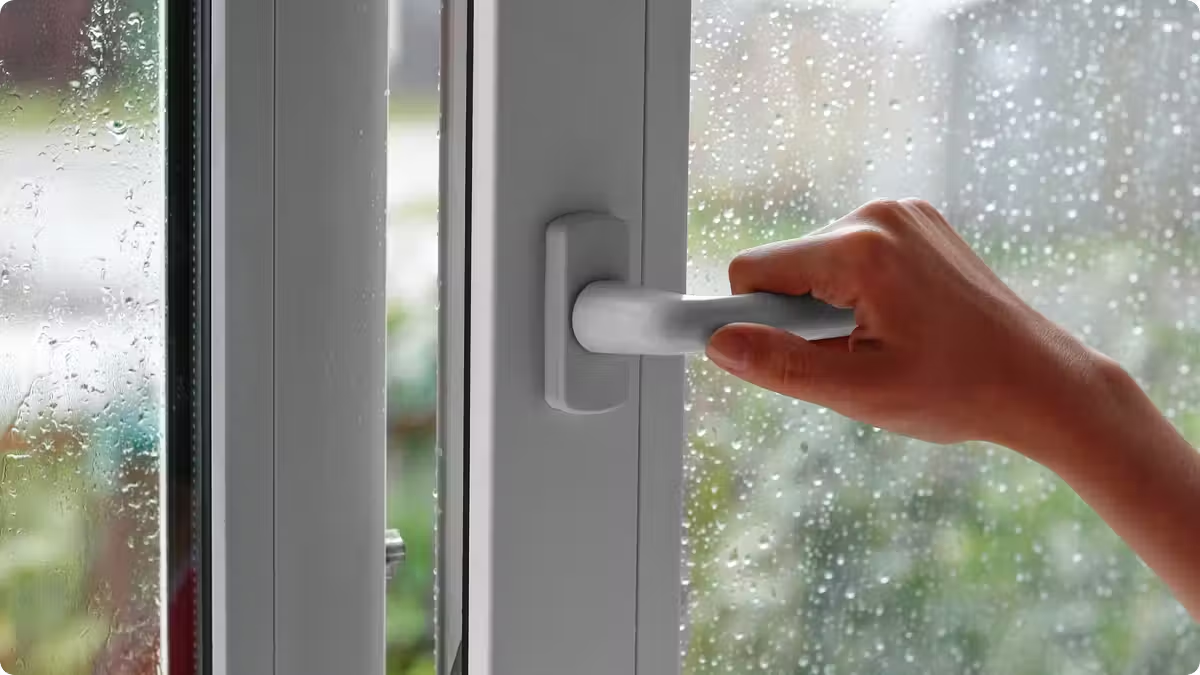
Contrary to common intuition, leaving windows open during rain does not necessarily increase indoor humidity, but can be an efficient solution for ventilation. Martin Brandis, an energy expert at the Consumer Center (Verbraucherzentrale), explains that the decisive factor is not the presence of precipitation, but the temperature difference between the interior and exterior. Warm air can hold much more water vapor than cold air: the maximum absorption capacity doubles with every 10-degree Celsius increase. [1]
A concrete example from the Bavarian Energy Atlas illustrates this physical phenomenon. External air, at a temperature of 4 degrees Celsius and a relative humidity of 100 percent, contains approximately 5 grams of water per kilogram of air. When this cold air enters a heated room at 20 degrees, its temperature increases, and its relative humidity drops sharply to approximately 35 percent, although the absolute amount of water in the air remains unchanged. Thus, the ventilation process is beneficial regardless of external weather conditions. [1]
However, there are conditions under which this general rule does not apply. In the event of strong wind or storms, windows should remain closed until the weather subsides to avoid rainwater penetration, which can cause damage to walls or floors. Additionally, during summer, when indoor and outdoor temperatures are similar, ventilation during rain does not significantly reduce humidity, although it will change the air composition, still providing superior air quality. [1]
The most effective time for ventilation is morning and evening, when outdoor temperatures are the lowest. This practice is also valid for periods with fog or snow, considering that the risk of mold is already lower in summer due to minimal condensation on cold surfaces. For correct ventilation, experts recommend opening windows fully for 5 to 15 minutes, several times a day, depending on the outdoor temperature, avoiding 'cracked window' positions (kip). [1]
To maximize efficiency and avoid water entry, it is recommended to open windows on the side opposite to the wind direction. During the ventilation process, radiator thermostats should be lowered to prevent unnecessary loss of heated warmth. The use of a hygrometer is essential for monitoring relative humidity; if it exceeds 60 percent, ventilation becomes necessary, and in well-insulated homes, the threshold may be even lower. Especially in the kitchen and bathroom, where a lot of moisture is generated, thorough ventilation in the morning and evening is crucial, especially for people who do not live constantly in the residence. [1]
- Categories:
- Education