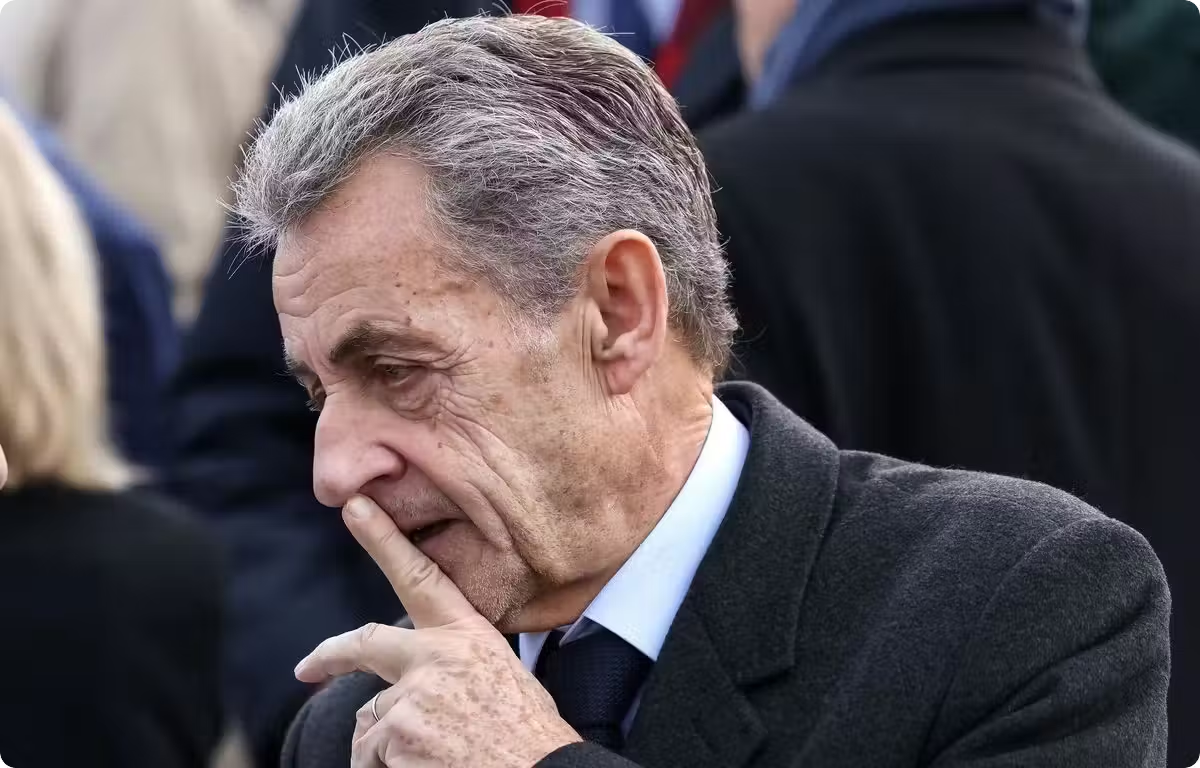
Former French President Nicolas Sarkozy has issued a stark warning regarding the nation’s economic future, predicting that a severe financial crisis is imminent and could occur before the scheduled presidential election in April and May 2027. In an interview published on Friday by *Le Figaro*, the conservative leader described the situation as akin to “dancing on a volcano,” suggesting that the threat of a financial “tsunami” is not a matter of if, but when. His commentary highlights deepening concerns within the French political establishment about the sustainability of current fiscal policies and the stability of the country’s finances amidst growing global economic pressures. [1]
Sarkozy argues that the immediate legislative priority, specifically the vote on the 2027 budget currently being pushed through by Prime Minister Sébastien Lecornu’s government, will be insufficient to mitigate these risks. According to the former president, structural reforms are urgently required rather than temporary financial fixes. He identifies two primary levers for action: a significant reduction in public expenditure, particularly through a decrease in the number of public servants, and an increase in the working lifespan by raising the retirement age. These proposals align with long-standing conservative economic platforms but mark a sharp departure from the current administration's approach. [1]
Beyond economic policy, Sarkozy used the platform to articulate his vision for consolidating the right-wing and centrist vote ahead of the next presidential race. He voiced strong support for organizing a broad primary election designed to select a single candidate from the right and center. Unlike previous iterations of such primaries, which faced internal resistance and limited participation, Sarkozy advocated for a process open to all candidates who agree to abide by specific rules. This stance places him in alignment with figures such as Bruno Retailleau, Gabriel Attal, and David Lisnard, who have also championed the idea of a unified primary. However, it stands in direct opposition to Édouard Philippe, the current Mayor of Le Havre and former Prime Minister, who has rejected the concept in favor of running independently or under a specific party banner. [1]
While Sarkozy refuses to endorse any specific contender for the upcoming primary, citing his own defeat in the initial round of the 2016 right-wing primary, he pledged to support whoever manages to assemble the widest coalition. He explicitly ruled out the possibility of Christine Lagarde, the current President of the European Central Bank (ECB), entering the race. Despite expressing personal “admiration” for Lagarde, Sarkozy dismissed her potential candidacy, likely due to her high-profile international role and the logistical challenges associated with leaving her position at the ECB. His comment echoes recent assurances from Lagarde herself, who stated in late September that a presidential run would be “not at all a good idea,” citing her age (70 years old at the time of the statement) and the need for vitality and energy for such an endeavor. [1]
The debate over the shape of the right-wing opposition is unfolding against a backdrop of shifting poll numbers that suggest high volatility in the French electorate. A recent survey conducted by Cluster 17 for *Politico* indicates that Christine Lagarde, had she entered the race, would perform surprisingly well, capturing 14% of voting intentions. This figure slightly edges out Édouard Philippe, who currently sits at 13.5%, suggesting a “very strong liquidity” in the central political space. The poll also shows Jean-Luc Mélenchon surpassing 20% for the first time, though still trailing behind Marine Le Pen’s 30.5%. These figures underscore the fragmented nature of the current political landscape, where traditional party structures are struggling to maintain dominance, and outsider candidates or technocrats like Lagarde may find unexpected openings. [1]
As France approaches the 2027 electoral cycle, the intersection of economic anxiety and political realignment defines the current discourse. Sarkozy’s call for drastic fiscal measures and a unified conservative candidate reflects a strategy aimed at recapturing the initiative from both the left and the far-right. Whether his warnings about a impending financial tsunami galvanize voters or fuel further instability remains to be seen. Meanwhile, the resistance from key figures like Édouard Philippe to the primary model suggests that the path to a consolidated right-wing candidate will be contested, potentially leaving the field open for independents or cross-party alliances that Sarkozy himself has tried to discourage. The coming months will be critical in determining whether the predicted crisis materializes and how the political elite responds to the growing pressure from a public increasingly skeptical of traditional governance. [1]
As the story develops
Update
Sarkozy Rejects Ban on La France Insoumise, Calling it a 'Curious Vision of Democracy'
In the same interview, Nicolas Sarkozy expressed his opposition to the proposal of banning the La France Insoumise (LFI) party, describing such a measure as having 'no sense.' To illustrate his point, he ironically compared banning the party to asking doctors to 'ban fever in winter.' This position directly counters a suggestion made in early October by Bruno Retailleau, who had described LFI as a party that 'calls for sedition,' although Retailleau acknowledged that such a ban would be legally difficult. Senate President Gérard Larcher had also previously supported Retailleau's view, stating that the question of a ban could be raised. [2] [4] [3]
Sarkozy further clarified that while he feels 'no sympathy' for Jean-Luc Mélenchon, he believes that as long as the Insoumis have the right to compete in elections, they are part of the 'republican arc.' He extended this reasoning to the National Rally (RN), asserting that attempting to ban either party—both of which polls suggest could reach the second round of the presidential election—would represent a 'curious vision of democracy.' [4]
Regarding his preference for the 2027 presidential race, Sarkozy remained vague, reiterating that his support in the first round will go to whichever candidate from the right and center manages to build the broadest possible coalition. [4]
- Categories:
- Economy
- Entities:
Sources
- 20 Minutes « Nous dansons sur un volcan »… Sarkozy prédit un « tsunami » financier, peut-être avant la présidentielle
- 20 Minutes Présidentielle 2027 : Nicolas Sarkozy ne veut pas interdire LFI, à rebours de Bruno Retailleau
- bfmtv.com "Une curieuse vision de la démocratie": Nicolas Sarkozy se dit contre l'interdiction de LFI suggérée par...
- fr.news.yahoo.com "Une curieuse vision de la démocratie": Nicolas Sarkozy se dit contre l'interdiction de LFI suggérée par Bruno Retailleau