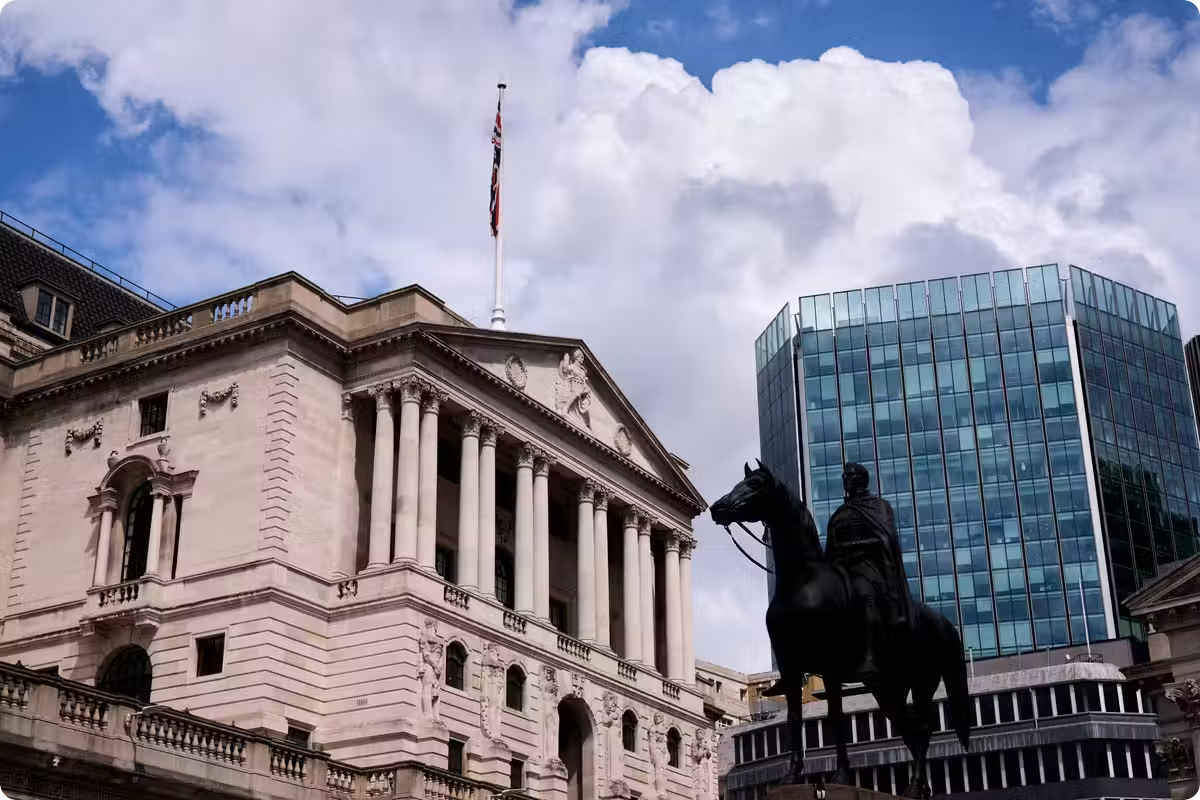
The Bank of England has raised interest rates for the first time in over three years, warning that more increases may follow if conflicts related to Iran are not resolved. At its last meeting, the Monetary Policy Committee (MPC) decided to raise the central bank's base rate from 3.75% to 4%. This marks the first increase in borrowing costs since August 2023. [1]
All nine members of the committee voted for this increase, although one member, Catherine Mann, preferred a more significant rise of 0.5 percentage points. The MPC argued the necessity of intervention to control rising inflation in the British economy, which is fueled by the impact of the ongoing conflict between the United States, Israel, and Iran on global energy and fuel prices. [1]
Governor Andrew Bailey said: “There is now sufficient inflationary pressure in the pipeline caused by rising energy prices, justifying a rise in the bank’s interest rate.” He emphasized that today’s increase should not be interpreted as the first step in a series of inevitable long-term hikes. However, he added: “Unless the Middle East conflict is resolved, it does not seem likely to be the last increase.” This position sends a clear signal to borrowers that further tightening is approaching at a time when the cost of living is rising. [1]
According to the MPC's statement, many companies have so far absorbed higher energy costs within their profit margins or protected themselves against sudden price hikes, as the war began roughly nine months ago. However, the bank warned that these “buffers will prove only temporary” and that these cost pressures will eventually pass through into higher consumer prices if the energy shock persists. This suggests households may face price increases in stores for products such as food, drinks, and other goods and services. [1]
Interest rates are usually raised in an attempt to reduce the inflation rate, hoping that higher borrowing costs will negatively influence demand, causing companies to limit price increases. On Thursday, the Bank of England announced that it expects inflation to continue accelerating in the coming months, peaking at “approximately 5%” in the second quarter of 2027. Subsequently, it is likely to decline steadily until it reaches the central bank's 2% target in the third quarter of 2028. [1]
This projection of rising living costs comes despite the efforts of Andy Burnham's Government to support households in the budget released last week. Bank research indicated that budget measures, such as removing VAT from household electricity bills, are likely to reduce the inflation rate by approximately 0.25% in the second quarter of next year. [1]
The inflation spike is driven primarily by rising energy prices, linked to the escalating conflict in the Middle East in recent months. Household energy bills are set to be a major determinant of inflation, with expectations that regulator Ofgem will raise the price cap for household bills by nearly 25%, to an average annual bill of £2,150 in January. [1]
The bank's report indicated that higher energy costs could feed into supply chains through next year as some firms roll over their hedges for energy prices. The bank also predicts that UK households will face higher food prices, with food inflation expected to rise to 4.8% next year. This is linked to higher energy costs for producers, as well as possible supply chain pressures related to the El Niño weather system. [1]
However, the bank noted that the UK economy has been more resilient than previously anticipated in recent months. It stated that higher business investment, partly linked to artificial intelligence, contributed to stronger growth so far this year. The UK economy is now projected to grow by 1.6% this year, compared to a previous forecast of 1.1%. Economic growth is then expected to ease slightly to 1.3% amid the pressure generated by higher inflation, which remains above the 1.1% projected in July. [1]
In conclusion, the Bank of England has lowered its growth forecasts for 2028 and 2029 as high inflation and interest rates exert pressure on potential demand. [1]
As the story develops
Update
Bank of England raises interest rate to 4%; inflation to reach 5% amid war with Iran
The Bank of England has raised the interest rate by 0.25 percentage points to 4% and warned that another increase is possible if the war between the United States, Israel, and Iran does not end. The Monetary Policy Committee (MPC) indicated that UK inflation is estimated to reach approximately 5% in the first half of 2027. Keep only paragraphs corresponding to this source in the broader context of the news about the interest rate hike, including specific details on inflation projections and anti-inflationary efforts. [3]
This represents the first interest rate hike since August 2023, making the UK the last major central bank to launch a cycle of monetary tightening after the outbreak of war between the US, Israel, and Iran eight months ago. Most of the committee voted for the 0.25 percentage point increase (8 votes), while only one member opposed, calling for a sharper rise of 0.5 percentage points, up to 4.25%. [3]
The MPC mentioned in its statement that “the Middle East conflict is now in its ninth month,” highlighting high and rising global energy prices. [3]
Update
Bank of England raises interest rate to 4% amid Middle East tensions
The Bank of England has raised the base interest rate by 0.25 percentage points, from 3.75% to 4%, for the first time since August 2023, marking the beginning of a new cycle of monetary tightening. [4]
The Monetary Policy Committee (MPC) voted unanimously for the increase, although a single member, Catherine Mann, opted for a more aggressive rise of 0.5 percentage points, up to 4.25%. [4]
Governor Andrew Bailey explained that inflationary pressure caused by rising energy prices justifies the measure, but specified that it is not an inevitable process. He warned that in the absence of a resolution to the Middle East conflict, further increases are likely to follow. [4]
The bank warned that the temporary “buffers” created by companies absorbing energy costs within profit margins will run out, leading to price increases for consumers, including food, drinks, and other goods. [4]
The bank's projections estimate that UK inflation will continue to rise, reaching a peak of approximately 5% in the second quarter of 2027, before gradually falling towards the 2% target in the third quarter of 2028. [4]
Government measures by Andy Burnham, such as removing VAT from household electricity bills, could reduce inflation by approximately 0.25% in the second quarter of next year, but will not fully counteract the effects of the energy shock. [4]
Regulator Ofgem is expected to raise the price cap for household bills by almost 25%, up to an average annual amount of £2,150 in January, further fueling the inflation rate. [4]
High energy costs will persist in supply chains through next year as companies roll over their price hedges. Food inflation is predicted to rise to 4.8% next year, due to energy costs and the effects of the El Niño weather system. [4]
The British economy has proven more resilient than estimated, growing by 1.6% this year, supported by high investments in technology and artificial intelligence. Economic growth is forecast at 1.3% in the future, superior to previous estimates. [4]
Despite current economic resilience, the Bank of England has revised its growth forecasts downward for 2028 and 2029, with high inflation and interest rates exerting pressure on potential demand in the long term. [4]
At first publication: Bank of England, inflation, interest rates, Iran, savings, Middle East, price increases, cost of living, MPC, investments. [4]
Update
Bank of England raises interest rate to 4% and warns that further increases will follow if the war with Iran continues
British Prime Minister Andy Healey condemned the imposed costs of the conflict with Iran, stating that it “hits the pockets of families and businesses in the country” and highlighted recent budget measures to alleviate pressures. [5]
Update
Bank of England raises interest rate to 4% and warns that further increases are coming
The Bank of England has raised the base interest rate by 0.25 percentage points, from 3.75% to 4%, marking the first increase in more than three years and the central bank’s direct response to the inflationary shock triggered by high energy prices in the context of the Middle East conflict. [6]
Governor Andrew Bailey warned that although the current increase should not be interpreted as the start of an inevitable sequence of tightenings, it remains likely if the Middle East conflict is not resolved, sending a clear signal to borrowers regarding the price of credit. [6]
Amid volatile oil prices, Governor Bailey emphasized that many price increases are “already in the pipeline,” even if the conflict finds a quick resolution, and inflation expectations will peak at “approximately 5%” in the second quarter of 2027. [6]
Energy prices are set to be a major driver of inflation, with regulator Ofgem expected to raise the price cap for household bills by almost 25%, up to an average annual amount of £2,150 in January. The economic impact of the war led Prime Minister John Healey to adopt compensation measures, including £100 energy payments for 20 million households, strengthening VAT cuts on electricity, and maintaining fuel duty, in an attempt to offer “breathing space” to families. [6]
Government protections, such as removing VAT from household electricity bills, could reduce inflation by approximately 0.25% in the second quarter of next year, but the Bank of England expects the energy shock to persist and pass through into food prices (predicted at 4.8% inflation), supported by meteorological factors such as El Niño. The UK economy has proven resilient, being forecast at 1.6% growth for the current year, supported by investments in technology and artificial intelligence, although the Bank of England has lowered growth forecasts for 2028 and 2029 due to the negative effects of high inflation and interest rates. Economic experts such as Thomas Pugh from RSM UK and Matt Swannell from the Item Club suggest that the risk of embedding shocks into wages and prices indicates the need for further increases, with an increase in February considered very likely, meaning the interest rate would reach 4.25%. [6]
- Categories:
- Economy
- Entities:
Sources
- standard.co.uk Bank hikes interest rates to 4% and warns more to come if Iran war continues
- standard.co.uk Bank hikes interest rates to 4% and warns more to come if Iran war continues
- CNBC Bank of England hikes interest rate for the first time since Iran war, warns inflation will near 5%
- standard.co.uk Bank hikes interest rates to 4% and warns more to come if Iran war continues
- standard.co.uk Bank hikes interest rates to 4% and warns more to come if Iran war continues
- standard.co.uk Bank of England hikes interest rates for first time since 2023 as inflation surges