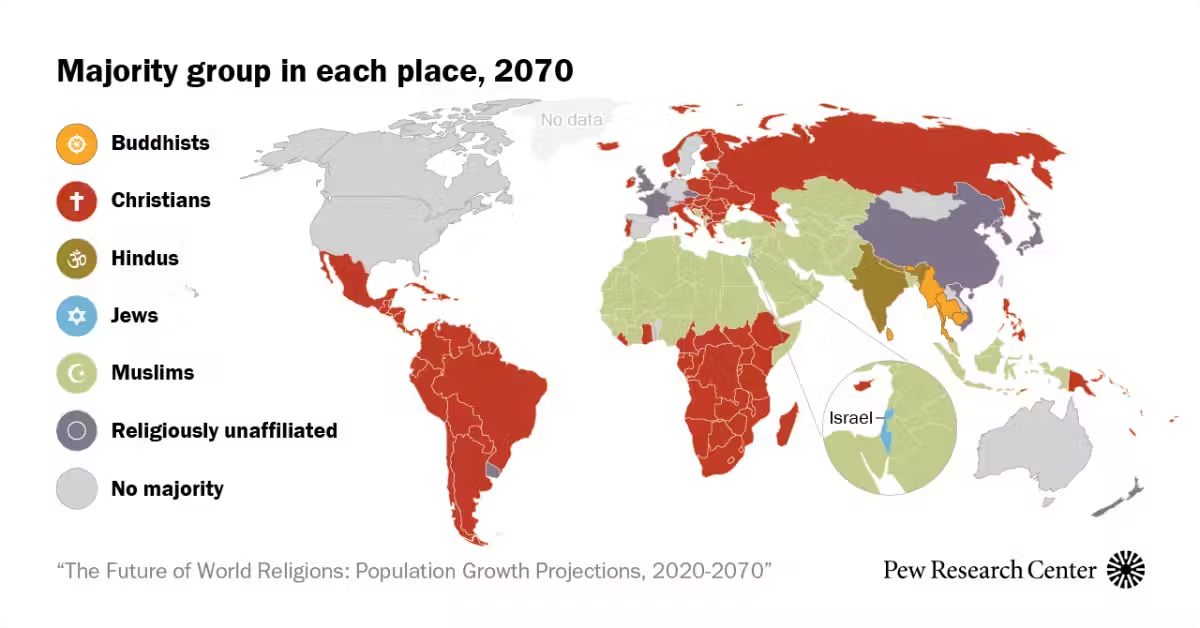
Pew Research Center projects a gradual decline in Christianity's share of the population in Latin America and the Caribbean over the coming decades. If recent trends continue, Christians are expected to fall from 85% in 2020 to 77% in 2070, while the religiously unaffiliated — people who say they have no religion — rise from 12% to 19%.
The projections are part of a broader Pew study on the future of religion worldwide that models changes for seven religious groups between 2020 and 2070 across 201 countries and territories covering 99.98% of the world population. The model uses cohort-based demographic projections informed by national censuses and surveys, fertility and mortality rates by religious group, past religious switching patterns, and migration estimates, developed with the Center for Advanced Studies of Population and Religion at Krakow University of Economics.
Together, Christians and religious 'nones' are projected to make up the vast majority of people in the region in 2070, as they did in 2020. Other major religions are expected to remain small: Muslims, Hindus, Buddhists and Jews are projected to be fewer than 1% of the region's residents in 2070, the same as in 2020. About 3% of people currently identify with other religions, including Afro-Caribbean, Afro-Brazilian and Indigenous traditions, and that share is expected to remain roughly stable through 2070.
In 2020, 36 out of 37 countries in Latin America and the Caribbean had a Christian majority, and that is projected to hold in 2070. Christian shares are expected to decline or stay stable in about three-quarters of the countries, 29 out of 37. Uruguay is the region's only country without a Christian majority in 2020, and it is projected to remain so, with nearly six-in-ten people, 59%, expected to be religious 'nones' in 2070, up from 52% in 2020.
Fifteen countries are projected to see Christian shares change by at least 5 percentage points between 2020 and 2070, with 13 seeing declines and two seeing increases. Religious 'nones' are projected to increase by at least 5 points in 11 countries. The four countries with the largest projected rises in 'nones' — Chile, Colombia, Mexico and Argentina — are the same where Christians are expected to decline most.
Chile is projected to see the region's steepest decline in the Christian share, 16 percentage points. In Mexico, Argentina and Colombia, Christians are projected to drop by at least 10 points. Suriname and Guyana are projected to be the only countries where the Christian share rises. In Argentina, 'nones' are projected to rise 10 points to 20% of the population in 2070, while the Christian share falls 11 points to 77%.
The region's overall population is projected to rise 8%, from 646 million in 2020 to 697 million in 2070. That growth is similar to projections for North America and the Asia-Pacific region, but much lower than for sub-Saharan Africa or the Middle East and North Africa. Suriname is the only country where Muslims or Hindus are projected to decline by at least 5 points as a share of the national population: Hindus from 22% to 15% and Muslims from 14% to 8%.
Key drivers of change include demographic factors such as age structure, fertility and mortality, international migration, and religious switching. The Christian population is projected to decline by 7 million to 540 million in 2070 from 547 million in 2020. Switching and migration are projected to subtract 39 million and 21 million Christians, respectively, partially offset by natural increase adding 53 million.
Religiously unaffiliated people are projected to grow mainly through switching, which is expected to add about 35 million people, with natural increase adding another 25 million and migration subtracting about 5 million. The 'nones' population is projected to increase by about 55 million, from 77 million to 132 million between 2020 and 2070.
Projections assume children inherit their mother's religion. Total fertility rates for 2020-2025 are below replacement level for all groups in the region and below the global average of 2.3. Christians have the highest regional fertility rate at 1.8, followed by 'nones' at 1.7. Religious 'nones' are the youngest group, with a median age of 28 in 2020, versus 31 for Christians and for the region overall.
Religious switching is a central mechanism: tens of millions are expected to leave their childhood religion, which helps explain the projected drop in Christians from 85% to 77% and rise in 'nones' from 12% to 19% by 2070. In a hypothetical scenario with no switching, Christian and 'none' shares would stay virtually the same as in 2020.
- Categories:
- Culture
- Entities: