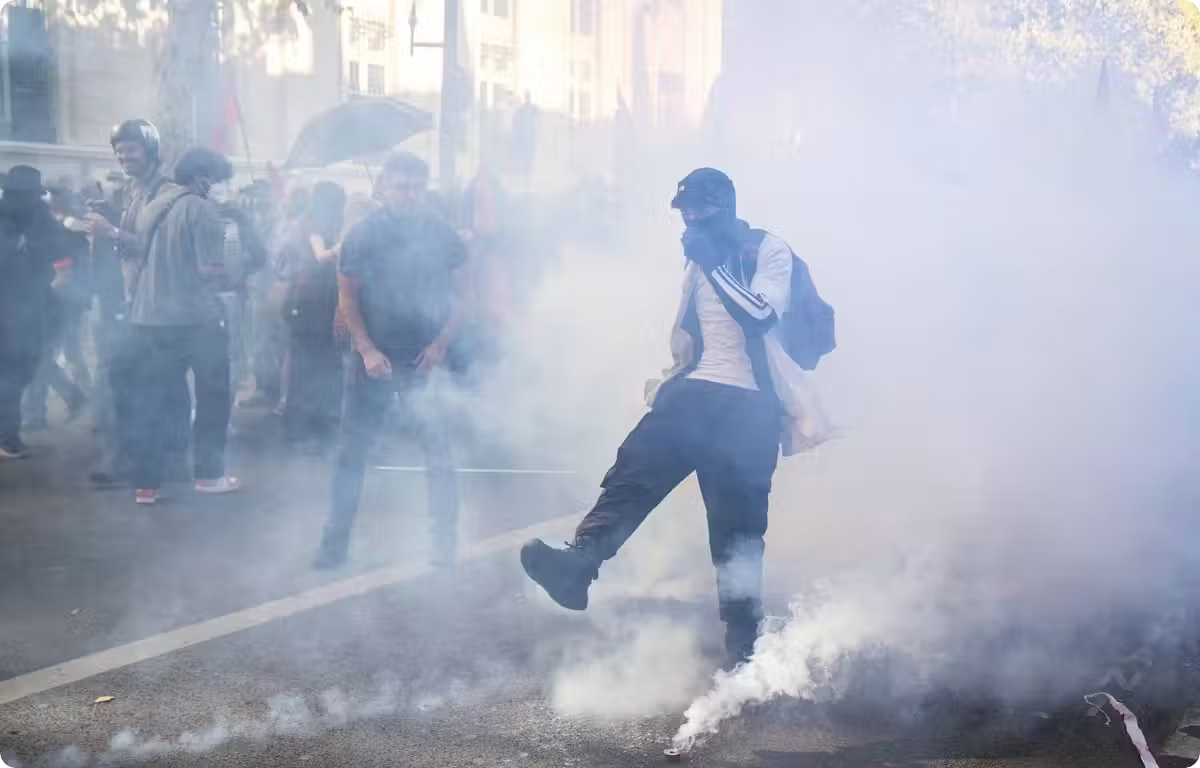
France's heavy reliance on tear gas during protests has drawn international attention, with researchers noting that the country uses significantly more tear gas than its European neighbors. According to Sebastian Roché, a CNRS research director, journalists and police officers from other countries frequently ask if this practice is normal. Data from the Armed Conflict Location & Event Data Project (ACLED) indicates that between 2020 and 2026, more than half of the 1,520 European demonstrations involving tear gas took place in France. This disparity persists despite the fact that France does not hold many more protests than countries like Germany or Italy. [1]
Sociologist Laura Keesman points out that French police often face unusually militant and sometimes violent protesters, which may partially explain the intensity of the response. However, the core issue lies in data opacity. Since 2020, the French Ministry of Interior has acknowledged that tear gas usage falls outside the official weapons tracking system due to the lack of a centralized registry. While Amnesty International maps abusive use globally since 2020, and notes that only the Netherlands and Slovenia maintain comprehensive registries for less-lethal weapons in Europe, France lacks such transparency. Although deaths related to police operations have been counted since 2018, internal reports from the General Inspection of the National Police (IGPN) for 2024 and 2025 detail only Live Bullet Device (LBD) and anti-barricade grenade (GMD) firings, omitting tear gas data. This opacity prompted eco-minded MP Sandra Regel to question the government in October 2026. [1]
Specific figures highlight the scale of usage. On October 17 alone, 22,000 tear gas grenades were fired, a volume described as 'phenomenal' by Sebastian Roché. At approximately 60 euros per unit, this amounts to a budget exceeding 1.2 million euros. For comparison, during the Sainte-Soline clashes in March 2023, the gendarmerie fired 5,015 grenades. The financial commitment has grown substantially; according to Politis, the most recent French market for tear gas and acoustic grenades, concluded in 2023, totaled over 78 million euros over four years, compared to 17 million in 2018, representing a multiplier of more than 4.5. [1]
European policing doctrines vary significantly. Research by Laura Keesman shows that while the UK and Sweden prioritize dialogue and graduated force, the Netherlands and Belgium focus on negotiation with organizers. France relies more heavily on crowd control and direct intervention. Researchers Olivier Fillieule and Fabien Jobard emphasize a shift toward offensive hardening. Notably, Germany, which Keesman categorizes similarly to France, largely abandoned tear gas firing after the 1980s, preferring pepper spray and water cannons, according to Rafael Behr of the Hamburg Police Academy. An observer noted to Roché that French police tactics appear strange, as officers often shoot and then charge directly into the gas cloud without masks. While precise comparative data is unavailable, the trend clearly shows France concentrating a disproportionately large share of European demonstrations marked by tear gas usage. [1]
- Categories:
- Culture