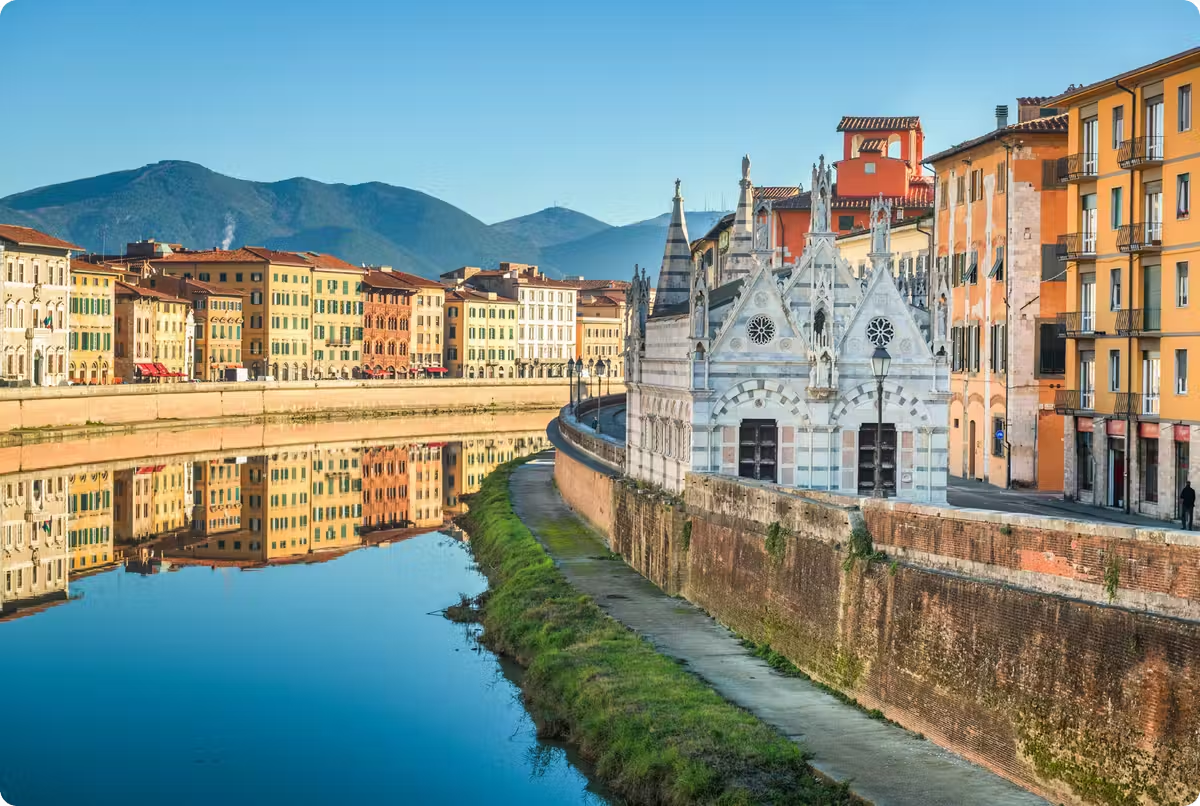
While the Leaning Tower defines its global image, the city of Pise offers a rich tapestry of history, gastronomy, and culture that extends far beyond its most famous landmark. Located in the heart of Tuscany, Italy, this historic republic-turned-university town invites visitors to explore its medieval roots, vibrant student life, and hidden artistic treasures along the Arno River. [1]
The journey begins on the Lungarni, the banks of the Arno River lined with Gothic and Renaissance palaces. At number 27 of Lungarno Antonio Pacinotti, the Palazzo Agostini, dating back to the 15th century, houses the Caffè dell’Ussero. Founded in 1775, it stands as Italy’s third-oldest café, trailing only Venice’s Caffè Florian (1720) and Rome’s Caffè Greco (1760). It is a essential stop for an espresso, macchiato, or a shakerato—a shaken iced coffee. Nearby, at number 23, Gelateria De’ Coltelli offers frozen sweets starting from 3.50 euros. Owner Gianfrancesco, known for his grey beard and warm smile, produces ice creams, sorbets, and granites exclusively from natural, local ingredients. Highlights include coffee granite, sheep’s milk yogurt ice cream, and fior di latte flavored with extra virgin olive oil, all marked as zero-kilometer products. [1]
Pise’s architectural heritage reflects its past as a powerful maritime republic. The stone facades bear the marks of medieval merchant towers. On Piazza dei Cavalieri, the Palazzo della Carovana, renovated since 1562, now hosts the Scuola Normale Superiore, established in 1810 by Napoleon I. As a major university center with 50,000 students—more than half the city’s population—the area around Piazza Dante Alighieri is shaded by palms and popular with young people. Here, visitors join queues at L’Arancio pizzeria for a slice of cecina, a wood-fired chickpea pancake priced at 2 euros. Further on, Piazza delle Vettovaglie, surrounded by arcades, hosts an artisan market and lively terraces. [1]
The medieval shopping artery, Borgo Stretto, leads from the pedestrian maze to the Arno and the Ponte di Mezzo. On the opposite bank, Corso Italia and its boutiques are the undisputed hub for passeggiata, the traditional Italian stroll. For dinner, cross to the other side of the river to eat at L’Artilafo, where Antonella and Bruno serve authentic Pisane cuisine. Menu items include pappardelle with cheek ragout and orange jelly, or fettuccine with lobster in bisque sauce, with plates starting from 13 euros. [1]
For nature escapes, visitors can rent bicycles from the central station starting at 14.50 euros per half-day with Smile & Ride. Rides begin past Keith Haring’s TuttiMondo street art and Galileo Galilei sculptures by Brazilian artist Eduardo Kobra, following the cycle path on the left bank of the Arno to the white pebble beaches of Marina di Pisa. Once a fishing village, this seaside resort features numerous Art Nouveau villas. Another natural option is the Certosa di Calci, a Baroque architectural jewel at the foot of the Pisa Mountains (entry 15 euros). This 14th-century monastery complex, largely transformed later, is set in the nature of Val Graziosa. Originally inhabited by self-sufficient monks, it includes a cloister, refectory, library, pharmacy, and apartments reserved for the Grand Duke of Tuscana who came to recharge here. [1]
Pise’s museums often remain unknown to tourists despite their unique collections. The Museum of Ancient Ships (entry 8 euros, free under 18) is housed in the old Medici arsenals. It displays Roman shipwrecks and their cargo—amphoras, ceramics, and remarkably preserved skeletons of a sailor and his dog, discovered in 1998. The National Museum of San Matteo (entry 5 euros), an 11th-century Benedictine convent, holds the world’s largest collection of medieval crosses. Another must-visit is the Orto Botanico (entry 6 euros). Created in 1543, this university botanical garden is one of the oldest in the world, hosting about 6,000 plants from various regions, including a ginkgo biloba from China planted in 1787 and a majestic camphor tree from 1872. Its museum features an impressive collection of wax anatomical plant reproductions. [1]
Travelers can access Pise via four direct weekly flights from Paris-Orly operated by Transavia, with round-trip fares starting from 66 euros (transavia.com). For more information, the Tuscany Tourist Office (visittuscany.com) and the Pise Tourist Office (terredipisa.it) provide detailed resources. Accommodation options include the Palazzo Feroci, a 16th-century palace located two steps from Piazza dei Cavalieri, offering double rooms with breakfast from 145 euros (palazzoferoci.com). [1]
- Categories:
- Culture