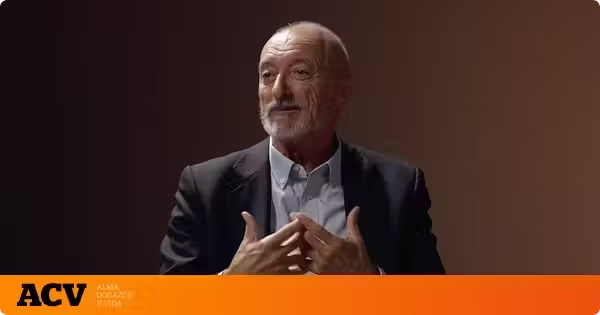
Spanish writer and journalist Arturo Pérez-Reverte, who spent over two decades as a war correspondent covering some of the world's most dangerous conflicts, has shared profound reflections on the nature of fear and human vulnerability. During a conversation with journalist Antonio Lucas, published on the Penguin Libros YouTube channel to promote his novel *La hipótesis más peligrosa* (The Most Dangerous Hypothesis), Pérez-Reverte explained that true fear often emerges not when one's own life is at stake, but when the people one loves are at risk.
The author articulated this sentiment by stating, 'When the world that burns burns part of you—things you want: children, women—you become vulnerable.' According to Pérez-Reverte, there is a fundamental distinction between facing danger alone and doing so when significant others are also exposed. He argues that in the latter scenario, fear shifts from a matter of personal survival to a concern for the well-being of others.
Reflecting on his years as a war correspondent, Pérez-Reverte recalled that he could maintain a certain level of tranquility amidst violence and destruction because his loved ones were far removed from the conflict. He noted that while he was surrounded by chaos, his parents, siblings, and later his daughter were safe, and he maintained the belief that he could attempt to escape if necessary. He posits that real vulnerability manifests when danger ceases to be external and directly threatens one's immediate inner circle.
This shift in perspective highlights how priorities evolve with age and experience. Pérez-Reverte suggests that actions once driven by courage, curiosity, or recklessness take on a different meaning when affective responsibilities are introduced. For the writer, fear is not necessarily a result of a lack of preparation or experience, but rather a conscious awareness of everything that could be lost—a theme he has integrated into the father-son relationship depicted in his latest novel.
Beyond his journalistic career, Pérez-Reverte discussed his relationship with the sea, a lifelong passion. Despite more than thirty years of navigation, he admitted to feeling constant fear whenever he sails. He recounted a specific incident where a momentary distraction led to his boat's keel grazing a shoal, serving as a stark reminder that even experienced sailors can make errors and that overconfidence can be one of the greatest risks.
Far from viewing fear as a weakness, Pérez-Reverte describes it as a vital tool for remaining alert and understanding reality. He characterizes the sea as a 'magnificent trainer,' forcing a state of constant vigilance that can be applied to daily life. His conclusions suggest that maturity is not the absence of fear, but the ability to recognize dangers, accept personal limitations, and understand that the things we love most are precisely what make us most vulnerable.
- Categories:
- Culture