The management of parking spaces constitutes a major challenge in Romanian urban centers, driven both by the chronic shortage of public infrastructure and by the behavior of some drivers who resort to non-compliant maneuvers. These tensions are often amplified by public debates sparked by posts on social media, which highlight conflicts between drivers' comfort and pedestrian safety. [1]
Statistics reveal a discrepancy between the supply of and demand for parking spaces: in Romania, approximately 1.35 million public parking lots operate, while the registered vehicle fleet exceeds 11.2 million cars. This disparity frequently leads to vehicles illegally driving on sidewalks or in prohibited areas, situations that are rapidly reported by citizens. [1]
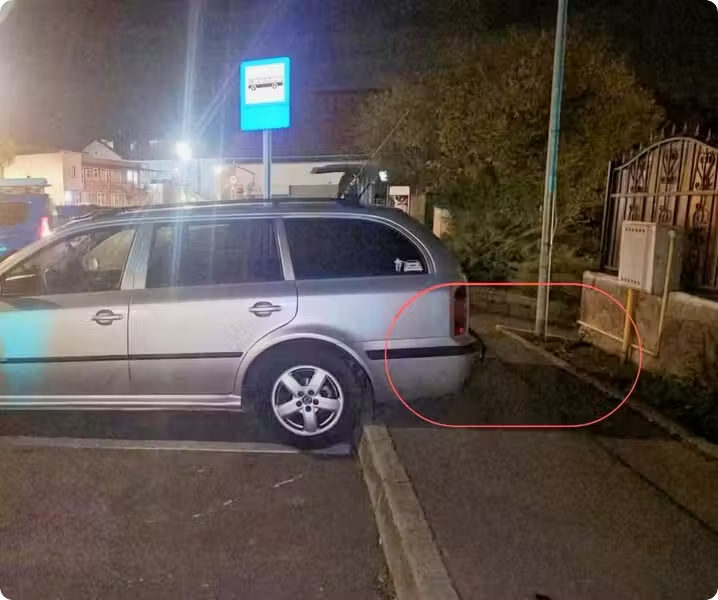
A recent controversy was generated by a post by traffic police officer Daniel Zontea, who shared an image of a station wagon parked backwards in a specially designated spot. The car had its rear wheels positioned against the curb, with the trunk occupying approximately half the width of the sidewalk (estimated at 1.5 meters), making it difficult for pedestrians to move about. Anticipating polarization of public opinion, the officer noted the divide between those who consider such parking legal as long as the wheels are not on the sidewalk, and those who classify it as illegal due to the occupation of pedestrian space. [1]
User comments reflected divergent perspectives. Some invoked the lack of road education or the lack of standardization in parking facilities, noting that many spaces do not meet the width of 2.50 meters and length of 5.00 meters stipulated by regulations. They criticized the arbitrary management of space, which prioritizes the number of parking spots over circulation safety, suggesting the installation of rubber bumpers mounted in Western countries to prevent exceeding limits. [1]
Other users emphasized drivers' responsibility, asserting that any vehicle must fit entirely within the boundaries of a designated parking space. They argued that lack of space does not justify pedestrians or people with disabilities having to move onto the carriageway, comparing the situation with fines imposed abroad for such violations. [1]
Daniel Zontea clarified the legal framework: occupying the sidewalk with a vehicle is permitted exclusively in specially designated parking areas marked accordingly. According to legislation, it is not necessary for the car's wheels to be physically on the sidewalk for the violation to be sanctioned; it is sufficient for part of the vehicle to exceed the parking space boundaries and affect the space designated for pedestrian movement. The officer illustrated the situation using the analogy of a bus parked with its wheels against the curb but occupying the entire sidewalk with its body. [1]
Ultimately, Zontea stressed the importance of correct parking, noting that although the car was positioned in a marked space, the maneuver restricted pedestrians' right to move freely. The presence of another image showing ample space for front-facing parking supported the conclusion that the driver could have avoided the conflict through more rigorous positioning of the vehicle within the reserved limits. [1]
- Categories:
- Automotive
- Entities: